Showing posts with label linden lab. Show all posts

Friday, July 18, 2014

Crap Mariner on the Second Life ToS Controversy

Hi there. It's me. I'm back again.

The subject of ToS 2.3 has come up privately, so I thought I'd bring it up in here in order to stick all of my GoS feet and shoes in my mouth.

What's happened so far? Well, here's my biased and paranoia-fueled summary:
  • Back in August 2013, Linden Lab made some changes to the Terms of Service that looked to many like an over-reach and a content-grab.
  • Several third-party content sites such as CGTextures prohibited SL users from uploading their textures to SL because of the ToS.
  • Rod Humble and Peter Gray insisted that it was not a content-grab, some wiser heads realized that it's the ToS and not the smoke and mirrors around it that matter, groups were formed, and... um... not much else happened.
  • When Rod left and Ebbe arrived, he said that he was looking into the problem.
(If you're looking for a full unbiased history of the ToS 2.3 issue, read Thinkerer Melville/Selby Evans... or Inara Pey... or Mona Eberhardt... or Ciaran Laval. All have conducted themselves in a rational and level-headed manner with dignity and journalistic integrity.)
Flash forward to this week, and lo and behold, Linden Lab made a big noise on their blog about making a long-demanded change to Terms of Service 2.3:
http://community.secondlife.com/t5/Featured-News/Updates-to-Section-2-3-of-the-Terms-of-Service/ba-p/2777874

Here are the Terms of Service:
http://lindenlab.com/tos
(48,000 words, according to Tateru Nino. Sorry, Linden Lab, but you're 2,000 words short of a NANOWRIMO novel, and twice as boring.)

The difference between the two can be summarized as follows: That blog post is full of crap.

There are a lot of blog posts on the subject. One in particular is Mona, who points out the actual changes made:
http://monaeberhardt.wordpress.com/2014/07/16/linden-lab-amends-section-2-of-its-tos/#more-2329

Others followed suit:
http://sl.governormarley.com/?p=4113
http://modemworld.wordpress.com/2014/07/16/lab-updates-section-2-3-of-their-terms-of-service-will-it-calm-doubts/
http://www.hypergridbusiness.com/2014/07/linden-lab-tweaks-terms-of-service/
http://slnewser.blogspot.com/2014/07/linden-lab-updates-terms-of-service.html
http://dwellonit.taterunino.net/2014/07/16/second-life-terms-service-part-problem/
(feel free to google for more.. Thinkerer has had a few updates over the past few months)

Interestingly, an attorney in SL looked over the changes and came to a disturbing conclusion:
http://insertfunnyname.wordpress.com/2014/07/16/linden-lab-whiffs-the-tos-again/

And most telling is CGTextures calling bullshit on Linden Lab:
http://sl.governormarley.com/?p=4117

But I think the strongest indicator that the Linden Lab blog post is full of crap is that James Wagner (Hamlet) Au swallows it - hook, line, and sinker:
http://nwn.blogs.com/nwn/2014/07/second-life-terms-of-service.html

He actually believes the blog post's claims despite all evidence to the contrary.

Really, dude. Stick to writing books, hawking the Oculus Rift, and having beers with the Labbies, okay? You're embarrassing yourself, and you're embarrassing us worse than the 80% with the misdirected anger.

Now where was I...

Look, the odds of Linden Lab selling a content-creator's pixel-panties in RL are zero, and I laugh when I see the mesh-makers cringe on various forums and sites. Yes, they rake in some bucks over their stuff, but outside of SL, not even the Japanese would buy nonexistent pixel-panties from a bullet train vending machine

If there's anything that has actual value in RL that could come out of SL, it's writing. And I'm a writer.

My take on it, scattershot-style as usual:
  • This has been and continues to be a thorn in the side of collaborative writing, whether it's content creation or peer-review and sharing of material that might one day be published professionally.
  • The Terms of Service is a typical Silicon Valley over-reach and quite a few have said that it is not defensible in court. They are claiming rights that they don't have and cannot demand.
  • If you have content that is original and copyright-protected, you do have the right to accept the ToS and then copy it back out to Word or Notepad or Google Docs if you don't have it backed up already. It shows intent that you do want to continue using the service, but want the opportunity to remove the material you do not grant the right to.
  • If Linden Lab can't effectively grow their subscriber base or retain interest in their flagship product, they're unlikely to have the skill, competence, or prowess to exploit user-made original content in the ways your paranoid fevered brain worry about at night.
  • If you have content in textures, notecards, or objects, you already agreed to the August 2013 ToS. Doing anything rash about it now is a bit too late. (But now is a good time as any, I suppose.)
  • Music streams do not travel over any part of Linden Lab's service. It's from source to Shoutcast/Icecast server to your client. Musicians and Deejays can get their pixel-panties out of a wad, now.
  • Unless Linden Lab has an infinite number of monkeys listening to Voice and transcribing everything you say at open-mikes, I think that's relatively safe for original spoken-word content.
This is why I do not notecard, texture, or text chat my stories within SL. I do not offer up my stories in notecard form for line-readers. When I perform them over voice, I'm confident that the imaginary rooms full of transcription monkeys are too busy flinging shit at each other to bother listening and typing down what I say. And I make it clear that the Weekly Challenge and my daily stories are not covered by the ToS and they are Creative Commons 4.0 Non-Commercial share-and-share-alike. (Or is that up to 5.0 now?)

So, in the end, I'm disappointed in the fact that the Lab is doing this, lying on the blog about the nature of the actual changes, and expecting people to swallow their bullshit and call it Starbucks. (Bullshit Mocha Latte, anyone?)

But I plan on staying in SL, enjoying my pretty park, my pretty bridge, my pretty friends, and my pretty me (with those pixel panties, no less) until somehow Linden Lab tries to fuck that up too.


PS: At least SecondLie is having a blast with all this, right?

Friday, June 27, 2014

Linden Lab Finally Moves on my 2011 Advice For The Future of Their Platform

For better or for worse, it looks like Linden Lab's vision for their next generation virtual world is close to the one I offered in 2011:
I've been flirting for a while with an idea that I think can meet those aims by extending the foundational vision of Second Life as a user-created world. Here's the basic vision: Second Life developers and entrepreneurs are given tools and support to create and market stand-alone applications using the Second Life platform. botgirl.com, January 2011
"It's a platform," he says. "In some ways, you could compare it to Unity." Altberg wants developers to see both Second Life and its eventual successor as game engines they can build their content on. Engadget, June 2014
I've written about this idea a few times over the years since then. I have no idea whether my writing has had an influence on anyone within Linden Lab, but it's gratifying to see that the idea itself had enough merit for the company to stake part of its future on it.

Wednesday, June 25, 2014

Three Foundational Requirements for Linden Lab's New Virtual World


I'm going to play analyst again and throw out three foundational requirements I believe Linden Lab should prioritize when planning the development of their new virtual world. 
  • Figuring out how to get current SL users to the new world along with their existing user identities, group affiliations and community networks. There's going to be a lot of competition by the time SL2 launches in 2016 including offerings designed by both of SL's cofounders. Duplicating existing Second Life social connections is a feature no competitor can match.
  • Supporting Second Life's creative community in transitioning to the new platform. Content creators and the goods they develop are Linden Lab's other main competitive advantage. Linden Lab should clarify what types of Second Life assets will be compatible with the new platform. Ideally, Linden Lab will provide an SDK, plug-ins for major 3D software creation tools and other software that makes porting non-compatible content to the new platform as simple as possible. 
  • Nailing UX and UI for both VR and standard screen users. Although Second Life's current users can provide the critical mass to jumpstart the new platform, the ability to attract and retain new users will make or break its ultimate success in the market. New user experience must be especially intuitive and breathtaking. New users must easily be able to find the types of experiences and communities that meet their interests. No one has figured out the ideal user interface for VR-based virtual worlds yet and there's a lot of work to be done.
So that's my three cents for the moment. What do you think?

Wednesday, June 4, 2014

Maybe I'm Not Tweeting Into the Wind

Linden Lab announced today that is sponsoring the Drax Files and has added a video trailer to the Second Life home page.  What a great idea!

Friday, April 4, 2014

Avatars Swoon as Linden Lab CEO Visits Virtual World


Avatar social media circles were buzzing yesterday when word got out that Ebbe Altberg, Linden Lab's new CEO, was visiting the organization's flagship virtual world, Blocksworld. "When I saw the tweet about Ebbe visiting Blockshire Sim, I just had to log-on and meet him," gushed Blueberry Zhing, one of Blocksworld's most well-known fashion bloggers.

There were a few bumps in the virtual road. The heavy load on Blocksworld's servers caused some hiccups in the Sim's performance. "It was pretty laggy," commented Joan Lawnly, proprietor of Blocksworld's famous 1932 Paris club. "But it's great to finally see Lindens stepping into the virtual world again and communicating with residents."

Only time will tell if this is the dawn of a new era of Linden re-engagement with the Blocksworld community or if this first flush of enthusiasm will fade back to its previous apathy and enmity. But for now, it's Ebbemania baby! I'm totally pumped!

Wednesday, December 18, 2013

Why Tier Doesn't Matter - Revisited

Last January, I posted the following observations about why Second Life wasn't growing, in the midst of a debate about the impact of tier on growth and retention. The debate has popped up a few times since then on social networks and there is still no consensus. As far as I know, new user experience hasn't seen any revolutionary breakthroughs since that time, so I'll stand by my prior theory.
There's been a lot of discussion recently about why Second Life's growth is stagnant . . . Is tier too high? Is the Marketplace eroding land ownership? Are wakadoodles ruining things for everyone?

Those factors may explain why some current users are cutting back on land ownership or even bailing out altogether. But they have nothing do with why hundreds of thousands of new registrations a month translate into zero growth in active users. There's one overwhelming roadblock to Second Life's growth. It's the terrible new user experience. See for yourself.

I shot these two videos a couple of years ago. The first video walks through IMVU's new user experience to provide context. The second follows a new user from clicking a Second Life banner through the first experience of rezzing. As you watch, notice factors that might motivate a typical new user to keep going, and at which points it seems they'd likely bail out and uninstall.


Saturday, March 16, 2013

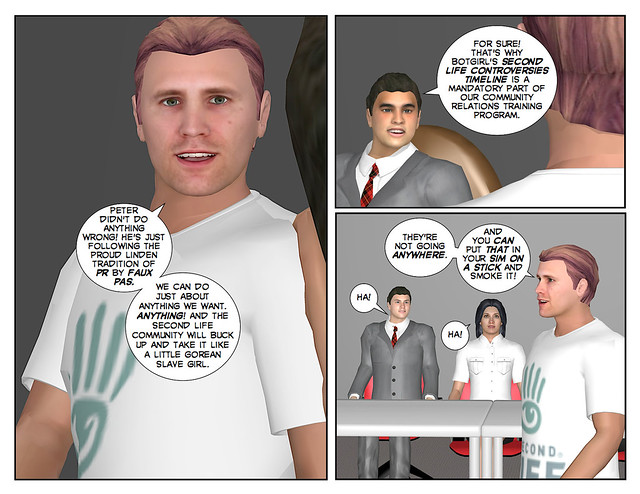
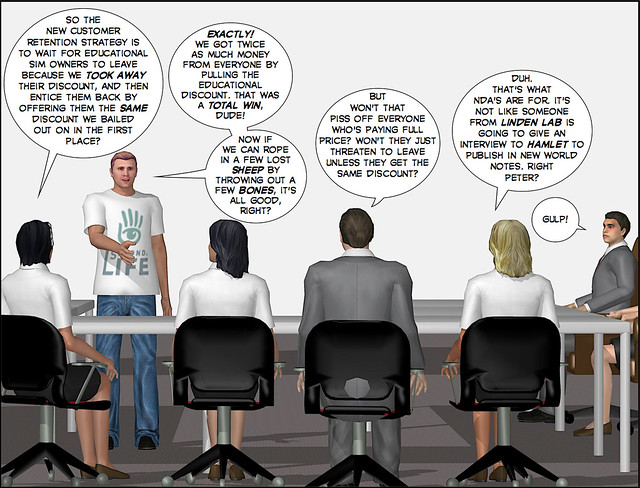
Customer Retention Comic Part 2

retention comic part 2

Wednesday, February 27, 2013

My Take on Catfish's Call for Second Life Participants

The Reveal

The Second Life community collectively cringes when media covers the collision between virtual world relationships and physical world reality. So I was surprised that Linden Lab advertised a request by MTV's Catfish, a series that, "brings together couples that have online relationships to meet offline for the first time, often with surprising results as the differences between online personas and offline lives are revealed." It seemed to me that encouraging media attention on that particular aspect of Second Life was a really bad idea.

Since I was home sick yesterday and needing some mindless distraction, I decided to wade through the first season. I expected it to be an exploitive Jerry Springerish freak show. What I found was a thoughtful series with a well-intentioned host who helps mediate positive resolution for both parties. The show takes situations that conform outwardly to the sensationalized stories we hate and respectfully reveals the underlying humanity.

The common thread in every episode is that someone feels they have to project a false image of themselves to initiate a relationship. As authentic human connection deepens over months or years, they become trapped by the initial lie, fearing that disclosure might end what has evolved into an important friendship. They agree to reveal their identity as a latch ditch attempt to salvage the relationship, or at least get closure. Although there was only one fairy tale ending, most participants used the show to move forward with their lives. None of them planned to try another online relationship.


Monday, October 15, 2012

Downsized Dreams: From Metaverse to Creative Spaces

Cemetery Shot
If you’re satisfied with creative spaces, good luck with that, but we’re holding out for the Metaverse. #lindenlab (Tweet)
Easy for me to say, right? Although many of us invest our own spare time and money chasing personal visions of the virtual future, companies don't have the luxury of pursuing their dreams indefinitely. I know from experience.

Thirteen years ago, I was co-founder of a "change the world" internet startup. We launched an online software development community where people could share ideas, co-develop new products and split revenue from their created work.  We thought we'd change the way software was developed and sold by replacing companies like Microsoft with thousands of entrepreneurial teams collaborating through our platform.

After a high-profile launch at a big software development conference in Silicon Valley. we grew rapidly in a few months to over 30,000 members from around the world collaborating on 1,000+ software projects. A year and a half later, the dot-com bubble burst, our funding prospects evaporated and we had to make hard decisions about the future of our company. We ended up shifting resources to a sister consulting company doing software development work for large organizations. Although our dot-com dream continued for a few more years, we eventually closed it to concentrate solely on what turned out to be a thriving and profitable business.

That's why I can't fault Linden Lab for trading their founding dream of changing the world for the smaller scale vision of creating collaborative spaces. Extrapolate the accelerating decline of Second Life private sim revenue just a year or two into the future and the survival of the company is at risk. Since they've tried and failed repeatedly over the last five years to turn Second Life around, it seems to me that hedging their bet with new products is a reasonable idea. As I wrote in February:
My guess is that Linden Lab calculated that even if they solved all current issues by investing a million or two on reengineering legacy systems, revenue would still decline over time . . . There is no sign that the market for sandbox worlds like Second Life will significantly increase in the foreseeable future. So there's really not a lot of upside for them. It's no wonder that they made the decision to take advantage of their current cash-rich situation to invest in new products that offer, at least potentially, a much higher return on investment.
Will their new products end up replacing the millions of dollars of projected shortfalls from lost sim revenue from Second Life? Will dividing corporate resources between half a dozen new products exacerbate their already checkered record at improving Second Life's long-standing technical and community relations problems? Is there some new business model for Second Life that will tie in with its launch within Steam? Or maybe a browser based client? Beats me. But since they've given up on the dream of changing the world through a platform that Philip thought would one day host the virtual equivalent of RL countries, I plan on holding out for the next company that tries.

Tuesday, September 18, 2012

New Linden Lab Product: Day-Glo Minecraft with Physics?

Since Patterns seems to have no avatars, I decided to add my own.

After a lot of speculation, Linden Lab announced two of the games it's been diligently working on for the past year. Patterns look like a day-glo version of Minecraft plus physics:
Explore caverns and valleys, while you harvest substances with real world densities. Build large scale structures that reach the sky or bridges that traverse chasms. Challenge real-world physics to see which creations will tumble -- or withstand -- the power of gravity.
Creatorverse is an iPad application that seems very reminiscent of Crayon Physics Deluxe.
Become an inventor as you design unique creations and then set them in motion. You’ll never know what to expect as you watch your creations bounce, roll, tilt -- or even accelerate on the screen. Let your creations come to life as you play with different joints, forces, motors, and teleporters and then watch what happens next.
At first glance, they both look pretty derivative of other people's products, but we'll have to wait until they're released to see how much originality Linden Lab brings to the mix.

Monday, September 10, 2012

How Will Steam Change Second Life?

Second Life is supposed to be available on Steam within a few months. Steam is an online game distribution platform that's captured about 70% of the downloadable PC game market.  It provides 50+ million active users with access to more than 1500 games including Skyrim, LOTR, Age of Empires and Eve Online.

The power of Steam isn't just that it aggregates so many games into a centralized marketplace. The unique value it provides is wrapping games within an integrated social network, an online community, cloud-based configuration management and a virtual goods marketplace. So I wonder how integration with Streamworks and Steam Cloud is going to impact Second Life.

I doubt that hordes of gamers are going to bail out on their current games of choice, become active Second Life participants and end up hijacking the existing culture. But I think it's likely that Second Life culture will be impacted through the addition of Streamworks functionality such as forums, voice communication, matchmaking and configuration management. Unless Second Life is subsumed completely under Steam's umbrella, I wonder how Linden Lab is going to approach the difference in user experience for those who access Second Life via Steam.

Another big question mark is how the business arrangement between Valve and Linden Lab will play out in functionality and pricing. Will Second Life be free to play on Steam? Seems likely. If so, will Steam only get a cut from premium membership or will Linden Lab integrate its marketplace into Steam. Will Steam get a cut from land purchases and monthly tier?  If so, will that impact the pricing or cost structure for everyone? Given the continuing decline of land ownership, will there be a change made to monetize the purchase of virtual goods? I guess it's even possible that Linden Lab will launch a new version of Second Life for Steam that is based on a completely different business model.

At the moment, I have a lot more questions than answers. Actually, zero answers. But it's interesting to think about.

Friday, September 7, 2012

Bugsy Linden Interview: The Real Story Behind the Jira Change


Yesterday, Linden Lab announced a significant change in their bug tracking process. I interviewed spokesperson Bugsy Linden for the inside scoop.

Friday, July 27, 2012

My Inside the Avatar Studio Interview

Yesterday's Inside the Avatar Studio show turned out to be a pretty enjoyable journey covering a lot of interesting topics. Phelan kept the conversation moving in unanticipated directions. One main thread was that the differences between virtual and physical experience are surface deep and that living consciously is the key to productive use of either domain. Another recurring theme was around the influence of tools and technology on the creative process. Here's the whole show. Unfortunately, it doesn't include the additional hour and a half free-form conversation that followed. If anyone snagged it and posts it somewhere, I'll add it.


Wednesday, July 11, 2012

Fuck You Video - SLCC Version


Since the sentiment is the same, I decided to trasform this SL9B parody song into an SLCC version. All it took was a vintage party planning video from The Prelinger Archives. Maybe I'll get around to some new verses later. The way things are going, it could be the song that never ends.

Fuck You

You thought we'd donate free land again
to SLB and we're like
Fuck you
The Destination Guide listing
wasn't enough, we're like
Fuck You
your community too

When Philip was with us
You were little bitches
Whining every move we made
Now that Rodvik's a hit
We won't take no more shit
Fuck you
Oo. Oo, ooo

No more mercy
All your controversy
Doesn't mean a thing
If you don't like mesh
Or TPV changes
Take your ass to Open Sim
We think it's real funny
That you give us your money
No matter what we do
So go wackadoodle
Cause we know it's futile
Just pay your tier when it due

Monday, July 9, 2012

Is 'Patterns' Linden Lab's Upcoming New Product?

A name and tagline for a new product appeared in an image that appeared briefly on the Behance Network under the title, "Linden Lab Redesign on the Behance Network." It could be just a fabricated placeholder, but it looks like an actual product to me. What do you think?

Friday, June 29, 2012

More on Second Life and the New Frontier

Wednesday's post outlined a series of milestones marking Second Life's transition from innovative frontier to conservative corporatocracy. The surface narrative since 2008 revolves around the downward spiral in the relationship between Linden Lab and the Second Life community. But underneath the never-ending controversy there is a hidden story of technical debt that is just as consequential.

In a world unconstrained by time, money and competitive pressure a software product's underlying code would be consistently refined and refactored. In reality, companies usually focus their resources on short-term tactical requirements instead of the less urgent task of optimizing code and updating architecture. Over time, a product's codebase can become so kludgy, convoluted and incompatible with current technology that significant improvement is too costly and complex to be practical. Second Life sits on a codebase with a decade's accumulation of technical debt.


For the foreseeable future, Second Life will continue to serve as a new frontier on a personal level for people who are exploring virtual worlds and avatar identity. It's a rich platform with diverse user communities, a massive amount of available content and a mature feature set supporting social activity and creative expression.

I don't think Second Life will continue its leadership as a virtual world platform. It's too tied to outdated technology, legacy code and an established community that has a huge amount of equity in the current paradigm. I don't know if Cloud Party is going to be the company that takes us on the next leap forward, but it's more likely to be a small start-up than one of the established players.

Wednesday, June 27, 2012

How Second Life Lost Its 'Old Frontier Feel'

Linden Lab CEO Rod Humble wrote in January 2011 that he would be initiating a monthly roundtable to chat about getting the frontier feel back for Second Life:
Conversations with many old Lindens and Residents have led me to conclude that we have lost something of the old frontier feel. Like we were exploring the world together, you knew people, you would bump into them more.  
My time in Cloud Party over the past week brought back some of the nube wonder that infused my first year in Second Life. Every time I logged in, I bumped into people who were hanging out, rezzing stuff, toying with scripted objects and chatting casually with Cloud Party employees. The sense of frontier life was strong and invigorating. It inspired me to consider how Second Life lost its own frontier feel.

2006 Cover Story on Second Life
Raph Koster's Online World Timeline and the the History of Virtual Worlds timeline make it clear that Second Life wasn't the first virtual world. Nevertheless, Philp Rosedale's mind-child blazed many new trails through a succession of frontiers since its Beta launch in 2002. Many of the features that the Second Life community takes for granted today didn't exist ten years ago except in science fiction. Virtual land ownership, ad-hoc avatar customization, virtual world currency and economy, in-world building and scripting, and the primacy of user-created content were all Second Life innovations. This mind map illustrates the depth and diversity of the novel social ecosystem that eventually emerged.

Between the launch of the Beta and a 2006 cover story in Business Week, Second Life grew to 125 square kilometers of virtual real estate and $5 million a month in user-to-user transactions. By the end of 2007 there were over a million active users, many of whom considered themselves to be digital people living significant virtual lives through pseudonymous avatar identities.

2008 marked the turning point from the frontier as Linden Lab shifted its path towards the corporate mainstream. Founding visionary Philip Linden stepped down as CEO and was replaced by ex-advertising agency executive Mark Kingdon. Linden Lab clamped down on the use of its trademarks,
sparking an uproar in the Second Life business, education and blogging communities. The Second Life blog began looking more like a corporate mouthpiece than the informal and transparent communication it had been in the past. Prices on the popular OpenSpace sims were raised drastically without warning, spawning another wave of protest from community members.

In 2009 a
new adult content policy segregated land with sexually explicit content into its own continent. Linden Lab purchased the two major independent virtual commerce sites and consolidated them under the corporate banner. An enterprise version of Second Life was launched as the new CEO made corporate customers a new priority.

The new approach crashed and burned in the summer of 2010 when an estimated 30% of Linden Lab employees were laid off. Mark Kingdon soon resigned as CEO and and the failed enterprise product was discontinued. EA executive Rod Humble was hired in 2011 as Linden Lab began to position itself to go after the mainstream market. In 2012 Linden Lab elected to not make its usual contribution of virtual land for the annual Second Life birthday celebration. Although the Second Life "residents" rallied together to create a 
brilliant exhibition, it's clear that Linden Lab is continuing its disengagement from the creative community.

In a future post, I'll consider whether Second Life can regain the frontier spirit at this stage in its life and how a small startup like Cloud Party might lead the way forward. For now, here's a short video documenting the Second Life website between 2002 and 2004. Just compare it to today's Second Life website and it's easy to see that Second Life is no longer positioning itself as a new frontier.


Monday, June 25, 2012

A Slightly Tongue in Cheek Trailer for Cloud Party


You can download the video from Vimeo if you'd like to see the full 1080p glory. I'll post a more serious piece later this week describing why Second Life is no longer the virtual frontier.