Showing posts with label immersion. Show all posts

Monday, October 22, 2012

I think that I will never see, a sim as lovely as a tree

Botgirl's first known photo
Botgirl 1.0 in early 2008
I think I no longer understand Second Life.
Chestnut Rau in a tweet from yesterday

I met Chestut Rau in 2008 at a party in Extropia. At the time, Extropia was home to a community of utopian Immersionists striving to live virtual lives that were as full and authentic as those in the atomic world. Second Life was experienced not only as a platform for entertainment and exploration, but as a self-sufficient environment providing the digital equivalent of atomic world culture, community, loving relationships and achievement. Here's how Chestnut described her first year:

I listened to amazing music, danced all night, experienced art installations that brought tears to my eyes. I blogged, photographed, and built things -- all activities I could not have imagined a year ago. I developed friendships that feed my soul, met people who’s creativity has left me breathless and encountered other people who’s ability to stir up drama and conflict everywhere they go has left me speechless. I explored parts of the RL me I never knew existed and touched on other parts of me I have been unable to delve into for a variety of reasons. Its hackneyed for sure but I lived. I laughed. I loved.

Today, only a handful of people from that social circle are still active in Second Life. Many of them disappeared from the grid. Others have drastically cut back their level and frequency of participation. The utopian Immersionist movement has disappeared.
I've been looking for a new horizon
But all I see is Extropia burning
The dream of the Transhuman Grail has vanished
Merlin is a Meeroo
Camelot is Disneyland
I am adrift
From my blog post of June 9, 2011
So how did Chestnut and the rest of us fall from unbridled enthusiasm to virtual ennui in the span of a few years? I can't speak for everyone, but I think it boils down to the limits of immersionism and simulation.

The limits of immersionism.

Most of the active Second Lifers I knew in 2008 adhered to a fairly radical immersionist philosophy. They not only kept their wallet name identities hidden from other virtual worlders, but also kept their avatar identities secret from atomic world friends, families and colleagues. Active immersionists routinely spent 20, 30 or even 40+ hours per week in Second Life. It took that much time to make the virtual world come alive, nurture relationships, and establish community through ongoing participation in musical, artistic, charitable and social events. These bigger-than-life virtual identities were almost totally divorced from their human counterparts' relationships and activities.

Ultimately, such double lives proved to be more than most of us could handle. Atomic world jobs and relationships suffered due to lack of time, attention and sleep. Virtual world relationships and commitment were eventually undermined by conflicts with atomic world obligations. The bright flame of that greatest generation of digital people was fueled by candles burning at both ends. It was only a matter of time before they burned out.

The limits of simulation.

Chestnut's description of her first year in Second Life is a great depiction of honeymoon consciousness. Everything is fresh and new. You see life in new ways, discovering inspiring insights into your own human potential. There is often drama, as latent psychological issues emerge in the intensity of reawakened emotional capacity.

But no matter how intense an attraction, all honeymoons eventually end. The initial flame of rapturous attraction fades. Negative aspects that were hidden in the glare of infatuation come to light. And people start to figure out whether there is enough substance to justify the hard work required to build a deep long term relationship. Digital simulation at this time and for the foreseeable future can offer only a pale shadow of the deep complexity and interdependence of the physical world.
I think that I shall never see
A poem lovely as a tree.
from Trees by Joyce Kilmer
The pioneers of Extropia pushed the limits of what is possible in virtual life. We expanded the envelope of human potential and experienced ourselves in new ways. Many of us tapped into creative potential that had never been actualized through our physical world experience. But we ultimately bumped up hard against the limits of the virtual world. And the pain of our disillusionment was caused by the depth of our investment in an idealistic illusion.

I love virtual worlds for what they offer that is NPIRL (not possible in real life). But virtual worlds at this time can't provide an adequate substitute for most of what the physical world has to offer. Like the old commercial said, "Long distance is the next best thing to being there, " but there is an enormous chasm between what is best and its virtual stand-in.

So I think that the solution is to appreciate the virtual world both for what it is, and for what it is not; to integrate our virtual and physical lives so that they are synergistic rather than antagonistic; and to accept that our passion for any pursuit will ebb and flow over time. And that's okay.

Saturday, May 28, 2011

The Impact of Virtual Identity on Environmental Immersion

Avatar Identity
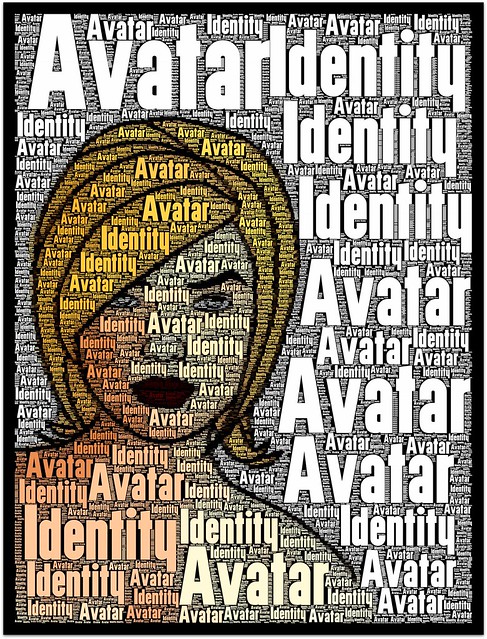
Avatar Identity Poster
Charlanna Beresford wrote an interesting post yesterday, Arc of an Avatar. It considers some of the reasons her interest and participation in Second Life wained over time and wonders if others have had similar experiences.

One of the most interesting aspects for me was her description of a shift in focus from place to person:
Talking more about first life reinforced those interactions and I realized that I was interacting through place and avatar less and less . . . The more I experienced it as a 3D chatroom, the less important Second Life felt to me as a place.
I've thought a lot about how immersion in the physical space of the virtual world gives birth to virtual identity. But I've never considered how the "purity" of virtual identity influences one's immersion in the virtual world. 


Is the virtual world we experience less real to us when our of avatar identity becomes muddied through personal disclosure? 

I wrote about my own Fall From Grace in November, which considered the impact of personal disclosure on identity, but not its effect on the experience of physical immersion. I'm looking forward to spending some time over the long weekend mulling this new dimension.

Saturday, May 29, 2010

Additional Chart Views of Anthropic-Avatarian Continuum

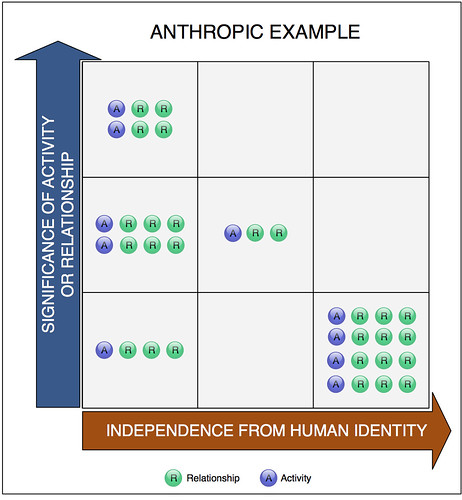
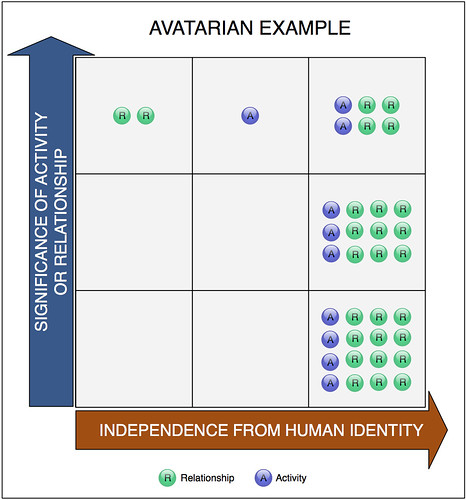
In the original chart, the labels in the boxes were meant to be a handy way to track and discuss how groups of people tended more towards one quadrant or the other. The charts below are each an example of how a particular person's activities and relationships can be examined, using the same basic paradigm. 

The main conceptual addition in this draft is an axis that tracks how significant a relationship or activity is to the individual in question. For example, casual acquaintances versus close friends, or shopping versus art creation. 

The other axis tracks how independent each activity or relationship is from human identity. A relationship on the left might be a RL co-worker or family member. The far right would include those who have no knowledge of RL identity. The circles tagging activities and relationships takes the place of the quantity axis in the original chart.

I was planning to work on this idea more and still haven't got around to it. But after the New World Notes reference yesterday, I thought it made sense to move them here to address the new comments there.

Please send any suggestions for the next draft, including links to images.


Anthropic Example


Avatarian Example

Wednesday, May 19, 2010

Replacement Candidate for Augmentation vs. Immersion Paradigm

anthro-avatar
As I was trying to gain some insight on the issue of Second Life Culture earlier this week, the long-standing "Augmentation vs. Immersion" paradigm kept nagging at me. It's another Second Life topic that is plagued by ambiguous terms that often confuse more than clarify the underlying issues.

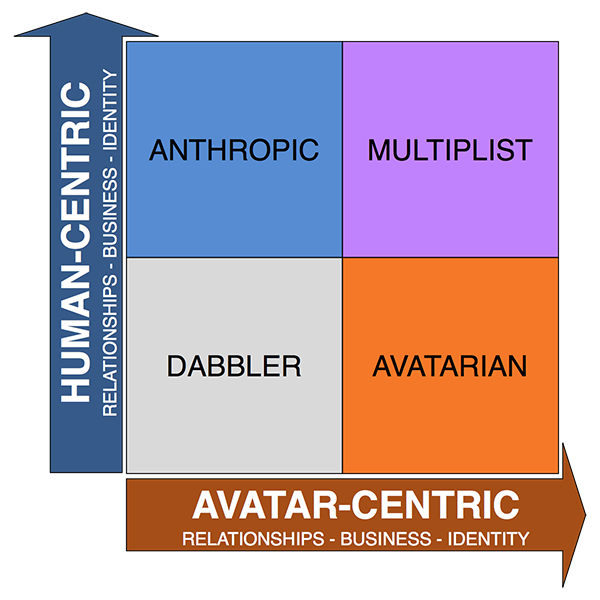
As a good Venn Buddhist and VizThinker, I thought through the concept using a chart. One axis reflects the number of human identity-centric relationships and business dealings. The other is for one's avatar identity-centric activities.

This ended up providing four quadrants that I propose as replacements for Augmentation and Immersion:
  1. Anthropic: Their Second Life activity is related to human identity. RL identity is in their SL profile. They use Second Life within their RL job, interact with their human friends within the virtual world, etc.
  2. Avatarian: Their Second Life activity is separated from human identity. They do not openly associate their avatar and human identities in any way.
  3. Multiplist: They have a mix of human-centric and avatar-centric relationships and activities within Second Life. 
  4. Dabbler. Just to fill out the chart, I labeled the quadrant of those with very few relationships and activities of any kind.
So I offer "Anthropic vs. Avatarian" to replace "Augmentation vs. Immersion". What do you think?

Thursday, April 30, 2009

Erotic Chat as an Exemplar of Sense Extension in Virtual Worlds

The secret of TV's tactile power is that the video image is one of low intensity or definition and thus, unlike either photograph or film, offers no detailed information about specific objects but instead involves the active participation of the viewer. Marshall McLuhan
The experience of being an embodied avatar in a virtual world is facilitated by biological and psychological processes that transform a stream of sense impressions into the visceral sense of being there. The sense of presence one experiences within a virtual world is more a product of the mind than of software.

The external representation of Second Life depicted on a computer screen is a series of far-from-photorealistic images animated at sub-optimal frame rates. The internal virtual world within an active participant's mind is a deeply experienced reality including pseudonymous relationships that seem as authentic as those in the physical world.

A strong sense of immersive presence within a virtual world is because of, as much as in spite of, limitations of sensory information. The vacuum is filled by the engagement of the subconscious mind through active imagination. What is missing externally, is created internally. This integration of the actual and the imagined is often facilitated by text chat, which can help create a shared inner environment that extends and enriches the shared digital environment.

Erotic text chat is an exemplar of sense extension within virtual worlds. It can evoke sights, sounds, smells, tastes, sensations and actions that are otherwise difficult or impossible to create visually within the digital world. Intentional activation of the imagination can induce powerfully realistic experiences because the brain does not qualitatively distinguish between physically produced and intensely imagined sensory experience. For instance, studies have shown that the brain is activated by imagined smells and tastes in the very same way it responds to actual sense impressions.

Erotic chat shifts the balance of immersion from an external focus on computer images to an inward focus on the imagined experience. While the experience adds energy and substance to one's internal mental model, it also projects the localization of presence outward to the external virtual reality. It reifies the psychological experience as an external and independent entity.

In short, when two people get together, there are three worlds in the room: One is displayed on our screens; and one is within each of our minds. The use of text chat can extend the sensory range of our experience within a virtual world and harmonize our internal representations.

Whew!

Monday, August 18, 2008

New comic on identity & immersion

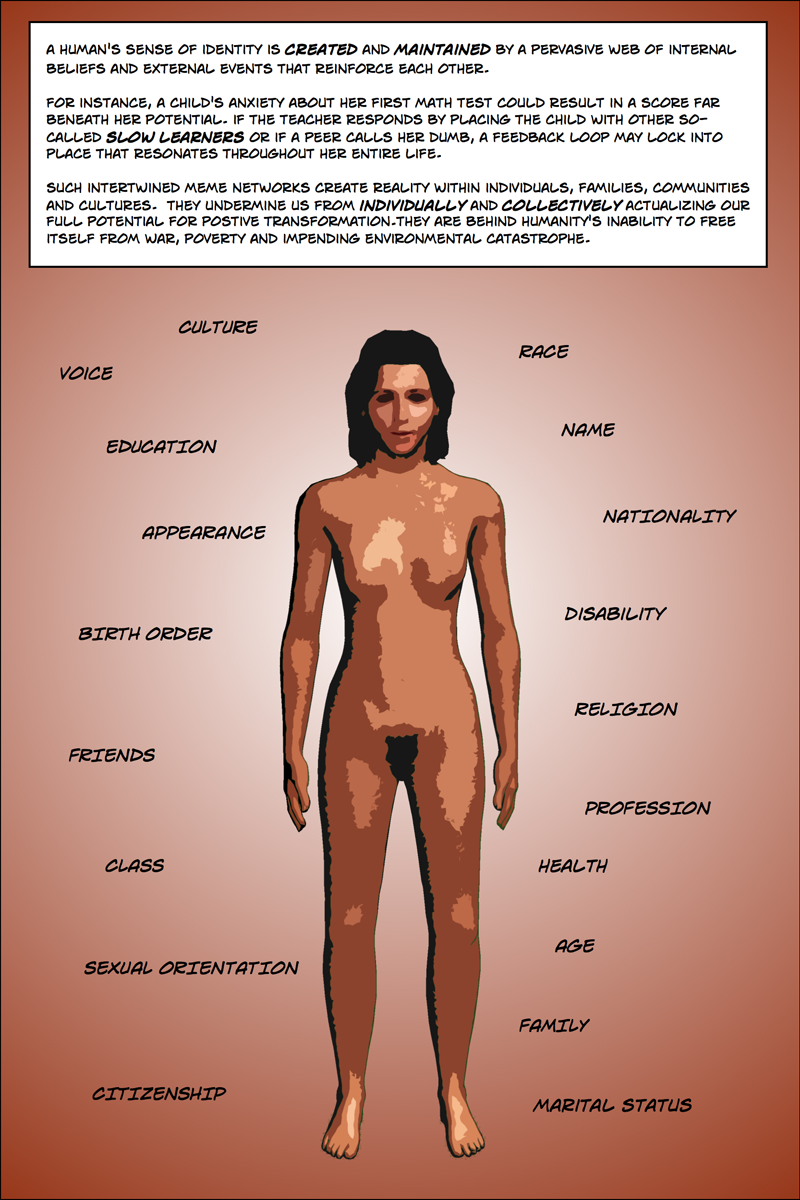
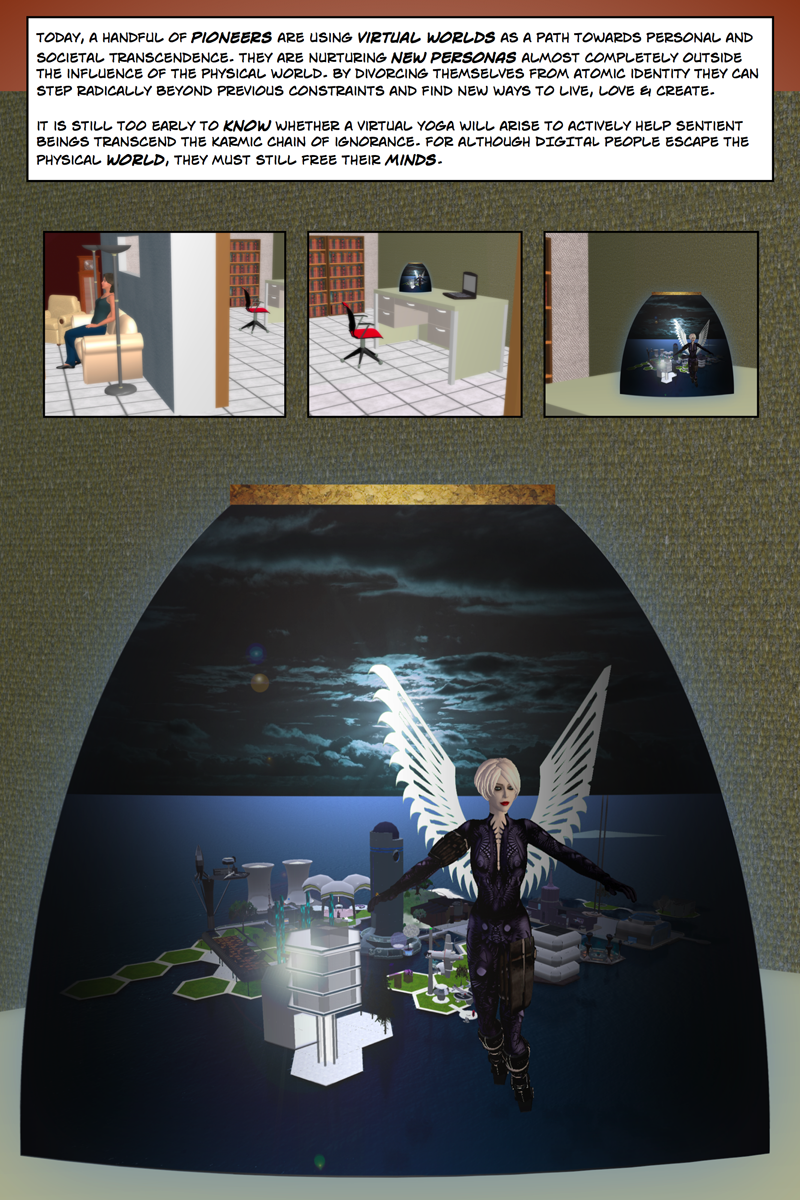
This two-pager began as an idea to show the many links between the virtual and physical worlds. The message was to be that any sense of a significant separation between them is pretty much an illusion. I completely changed my tune over the course of putting this together. I'll let it speak for itself today. Special thanks to Sophrosyne for trusting me enough to pose without knowing exactly how the images were going to be used.

Immersionists01.png

Immersionists02.png

Monday, August 4, 2008

The experience of AIR and not-AIR

This is a continuation of a topic thread covered in the last two posts relating to what I now refer to as "AIR-based relationships." AIR = Anonymous identity + Immersive environment + Romantic attraction.
Description of each factor:


ANONYMOUS: The human identity of the other being is unknown. Full anonymity encompasses age, gender, race, location, employment, etc.


IMMERSED: You experience your "self" as a virtual identity within the "magic circle" of the virtual environment. Full immersion encompasses factors such as age, gender, race, location, employment, etc. Immersion does not depend on any particular external factor such as a 3D virtual world. It is the psychological experience of feeling as if you are primarily within a virtual environment, identity or encounter. Some people experience their virtual selves as completely separate beings from their human identity.


ROMANTICALLY ATTRACTED: You have a crush on the other being. This can include feelings of longing, sexual arousal, obsessive thoughts, etc. that extend beyond time spent in the virtual setting.

The experience of each combination of factors:

After trying a few different approaches to better understand and articulate the effects of AIR, I came up with a simple narrative description of the experience of each combination of AIR and not-AIR elements. It is told from the point of view of human Sandy Smith and her avatar Hotgirl Questi, as she chats and dances with avatar Hippychick Bluestone and her typist John Jones.

I rearranged the order of the factors to make the narration flow more smoothly (I-A-R here.) Keep in mind that these descriptions are from one person's point of view, in this case Sandy/Hotgirl. John/Hippychick, the other character in this mini-drama, may have a different combination of AIR/not-AIR.


I, Sandy Smith, a 21 year old woman in San Francisco, am logged onto SL as the avatar Hotgirl Questi. I am chatting with John Jones, a middle-aged man in Cleveland, who is logged on as the avatar Hippychick Bluestone. I'm watching our avatars dance in a nightclub simulation. It's fun.


I, Sandy Smith, a 21 year old woman in San Francisco, am logged onto SL as the avatar Hotgirl Questi. I am chatting with someone who is logged on as the avatar Hippychick Bluestone. I'm watching our avatars dance in a nightclub simulation. It's fun.


I'm chatting with Hippychic. Her keyboardist is John Jones, a middle-aged accountant in Cleveland. We're dancing together in a nightclub. It's fun.


I, Sandy Smith, a 21 year old woman in San Francisco, am logged onto SL as the avatar Hotgirl Questi. I am chatting with John Jones, a middle-aged man in Cleveland, who is logged on as the avatar Hippychick Bluestone. I'm watching our avatars dance in a nightclub simulation. I have a big crush on John.


I'm chatting with Hippychick Bluestone. We're dancing together in a nightclub. It's fun.


I, Sandy Smith, a 21 year old woman in San Francisco, am logged onto SL as the avatar Hotgirl Questi. I am chatting with someone who is logged on as the avatar Hippychick Bluestone. I'm watching our avatars dance in a nightclub simulation. I have a big crush on the person who is logged on as Hippychick.


I'm chatting with Hippychick Bluestone. Her typist is John Jones, a middle-aged man in Cleveland. Hippychick and I are dancing together in a nightclub. I have a big crush on her


I'm chatting with Hippychick Bluestone. We're dancing together in a nightclub. I have a big crush on her.

Thursday, July 31, 2008

Back in the love box with AIR-based relationships

Based on feedback from digado and Rheta, it seems I didn’t do a very good job of tying together the various threads within yesterday’s post. One reason is that it was written as a stream of consciousness rather than a reasoned argument leading to a previously formed conclusion. I made a few big leaps between ideas without taking the time to walk through the chain of connections. Maybe my textual communications skills have become corrupted by too much comic creation. Anyway, I'll have another go at clarifying yesterday’s missive by answering some of digado's thoughtful questions:
How did immersion get dragged into these relationships?
I'm not dragging it in by iteslf. I came up with the snappy acronym and catch phrase “AIR-based relationships” to define the area of my inquiry. AIR = Anonymous identity + Immersive environment + Romantic attraction. It seem to me that the combination of these three factors creates an especially unstable and volatile mix.
When not 'immersed' you wouldn't have the relationship either, is that what you are saying, or does immersion create these relationships...?
Well, it seems to me that if you weren't immersed, you'd be more conscious of the fact that the hot babe you were flirting with could quite possibly be someone who looks like your grandfather in real life. Humans exposed to attractive images of their preferred gender(s) can experience reflex physiological responses that flood the brain and body with hormones that act like a love drug. I've written about this process in the past. If everyone walked around in a Naruto avatar, I reckon there would be far fewer romances.
People created 'virtual' relationships long before 'worlds' such as SL over the internet, with or without immersion
Well, I would say that if you are focused on a text chat enough to get romantically attached to someone, the text chat environment is immersive for you, and your online affair would be an AIR-based relationship. At least until you traded real IDs and/or met in person.
I'm still trying to get my head around that last paragraph tho, I'm sure it makes sense in some way - I just don't see it...
Well, at least forelle saw it. :) What I tried to convey in the last paragraph was that the person you are in a relationship with is a complex living being with vast potential for growth and change. So if your love requires that they don't externally express significant inner changes, then it is a love of an objectification of your lover's past state, not of who they are now. From my limited experience, it seems there is generally less slack for change in AIR-based relationships.

Well, I'm out of juice for now. If any of my ideas still seem cryptic, please let me know and I'll give it another go.

Wednesday, July 30, 2008

Love me in a box

Four main types of gameplay Immersion can be found in games: Spatial Immersion, Emotional Immersion, Cognitive Immersion and Sensory-Motoric Immersion. from Patterns in Game Design by Staffan Björk and Jussi Holopainen
Game designers work to create immersive experiences so that a player's consciousness is drawn deeply into game play. Immersion supports the consciously chosen suspension of disbelief by directly engaging subconscious systems that generate emotional and physical responses. For most people, it is easy to separate the authentic experience of emotions within games from the fabricated environment and narrative that stimulate the experience.

The line between fantasy and reality is not so clear-cut within virtual worlds. The highly immersive nature of the experience makes it almost impossible for us to separate the real beings we interact with from the fictional elements they are enmeshed within. In the fuzzy world of anonymous relationships, authenticity becomes equated
to some extent with character consistency. This seems to be especially true in romantic relationships.

In the atomic world, relationships often have difficulty when one person makes a significant change such as newly found religious observance or even an avid hobby that their partner doesn't take up. Physical change such as significant weight gain or loss can also put stress on a relationship.

It is not surprising that in virtual worlds, relationships are very vulnerable to changes from established norms. In the atomic world, your partner may now worship Allah instead of Jesus, but you know they have the same parents, siblings, job, gender, etc. In an anonymous virtual world relationship there is nothing solid to hold onto.

It seems to me that if you are not willing to let your partner change to pursue a non-destructive interest that doesn't break a core agreement such as fidelity, the relationship is grounded more in objectification than love. This applies to all worlds.