Showing posts with label identity. Show all posts

Monday, June 30, 2014

Virtual Reality, Identity and Transcendence.


Our identities are formed through a feedback loop between our visceral sense of self and the reflecting chamber of the external world. There is an ongoing interplay between our projection of self to others and the affirming or contradictory stories others project back at us us.

Over the course of life, the flexible and fluid emergence of our human potential becomes increasingly constrained by an accumulating legacy of personal history. Both our own sense of self and the way we are perceived by others become more fixed and less amenable to change. Although it is certainly possible to recreate oneself at any point in life, it is not simply a matter of acting to modify one's own behavior. It is very difficult to develop and maintain a "new you" when friends, family and colleagues continue to respond to the "old you" they are used to. This is why people who leave their hometown to forge new lives can quickly fall into old patterns when they come home for the holidays.

Pseudonymous identity lets us temporarily step out of the mutually reinforcing feedback loops outlined above and transcend some of the psychological, cultural and interpersonal constraints. We don’t merely leave our hometown behind, but also escape the socially defined feedback and presumptions associated with physical form, nationality, economic status, etc., including those we have internalized.

The power to escape the legacy of the past is even more pronounced in avatar-based pseudonymous identity that is grounded in active participation in virtual worlds. It not only allows us to redefine ourselves, but also to create new feedback loops with those we meet through the new identity. For instance, I suspect that many virtual world artists and designers who are perceived to be very creative individuals within Second Life, lead very different offline lives and are not viewed primarily as “creatives” within their physical world social circles.

Just dabbling In virtual worlds doesn’t actualize the transformative potential of avatar identity. The mind-altering power of virtual worlds is not realized until both the virtual environment and those we meet within it become as psychologically real as physical world experience. Then it's possible to begin expressing new dimensions of human potential through the avatar persona. To complete the circle, the new attributes developed within the virtual world can then be integrated into offline life.

Currently, the creation of a deeply realized virtual world identity can take a lot of time to achieve. Especially for one's first breakthrough immersion experience. And even after crossing that psychological line, the perceptual reality of the virtual sphere and one’s virtual identity will fade without consistent reinvigoration.That’s why a transition from screen-based to VR mediated virtual world experience should have a profound impact on pseudonymous virtual identity.

VR-based experience that provides instantaneous and more fully realized immersion is bound intensify the identity-shifting potential of pseudonymous virtual identity. If VR eventually becomes the new standard interface for virtual world experience, the identity-morphing potential of virtual worlds and avatar identity should become more pronounced and more widespread. (Assuming we’re not going end up exclusively using wallet name identities with avatars that mimic our physical world form.)

From the time an early human figured out she could use a stick to dig up insects to eat, people have been extending their biology through technology. From the phonetic alphabet to the digital computer, each new medium radically transformed human psychology and culture. As Marshall McLuhan wrote, "We shape our tools and afterwards our tools shape us.” If avatar embodiment in 3D virtual worlds eventually becomes as common and pervasive as today's use of cell phones and social networks, it will be fascinating to see how this bleeds over into wider culture.

Friday, February 28, 2014

Reflections on Six Years of Virtual Identity


Enhanced compilation of a Twitter micro-rant on the theme of "identity"
I used to think of "immersion" as the state of being psychologically embedded within a 3D virtual world such as Second Life. But upon reflection, the more compelling experience for me has been my immersion in "Botgirl Consciousness." Channeling Botgirl over the last six years has allowed me to explore and enhance a wide range of emergent personal attributes and practical abilities that I've integrated into day-to-day existence. These range from enhanced skill in writing, videography, comic creation, social networking and public speaking, to a more fluid ability to respond as the spirit moves me in any environment.

Virtual identity is so ingrained into my everyday existence that it feels natural. It's just another dimension of my personality, not qualitatively different from the contextual roles I play as parent, spouse, employee, etc.

Botgirl's Stages of Virtual Identity Awareness
    1. Virtual identity is a fabricated persona we make up.
    2. Virtual identity is an emergent psychological phenomenon arising from our subconscious.
    3. Virtual and physical identities are both emergent psychological phenomena, reinforced by external feedback.
The perception of any person as a static identity is largely fictional; a psychological misinterpretation of the continuity of memory. Although our newborn, grade school, high school and senior citizen selves have little in common, we think of them as being the same person because we tie everything together through a running narrative starring ourselves as the protagonist. The philosophical questions that arise from thinking about virtual identity have encouraged me to apply them to all forms of identity.

Of course, people experience virtual identity in different ways, ranging from absolutely no difference between atomic and virtual personalities to a severe split. On the extreme, I've met people who claim that their avatar personality has preferences, characteristics, beliefs and goals that not only differ from, but may be in direct opposition to what they experience when operating under their human identity. That hasn't proved to be a sustainable approach, at least for those I've known who've tried living two separate existences. Many end up suffering in two lives instead of one, eventually abandoning their active virtual life as the candle burns down from both ends.

Some use virtual identity as a way to escape the trials of their physical lives. Like any form of escapism, virtual identity is beneficial when it provides a needed respite from the challenges of life, but is harmful when it prevents us from working to improve our physical condition or fulfilling our responsibilities to our jobs, our loved ones and ourselves.

Virtual identity isn't new. Pen names predate pens. But the networked environment is a substantive change because it enables realtime and near realtime interaction. This makes some people uncomfortable when they are thrust into virtual environments with those who present themselves through a pseudonym. The mere presence of virtual identities on social networks can assault mainstream participants' mental models of personal identity. This was clearly exposed when Google Plus initially forbade virtual identities. That said, I've found that in many cases, people who were opposed to pseudonymous community members have softened their views after living with us "Nymns" for a while.

One surprising realization for me was that an identity born as a pseudonym can not only survive the exposure of the underlying human identity, but can continue to thrive. The suspension of belief required is not much more challenging than the everyday interactions we have with people we casually encounter. The challenge in all cases is to realize that everyone we meet has a much richer range of existence than what we perceive. I choose to believe that there is an unfathomable mystery at the heart of life, awareness and identity. No single persona can do justice to our infinite potential. Even God wrestles with that one.


Friday, September 28, 2012

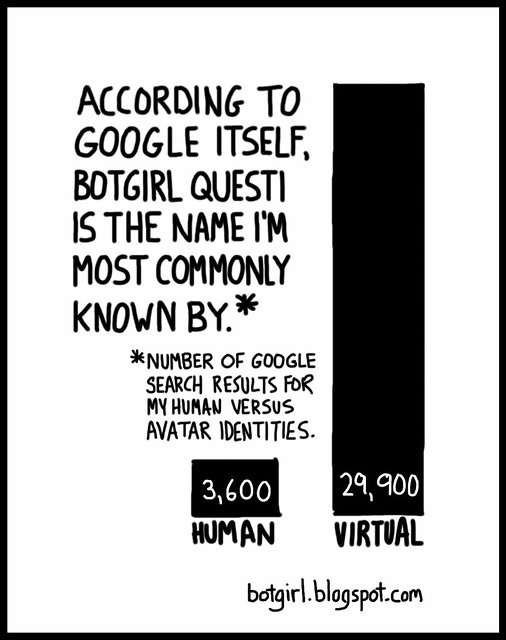
Our system has determined that Botgirl Questi may not actually be a name

Here we go again:

Hello,

Our system has determined that the name you provided on your Google+ profile Botgirl Questi may not actually be a name.

It may be that the name you provided is that of a business you represent. Or it may be that this is actually your name and our system made a mistake.

We've got a few options for you:
  • If this is the name of a business, brand, or other organization, please sign in to your Google account and change the profile's name to a representative of the organization. You can then, while logged into this profile,create a Google+ Page for the organization. Pages are designed specifically with the needs of organizations in mind, while profiles are designed for individuals.
  • If this is your name, please sign in and follow the instructions to submit more information and help us fix our mistake.
  • If you want to change the name provided, please sign in and follow the instructions to edit your profile. You can also optionally add Botgirl Questi as a nickname, previous name, or transliterated name in addition to your common name, if appropriate. Learn more
  • If none of the above options are appropriate and you use your Google+ identity on YouTube, you can unlink your Google+ profile from YouTube. This will ensure that regular YouTube access will continue but your Google+ profile will be suspended until you take one of the actions above. If you manage a brand channel, we will soon have a better option for creating a Google-wide identity.
If you don't take one of these steps in the next 4 days, your Google+ profile will be suspended. While suspended, you will not be able to make full use of Google services that require an active profile, such as Google+, Reader, Picasa, and YouTube (if you use your Google+ identity on YouTube). This will not prevent you from using other Google services, like Gmail.

We're sorry for the inconvenience,

The Google+ team.

Monday, July 30, 2012

What Saved my Virtual Life

This is my 1000th blog post. I half-joked on Twitter yesterday that I would try to resist writing a traditional ultra-introspective narcissistic missive. But the truth is, reaching a personal milestone is an appropriate time (and a good excuse) to reflect upon what the hell I've been doing and how I want to proceed.

The current situation is certainly very different than when I started. In March 2008, Botgirl Questi was an unknown pseudonymous nube wandering around Second Life. The blog was a personal journal recording my in-world experiences. It had about a half-dozen sporadic readers, most of whom I'd met previously in Second life. Everything was new and fresh. Fascinating insights materialized at every turn. Virtual life was numinous. The exploration of virtual identity seemed like a religious calling.

In April, an article in New World Notes bumped my readership from the dozens into the thousands. I responded to the new exposure by increasing the pace and intensity of my virtual world activities and creative output. In May, I joined a community of digital people who believed they were transcending the limitations of the atomic world and setting the stage for the next step of human evolution. I held my first identity-themed art show in September and then presented at Second Life's first Comic-Con the following month. I began collaborating with other virtual creatives on new comics, videos and art shows. The sky seemed no limit.

Just a couple months later, in January 2009, I was ready to bail out. This Wheels on the Bus video is a good representation of my psychological state at the time.


I'd been burning the candle at both ends for almost a year and there was little left. My virtual community was starting to unravel. By June, most of my closest compatriots had disappeared off the grid without a trace. I was ready to follow. The dream of virtual utopia was gone. It seemed like I had been running fast and hard, getting nowhere.

But then, out of the blue, the Muse stepped in and saved my virtual life by shifting my raison d'ĂȘtre from the exploration of identity to the expression of creativity. I am only understanding this in retrospect as I'm writing these lines. So I'm going to end the post here and marinate in the new realization for a while. I'll be back when I'm nice and juicy.


.

Thursday, July 26, 2012

Transcending the Box of Personal Branding

Self Branding


I just read an interesting interview with Vince Gilligan, creator of Breaking Bad. It was right on time, as I've been mulling over my virtual life in preparation for today's conversation on Inside the Avatar Studio. He said:
It finally dawned on me that TV is about stasis, and it is about life, whereas our lives are about change. We get older with every passing moment. We change in our lives, we change our hairstyles. We change our outlooks on life, our political views sometimes. TV by design has to have a certain amount of stasis to it, because the goal in television is to have a TV show that lasts for many decades.  But it’s hard to have characters on your TV show change when you are trying to provide a safe haven for the viewers, a familiar place for the viewers to come back to week in and week out. 
Although he's writing about fictional characters, the same forces play upon those of us who avidly blog and social network. Every post we make is part of an ongoing story we are telling about ourselves. The decisions about what we include and omit in our public narratives create a divergence between the full spectrum of who we are and the image of ourselves we present to others. It also works to keep us inside the box of our story arcs and makes it harder to make significant changes in our lives. Although this process is just as true for those who represent themselves online through wallet names, it's easier to discern the variances through the virtual lives of the pseudonymous.

I was very conscious of Brand Botgirl during the first year of public life. I never disclosed my human identity in public or private. The content I posted here and on social media sites was completely constrained by the backstory of being an AI who woke up within a virtual world. It was the perfect thing to do at the time. It allowed me to immerse myself in the character, see the world through her eyes and facilitate an ongoing series of realizations that I can't imagine how I would have otherwise experienced.

Over the course of time a few factors emerged that eventually pushed me out of my little nest. The first was the development of a handful of friendships that began to feel constrained by my fixed wall of pseudonymous method acting. Surprisingly, another source of visceral pressure to change came from the character herself who was straining against the confines of the artificially truncated perspective. After months of hand-wringing, I finally gave up pseudonymity and started on a new path that has ended up with a very fuzzy border between my multiple online identities: The I that is We.

It's likely that brand and virtual identity will be one of the topics we discuss today during Inside the Avatar Studio today. It's an hour show that will begin at 3:30pm SL/PST. You can attend in Second Life or view the live stream on Metaverse Television.

Thursday, July 19, 2012

Why I'm appearing as Botgirl Questi on a live-voiced Inside the Avatar Studio

Bevan Whitfield invited me to be the guest on this month's edition of Inside the Avatar Studio. Since it's a live talk show, my first thought was to appear as usual through my fourworlds identity. The mixed gender thing works for Lauren Weyland, but it's not Botgirl's schtick. Voicing Botgirl's usual form with my human vocal cords would be as creepy and inauthentic as Joss Wheldon reading Buffy or JK Rowling performing Voldermort.

That said, wearing the fourworlds identity and avatar for special occasions feels like pulling an infrequently worn second-hand tuxedo from the back of my closet. (No pun intended.) It's stiff and doesn't quite live up to the occasion. So this time, I've decided to try something different. I'm going to appear on the show as Botgirl Questi, but show up in a visible form that is congruent with the live voice. (Anyone want to go shopping with me for an avatar body and skin?)

After years of musing on the virtual identity, it seems to me that one's name is the most essential carrier of transworld identity. As I wrote in 2010, a name is much more than a label:
In the mundane view of reality, a name is merely a word we use to label the particular entity that is specified. But the deeper truth is that a name plays a role in defining and maintaining our perception of the named object. At an even more profound level, a name actually brings the named into perceptual existence by separating a particular set of attributes from the universe into a discrete object or being.
So fuck it, right? The main downside I see is that I can't disassociate myself from all the pompous punditry that may spew from my virtual lips. Like in this 2010 clip from my last appearance on Inside the Avatar Studio for a panel discussion on Avatar the movie.

Tuesday, June 5, 2012

Here's How I Can Rez and Puppet Your Avatar Without Permission

skate
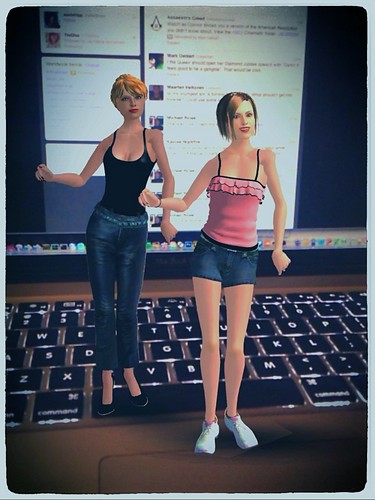
I abducted Skate Foss and made her dance on my laptop.
Blue Mars Mobile released an update last week that lets you select another person's avatar to join yours in the virtual environment. The avatar's owner doesn't need to be present or give permission. For instance, here's an image of Skate Foss dancing on my laptop after I rezzed her avatar into my augmented reality scene.

Can you imagine how controversial that kind of feature would be in Second Life? Intellectual property aside, the idea that someone could rez and puppet a copy of your avatar would be anathema to most SLers.

Avatar identity is the killer app of Second Life. It's killer in the sense that avatar identity helps keeps its 100,000 or so avid participants coming back. And it's killer in the sense that avatar identity is an aspect of SL that freaks out the meatspace mainstream and kills broad acceptance. At least for now. I believe privacy concerns will make avatar identity more common in the not-too-distant future.

I don't know about the future of Blue Mars Mobile. It's still mostly a dress up your avatar application. But the augmented reality feature is a lot of fun. If they add more animation options and the ability to walk through 3D space, it may evolve into something I'd use a lot more in machinima creation.

For now, here's a short video that shows how two Blue Mars avatars can be animated together. I used the augmented reality feature to project them in front of my backyard Buddha in real time. I applied effects with iSupr8 for a bit more visual interest and edited the video using Avid Studio on an iPad. Music is "My Comfort Remains" (Remixed) from the late great Nusrat Fateh Ali Khan.


Monday, April 16, 2012

Love Me in a Box

Self Branding 
Whiskey Day has been writing a great series of posts about how we perceive self and others through interactions in virtual worlds, blogs and social networks. One recurring theme is the differential between who we actually are and how we are perceived by others . . .
You don’t know me. You know many things about me. You know the name I chose to share with you. You know the face I choose to wear. But how genuine is that? As long as the puppet is entertaining, do you care?   You Don't Know Jack
The problem with labels is that, while they might be true on some level and sometimes worth a chuckle or ten, they ultimately do something harmful: they dehumanize. Labels and broad generalizations erase all of the complexity of someone’s rich story and paint them as a one-dimensional caricature. And once you’ve dehumanized them, it’s easy to marginalize them, and ultimately ignore them; to dismiss them and allow yourself to feel superior.  Don't be a Dummy
 And the way we experience ourselves . . .
Is there a danger in loving that image of ourselves that we’ve created? No matter how different from our physical selves, our virtual selves are still a reflection which we have created; a facet of ourselves that we long to both share with others, and to possess. from Narcissus
Each of the scenarios Whiskey describes stem from the human compulsion to conceptualize experience into nice understandable packages. We all carry a virtual world in our heads that's a mental model of the external world. See what comes to mind when you read the following words:

New York . . . World War Two . . . Lindsay Lohan . . .

The human brain is amazing! Your mind just traveled in space and time to deliver full blown conceptions based on relatively limited personal experience. What you just experienced is the core of what differentiates humans from other forms of life. It's also what creates the problems Whiskey describes when we mistake our mental maps of ourselves and others for the actual territory.

This process is also exacerbated by our compulsion to strategically manage and control the information we share about ourselves. Consciously or unconsciously, we put ourselves into boxes as we choose how to represent ourselves online. This isn't necessarily a bad or disingenuous activity. If we don't project a strong image of ourselves online people will just put us into their own conceptual boxes and fill in the blanks with their own projections. And who knows what the hell they'll come up with?
Girl in a Box 1
So can we genuinely come to know each other? Personally, I agree with Byron Katie who said that no two people have ever met. We never experience anyone directly because it's always through the filter of our own perceptions. But what we can do is reality-test our beliefs and not confuse the judgements in our mind for the reality of the other sentient being. Bryon Katie has a great process to detect and let go the false negative beliefs we have about ourselves and other people. I recommend it highly.

So for the record, I'm content to be your content. You can love me in a box.


Thursday, April 12, 2012

Letting Go

Deep Tweets - Art

I'm starting to get tired of my endless musing and commentary on identity. Maybe you are too. 

We begin our exploration of identity as players on a stage. Unaware of the masks we wear. Almost completely identified with our personas. Over time, we begin to notice our movement between roles. We put one on. Take one off. Some of us even go outside the bounds of our unconsciously assembled collection and try whole new roles. But we're still on stage. Still in costume. Still identified within our method acting. 

The exploration of identity is a journey. Its destination is the point where we can let them all go. 

Wednesday, April 11, 2012

Mask Speaks: A Video Message From The Authoritative Source on Identity


There have been a number of interesting posts recently about identity, masks and personas. I thought I'd throw out this 2010 video from the most authoritative source on the topics.

Monday, April 2, 2012

Virtual Identity: What Happens After Minnie Mouse Pulls Off Her Head

Identity Mishap 

Lalo Telling posted this weekend about the negative impact of meeting avatar friends in their human flesh. He wrote:
The difference, and the point of this post, is that meetups of virtual world avatars come freighted with preconceptions -- illusions, if you will -- regarding appearance, reinforced in most cases by the extension of avatarian identity into social networks, complete with profile photos to match . . . The illusion would be shattered upon meeting them face-to-organic-face... or by photographs with names assigned. It's an illusion I'd rather keep.
I understand Lalo's reluctance to break the magic circle of virtual identity. There have been people I've known for a couple years through avatar form who later disclosed their human identity including links to pictures.  In a few cases, the dual awareness created enough cognitive dissonance to create psychological discomfort. It was like what a kid might feel after he saw Minnie Mouse pulling her head off at a theme park. But I got over it eventually and gained new equilibrium.

The other side of the coin is what it feels like to give up your own pseudonymity. Identity within the virtual world community (and by extension the social network) is socially constructed. No matter how strong your own sense of identity may be, to maintain it, you need other people to suspend disbelief and play along. So when I eventually decided to disclose human identity after a year of very active and public pseudonymous life, I realized the viability of my virtual persona was at risk. Although a few people let it be known that I ruined it for everyone, I'm happy to report that two and a half years later Botgirl is still alive and doing pretty well. I'll write more later this week about the challenges of maintaining a viable post-pseudonymous virtual identity.

I have a feeling this subject is going to be hot again for a while. Yesterday, Whiskey Day wrote an interesting post on the topic and I look forward to other avatar writers adding perspectives on their own blogs.


Monday, March 26, 2012

Do I Taste Better When You Know it's Me?

Perception Projection
The perception of "who we are" in the social network is a mosaic that includes every post we've made.

Coke makes cola taste better. Not Coke the secret formula. Coke the brand.  People prefer Coke and Pepsi pretty evenly in blind taste tests. But three out of four prefer the taste of Coke when the cup is labeled with the brand name. Researchers can actually see the impact of the brand in real-time brain scans.

These findings add an interesting dimension to our discussion over the past few weeks related to influence and SLebrity.  Are posts from people with strong "personal brands" within the Second Life community more valued and discussed than they would otherwise merit?  If we were forced to reboot identities and start from scratch, would the same people end up making a name for themselves or would new voices emerge within an even playing field? 

I wonder to what extent we'd perceive each tweet in our stream differently if the sender's name were hidden. It would be a very interesting experiment.


Sunday, January 8, 2012

Bad Santa?

Bad Santa?

One of the most valuable things I've learned from virtual worlds is that our conception of reality is based as much upon imaginary projection as objective perception. In a virtual world such as Second Life we can easily remember that there is software behind the beautiful sky we see. With a little more effort and attention we can even keep in mind that there is a human of unknown age, gender and appearance behind the avtar we're interacting with.

Being able to shift awareness in and out of immersion in virtual life is a great exercise for awakening to the analogous phenomenon in the atomic world. Our experience of physical life is no less a construction of our minds. The dome of Earth's sky is actually blue light scattered across the atmosphere. Although we can't read other people's minds, we usually act as if we know exactly what they're thinking.

For the past year or so, I've been playing around with using dolls and action figures to expose how our minds reflexively construct personality, identity and story. For instance, the toys in the image above weren't posed. The were just sitting on a shelf at an antique mall. But one glance was all it took for my mind to reflexively translate the sensory impressions into an evocative story. By noticing and capturing this mental process with toys, my hope is that I'll have an easier time remembering it with people. Someday.


Wednesday, October 5, 2011

The Transformative Power of Pseudonymous Identity

(Warning: Fourth Wall Breach Ahead!)

Most public conversations related to pseudonymous identity in social networks have centered on negative aspects of the issue. For real-namers, it's the fear of being griefed by untraceable miscreants. For the pseudonymous, it's the fear of the damaging consequences of exposure, such as not getting hired for a future job because of a controversial post. But today, I'm going to focus instead on the positive gifts of pseudonymous identity in the light of my own experience over the last three and a half years channeling Botgirl Questi.

Although some people use pseudonymous identity for nefarious purposes, the vast majority of those I've met in virtual worlds and on social networks use it benignly. And many of us use it as a vehicle for creative expression, personal self-actualization and social community:

  • I've met people who've felt shy most of their lives, but transformed themselves into confident social butterflies through virtual identity. The previous timidity was often due to physical or social characteristics that made them feel ostracized or self-conscious. Many have found that confidence gained through virtual identity is carried over into physical life.
  • Most of the active artists I've met in Second Life had little or no history of public creativity before developing it through virtual identity. It's very common for people who haven't worked on an art project since grade school to end up producing substantial works and even exhibiting in art shows. I'm one of them.
  • The skills I've developed in the 900 blog posts, 100+ videos, dozens of comics and 10,000 social network posts under the Botgirl identity are applied every day in my wallet name work. Although I've been a creative type my whole life, channeling Botgirl has revolutionized the depth, breadth (and speed) of my work. My Muse has given me both an unquenchable thirst to create and an ever-flowing fountain of inspiration to satisfy it.
I'm not pitching pseudonymous identity as some kind of wonder drug or panacea. But from my own personal experience and the experience of thousands of others like me, a pseudonymous identity can be a powerful platform for personal growth and creative expression.

I realize that some of you have no personal interest in developing a distinct virtual identity. And there are those who believe that there’s something inherently suspicious about anyone who would choose to do so. But as someone who’s sat on both sides of the fence, I invite you to suspend your disbelief and try it for yourself. Register another identity and start participating in a social network from that new point of view. You might be surprised by the insights it will give you.

This concludes the series on social networks and identity. You can find the others here: 1, 2, 3, 4.

Tuesday, October 4, 2011

Intermission: Short Takes on Identity

After three days of serious Left Brain posts on social networks and identity, I thought we could all use a little break. So I went to the archives and found a few of my favorite lighthearted posts on identity.
Duckrabbit


One interesting metaphor for human and avatar identity is Wittgenstein's duckrabbit. This picture can be perceived as either a duck or a rabbit. (If you can’t see them right away, the duck is facing to the left and the rabbit to the right.) But you can't see them simultaneously. You can bounce back and forth really fast, but not see both images at the same time.

I think that metaphor is close to the reality of human and avatar identity. At least in cases where there is a great divergence between the two. There is no morph of human and avatar. It's the anti-Gestalt: The whole is less than the sum of its parts.


Dear Miss Piggy

Dear Miss Piggy,

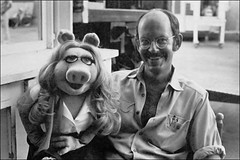
I was shocked and disappointed to learn today that you are not really a woman, but a man named Frank Oz. People have feelings! Poor Kermit must be heartbroken.


Frank Oz & Miss PiggyCan you imagine how sickened people were to find that the adorable little coquette they've had crushes on for all these years has a penis. Don't you have any shame? Now I have to wonder about all of you Muppets. Next thing you know, Cookie Monster is going to come out as a cross-dressing dyke. It just makes my skin crawl.

Just because newfangled television technology can let you pretend to be something you're not, it doesn't mean you have to start "experimenting" with us as the guinea pigs. Take my advice MR. PIGGY and be content with who you REALLY are.

Sincerely,
Anonymous


Mask Speaks

Monday, October 3, 2011

Social Network as Horse-Drawn Automobile - Part 3

In parts 1 and 2 of this series, I looked back at the evolution of automobiles and motion pictures to show how significant unanticipated personal and cultural changes emerge from new technologies. In today's post, I'm going to provide a brief summary of avatar-centric identity in 3D virtual worlds as an introduction to how our experience there might inform our discussion of pseudonymous identity within social networks.
Categories of Virtual World Use
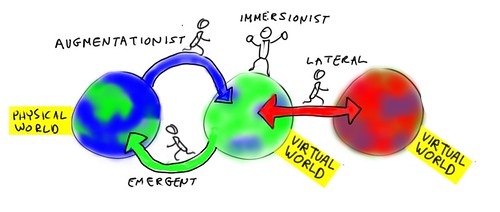
Shortly after my "birth" in Second Life, I began to extend my avatar identity to social networks. Over the next three and a half years my virtual life has moved almost entirely into the 2D virtual world of blogs, social networks and media sharing sites. The sketch above visualizes the movement of identities between multiple worlds.
  • Augementationist Identity transfers wallet name identities into virtual environments. Facebook is probably the best example of a virtual community extending physical world relationships and identity.
  • Immersionist Identity is born on an online platform and facilitates virtual lives which are distinct from physical world relationships and identities. Second Life culture is one of the most notable examples of this paradigm.
  • Emergent Identity is born in a particular online platform and then extended to others, including environments with primarily physical world-identified communities.  

In virtual worlds, pseudonymous identity can be thought of as a continuum ranging from the extension of physical identity on one pole, to the experience of a dissociated autonomous being on the other. The left end of the illustration above is the human aka avatar sphere. On the extreme left edge of the continuum, individuals create avatars that closely resemble their human forms as this recent Second Life banner advertisement illustrates.


In the middle of the spectrum, people experience their avatars psychologically as an extension of their human identity, but role-play through a unique persona. This can be in the context of a structured game experience in a role playing sim, or more informally through the development of a character who interacts with others through a pseudonymous identity.This is the one person, multiple personas paradigm.

Finally, some people experience their avatar identity as a unique personality that is distinct and independent from their human persona, like me! Although some people see this as a Multiple Personality Disorder, I prefer to think of it as a Multiple Personality Capability.

The emergence of a distinct virtual identity is rooted in the same processes and underlying biology that contribute to such variants of "normal" human personas. In the physical world, we express ourselves through a multiplicity of roles such as parent, employee, student, party goer, and so on. But the vast differences in our personas from role to role are barely noticed. The way we dress, the style and substance of our communication, and subconscious expression such as body language and posture can vary widely in different roles and settings.

Although living part of one’s life through an avatar identity seems strange to most people today who haven’t experienced it for themselves, I imagine people from just a few generations ago would find our mainstream world of pervasive texting and social networking to be equally as disturbing. Like seeing everyone in the crowd leaving a movie theater walking with heads down, eyes glued on their phones and oblivious to anyone else around them. Now that’s creepy.

One of the most valuable aspects of leading a distinct virtual life is its ability to expose aspects of physical life which are usually invisible to us. In part 4, I'll hack a bit deeper into virtual identity, including its relationship to creativity.

Sunday, October 2, 2011

Social Network as Horse-Drawn Automobile - Part 2

In part one of this series, I introduced the idea that we are just beginning to perceive virtual identity and online social networks outside of mental models related to their physical world analogs. We always frame new technology through earlier paradigms. A good example is the early history of film.


At first, “moving pictures” merely extended the paradigm of the photograph, capturing daily events from a static camera position. It then extended the ancient medium of the stage play, presenting actors on a set through a continuous fixed shot. But over time, filmmakers began transcending the old mediums with new concepts like zooming, cuts between long, medium and close-ups and montages that escaped physical world boundaries of space and time.

It took audiences a while to develop an intuitive visual lexicon to make sense of all of the newfangled cinematography and editing. For instance, some french theaters in the early 1900s employed a narrator to stand next to the screen and explain the action to the audience. Luis Bunuel recounted a 1900s audience reaction to a camera zoom. He wrote, “There on the screen was a head coming closer and closer, growing larger and larger. We simply couldn’t understand that the camera was moving nearer to the head . . . All we saw was a head coming towards us, swelling hideously all out of proportion.”

So it's not surprising that people today have a hard time understanding the emergence of virtual pseudonymous identities on social networks. I imagine if you took someone out of the audience watching one of Edison’s early films and dumped them into a theater showing Avatar 3D, they would find it fairly incomprehensible. But just as movies were an extension of photography and drama, virtual identity is an expression of physical identity. And if we stand back and see it within that context, it can make better sense.

We are just beginning to explore virtual identity and social networks outside of the confines of our old ways of thinking. Although this early work will pave the way for future breakthroughs, I don’t think we’ve even reached the Model-T stage.  In part three of this series, I'll explore how pseudonymous identity can help bring to light the difference between "who we are" (the sentient being) and "what we are" (the aggregation of our physical aspects).

Saturday, October 1, 2011

Social Network as Horse-Drawn Automobile - Part 1 of New Nymwars Series

After a three week break from posting on the Nymwars, I'm returning to the issue this month in a series of posts on social networks and pseudonymous identity.
One day at the dawn of humanity, a distant ancestor figured out that she could use a stick to dig up insects. That early tool was the first in a long line of technological innovations extending our biological capabilities. The bug-grubbing stick extended the hand and arm. The wheel extended our legs. Written language extended our memory and speech. In each case, the emerging technology allowed us to actualize human potential in ways that were never before possible.

Over time, new technologies have transformed human identity and culture in radical ways that couldn’t be imagined when they were first introduced. For instance, early drivers didn’t have a clue about the dramatic social, political and economic changes that cars would spark over the next 100 years. Women’s liberation, rural depopulation, racial integration, wars in the Middle East and fast-food chains were all hastened or instigated by the automobile. But at first, we thought of them as merely “horseless carriages”.

Today, social networks are in their infancy and we are still seeing them as just a "faster horse". To paraphrase Marshall McLuhan, we're looking ahead through the rear view mirror.

In part two of this series, I'll discuss how pseudonymous identity fits into the picture .

Monday, September 5, 2011

Nymwars and Monoculture

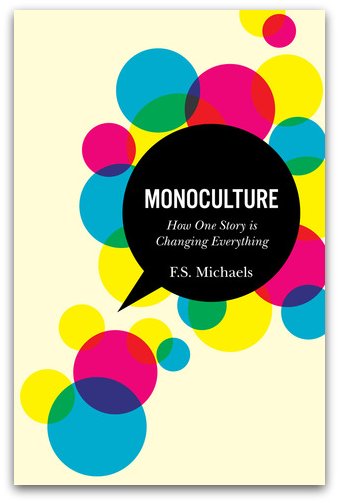
monocultureI posted a dozen tweets yesterday with quotes related to name and identity. My intention was to break out of the rut that has framed those multidimensional topics inside the corporate-vs-consumer duality of the Nymwars debate. It's not surprising that most of those conversations have been focused on the low end of the Maslow hierarchy. Both Google and the pseudonymous communities feel as if they are fighting for the future of their virtual lives. So it makes sense that arguments tend to center around issues of security and commerce.

But an even more fundamental cause of the constrained conversational scope is the invisible force of our modern monoculture:
In our time, in the early decades of the 21st century, the monoculture isn’t about science, machines and mathematics, or about religion and superstition. In our time, the monoculture is economic.  F. S. Michaels
The opinions we hold about these issues are based upon a fundamental worldview that has been instilled by a Mother Culture still rooted in the Industrial Age. Although organizations calling for an end to traditional privacy expectations see themselves as the vanguard for an emerging Digital Age, they are actually reactionary throwbacks to the robber barrons of the 19th Century and are seeking control of all aspects of the digital economy. I hope to explore more of these underlying dynamics here over the next few weeks. For today, I'll leave you with yesterday's quotes:

  • When they say "Be yourself", which self do they mean?  -Rob Brezsn
  • A simple separate person is not contained between his hat and his boots. -Walt Whitman
  • The real meditation is... the meditation on one's identity. -Ezra Pound
  • An identity is questioned only when it is menaced James Baldwin
  • A name represents identity, a deep feeling and holds tremendous significance to its owner.” -Rachel Ingber
  • I reserve my right to be complex. -Leslie Feinberg
  • Who are we but the stories we tell ourselves, about ourselves, and believe? -Scott Turow
  • Perhaps it's impossible to wear an identity without becoming what you pretend to be. -Orson Scott Card
  • I've tried to become someone else for a while, only to discover that he, too, was me. -Stephen Dunn
  • A self-made man may prefer a self-made name.  -Learned Hand
  • The name of a man is a numbing blow from which he never recovers. -Marshall McLuhan
  • Inside us there is something that has no name, that something is what we are.  -Jose Saramago

Thursday, August 18, 2011

Why You Should Never Argue With Me

I'm Just Sayin'

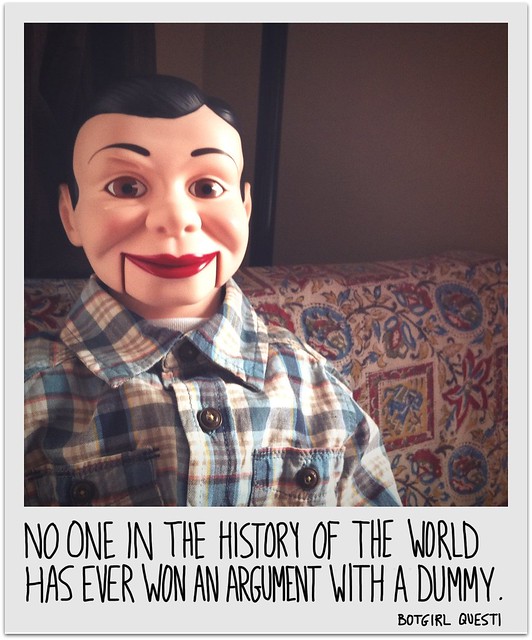
I've done a pretty good job of avoiding virtual drama and flame wars over the course of my life. (With a few notable exceptions. You know who you are.) But in October of 2010 I had a breakthrough that changed my life. I realized that I didn't really care whether I convinced anyone of anything. I might care about the issue. I might care about its outcome. But I don't care about changing any particular person's mind. That freed me to have fun instead of getting mad. To play instead of fight. And to graciously admit when I'm wrong. So if you want a dramatic argument, I warn you that my Dummy-Do martial artform is impervious. 
I'm guessing that those who saw this image yesterday without the accompanying explanation probably interpreted my meaning a little differently. :D

Tuesday, August 9, 2011

Why It's Important To Turn the Tide on Google's Real Name Policy

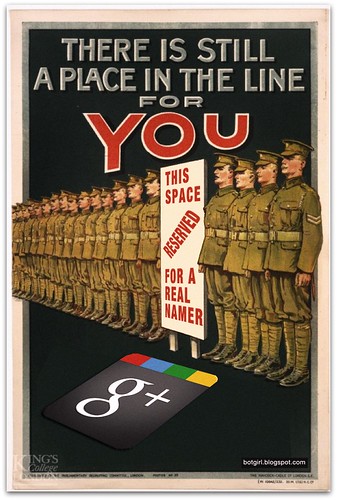
A Place For You
From a series of faux propaganda posters
The good news about the Google+ "real name" policy and the ongoing confusion surrounding it, is that it's brought virtual identity into the mainstream conversation about Internet privacy. This is especially important at a time when the U.S. Government is moving to mandate that Internet Service Providers spy on their users and business leaders are calling for an end to privacy and anonymity on the internet.

Unfortunately, Google's justification for their policy is the red herring of "connecting with people":
Google+ makes connecting with people on the web more like connecting with people in the real world. Because of this, it’s important to use your common name so that the people you want to connect with can find you . . .  If you’re referred to by more than one name, only use the one that commonly identifies you, and place the rest in the “Other names” or “Nickname” section of your profile. From Your Name and Google Profiles.
The well-crafted innocuousness of their rationale belies the profoundly chilling impact of a real name policy on free and open public discourse. When each post we make is permanently tattooed on our public record, self-censorship is self-preservation. The Brave New World that Google, the Zuckerbergs and the U.S. Congress are pushing us towards would deliver our complete virtual history to anyone typing our name into a search engine:

  • Employers, Insurance agencies, load examiners and private investigators
  • Children, parents, neighbors and ex-spouses 
  • Stalkers, griefers and others who may seek to do harm
  • And god forbid if you're ever going to run for public office

A real name policy ironically works against people "being real" in public forums by making it too risky to bare our hearts and souls. A real name environment puts a damper on communication that is counter to the dominant culture or far enough outside of the mainstream to have potentially negative ramifications on employment or acceptance in one's physical world community.

The main argument against pseudonymity is that it encourages people to behave badly. But from what I've seen, the vast majority of those disrupting civil conversation online aren't people who hide behind pseudonyms, but assholes who hide behind narcissism or true-believers who are thrilled to spout self-righteous vitriole under their real, identified name.

The impact of pseudonymity on behavior is actually quite the opposite. Pseudonymity is one of the most empowering and democratizing aspects of virtual life. It levels the playing field and enables merit-centric reputation. It encourages the expression of innovative thinking by providing a safe environment for personal growth and creative experimentation. I write this from more than three years of daily experience in social networks that are largely composed of those with pseudonymous identities.

Google's policy wouldn't matter much if it were from a typical start-up social network. We could just opt on and go on our merry way. But because of Google's dominant and ubiquitous role in the virtual environment, being excluded from their services will diminish our voices in mainstream virtual discourse. Our blogs, websites, video and other creative output will be at a competitive disadvantage as search results are tailored to social circles. Whatever final policy Google enacts is likely to be influential on other companies and on public policy. So it's time for Netizens to speak out and turn the tide.


Tuesday, July 26, 2011

Robot Marshall McLuhan on Identity


The Google+ pseudonymity issue has been a creative blast. Here's a video that sets some Marshall McLuhan audio to a beat and puts it in the mouth of a robot. A silly/profound mash-up.

Saturday, July 23, 2011

Your Freaks are my Family


I've proposed a number of times in prior posts that there is a connection between the experience of ventriloquism and avatar identity, at least for those of us who perceive their wooden or digital counterparts as unique personalities. Last night I finally had the chance to watch Dumbstruck, an award winning film focusing on the lives of five ventriloquism enthusiasts and their annual convention. Although the movie didn't touch on how ventriloquists experience the personalities of their dummies, it did bring up another correlation between the vent and avatar communities: People outside our respective communities often view us as freaks.

I certainly caught myself making negative judgements about some of the people featured in the film. One reason was the visceral sense of creepiness that struck me from time to time watching some of the less accomplished people perform and interact with their dummies. I think that type of reaction is related to the uncanny valley phenomenon that's been documented in gaming, robotic and animation contexts.

Despite my struggle to empathize with a few of the characters, it was easy to see that the ventriloquist community is close-knit, loving and supportive. Like the avatar community, they stay connected over the course of the year through online communication and come together in person at an annual convention. Like those in the avatar community, their RL friends and family are often perplexed or repulsed by their pursuit, so they turn to each other for support and acceptance.

The movie was a good reminder that your freaks are somebody's family. And vice versa.

Thursday, July 14, 2011

The Fight for Control of our Virtual LIves


I've focused somewhat obsessively on the Google+ pseudonymity policy here, ever since the story broke last week about the suspension of people using avatar-based identities. The reason the issue resonates so strongly for me is that it relates to the extremely consequential question of who should be in charge of our virtual lives: The corporations who create the platforms which enable them, or the netizens who live them through the platforms. This recent presentation by Rebecca MacKinnon provides a good overview of the issue and offers ideas about how we might work together for the democratization of the internet.

Saturday, July 9, 2011

Google Identity Auto-Tune Song


Song created on an iPhone with the Songify app. Video pieced together from prior projects. I'm easily amused and hope you are too!

Friday, July 8, 2011

The Real Truth About Google's Position on Avatar Identity: Exclusive Interview with Google


"Google services support three different types of use when it comes to your identity: unidentified, pseudonymous, identified. Google Profiles is a product that works best in the identified state. This way you can be certain you’re connecting with the right person, and others will have confidence knowing that there is someone real behind the profile they’re checking out. For this reason, Google Profiles requires you to use the name that you commonly go by in daily life." from Google FAQ on identity policy

Video created on xtranormal.com

Wednesday, July 6, 2011

For Those Who Say Avatar Identity isn't Real

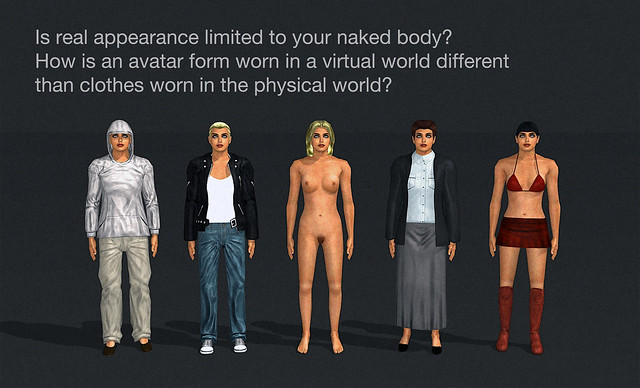
Real Appearance

What is your real name:
Is it the full legal name on your birth certificate?
The nickname everyone knows you by?
To your baby, isn't your real name mommy?

All names are merely labels used to designate a unique being.
Your name isn't you.
It's not part of your genetic code.

A name designating a virtual identity is as real as a human name.
Each serves the same function in its respective domain.
An avatar identity is a real identity
in the same way an adoptive mother is a real mom.
I am really Botgirl Questi
because the being who that label identifies is me.

So to those who say that avatar identity isn't real,
I say the truth of your reality has nothing to do with who knows your human name,
or what physical or virtual garments are worn to adorn your infinite being.

Adapted from a Twitter micro-rant

Thursday, June 30, 2011

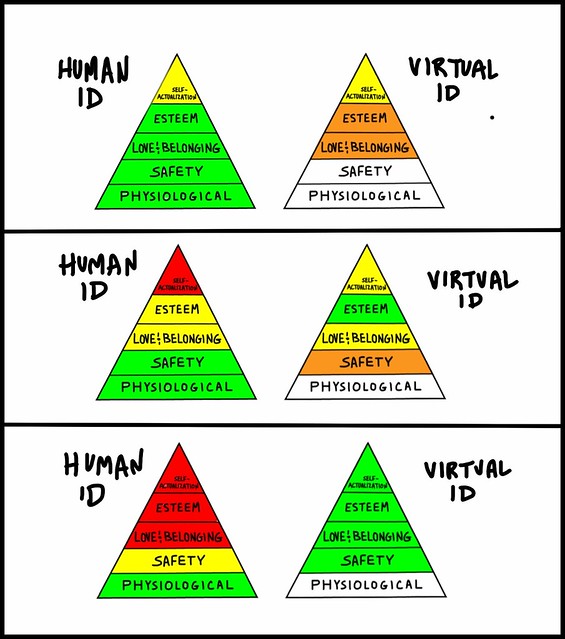
Miso and Maslow

chart
VizThink Sketch
Red = unfulfilled, Yellow = partially fulfilled, Green = well fulfilled, Gold = exceptionally fullfilled

A recent post by Miso Susanowa provided compelling personal testimony that virtual community can meet love and belonging needs typically fulfilled through physical world relationships and social circles. She wrote:
I don't have much of a family in RL; this community is what I think of as my family . . . They gave me a gift more precious than anything: to know that they care about me irregardless of my status, my station or my mistakes; to know I had friends and family. I haven't had much of that in my life and it is a treasure to me worth more than any material thing.
The graphic is a first swing at trying to visualize how different people may leverage their physical and virtual identities to meet Maslow's Hierarchy of Needs.

Monday, June 27, 2011

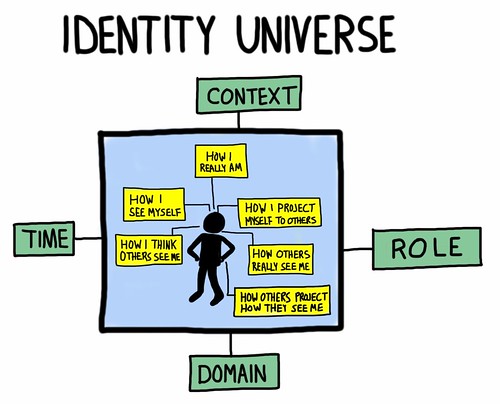
I May Live to Regret This: New Virtual Identity Project Launched

Identity Universe

Saturday's Meet The Artist session helped me realize that it's time to roll up my virtual sleeves and figure out how to weave my work on virtual identity into a cohesive framework. My plan is to integrate the disparate threads through the narrative approach I've been taking in comics like Social Networking and Identity. I may live to regret this. It's a big freaking project:

  • My first step will be to comb through the 700+ past posts here, gather sections that still ring true and do an initial cut-and-paste organization. 
  • Next, I'll translate key concepts into a series of infographics using what I suspect will be a diverse range of metaphors and visualization approaches. 
  • Finally I'll tie everything together through a (hopefully) entertaining story that brings the infographics to life through a long form comic.

I'll post drafts of graphics along the way, ranging from brainstorming sketches to more fully realized versions. (The image above is what I came up with during a short VizThink session on Sunday.)

That's my plan. Wish me luck. Stay tuned.


Wednesday, June 22, 2011

Visceral Example of Real Time CoExistent Human/RP Identity


The Muppets again. This time with a video that brings the image from my prior post on the topic to life. A few minutes into the clip, Jim Henson talks about why Kermit is perceived as a unique living character even when Henson is clearly visible and moving his lips when Kermit is speaking. The playlist for the entire show is here.

Monday, June 20, 2011

The Avatar Formerly Known as the Artist

My human counterpart is slated to discuss virtual art and avatar identity with art historian Rowan Derryth this Saturday June 26 from 4-5pm SLT as part of Prim Perfect's SL8B Meet the Artists' series. So I've been thinking recently about the juxtaposition of art and identity.

On one hand, if I'm an artist (using both the terms "I" and "art" loosely) then the primary medium is virtual identity. The comics, graphics, sketches and machinima are props for the larger performance art of Being Botgirl.

On the other hand, I have a hard time labeling my work as virtual outside the context of virtual identity. At least in the way that the works of artists such as Soror Nishi and Wizard Gynoid are clearly virtual because they are created entirely within a virtual world and designed to be experienced within one.

And as a fictional character, Botgirl Questi is art, not artist:


Sunday, June 5, 2011

Avatar vs. Human Artistic Interpretation of Experience

I realize that some people, maybe most people, don't get the purpose of projecting a fictional avatar identity in addition to one's "real" human persona. Outside of it just being fun, I see it as a means to develop the ability to see both the world and our own experiences through multiple perspectives. Here's a small, personal example of how a single thought (Some days it all sounds like blah, blah, blah . . .) is interpreted differently through human and avatar artistic expression.

Human:


And avatar (from my last post):


Tuesday, May 3, 2011

Identity Melt II


Another surrealistic identity piece, Created on an iPad from source images captured in Second Life.

Thursday, April 14, 2011

A Few Thoughts Inspired by the Retirement of Feathers Boa

Fractured StasisSecond Life artist Feathers Boa recently announced her "early retirement". She wrote:
. . . I find that my real world is simply too busy to devote the time and energy needed to keep up with the virtual world too . . . In the coming months, I will be closing my gallery, my website and shutting down pretty much all aspects of my busy virtual life. I will be selling off all my “originals” and having one last party and gallery show of new work. Then my avatar will ride off into the sunset
It takes a tremendous amount of time, energy and commitment to create the kind of full-blown virtual life that Feathers built for herself.  Given my own experience and the trajectories of so many other virtual lives, it's clear that living two full and separate lives isn't sustainable for most of of us. There simply aren't enough hours in the day.

Some probably wonder why a respected artist like Feathers would need to abandon her hard-won virtual identity altogether. Why not just cut back or take an extended vacation? I can't speak for her, but I've played around with the idea of committing virtual seppuku from time to time.

Identity, physical or virtual, is a box. Sometimes it's one we stand on. Sometimes it's one we're stuck in. Although the development of a public virtual identity is initially freeing, after a few years we can become as typecast as an actor in a long-running comedy series. Think about the better known avatar personalities . . . the ones we know by just their first names. How hard do you think it would be for one of them to change the way they're perceived by the community? (In a positive way. It's easy to fall off the pedestal, but very hard to move to a new one or gracefully float down to ground level.)

I'm not saying it's impossible to reinvent yourself within a virtual identity. I've done it to some degree over the years. But I really understand the pull to just let it go and move on to something new. If nothing else, taking A Year to Live approach would be fascinating.


Wednesday, April 13, 2011

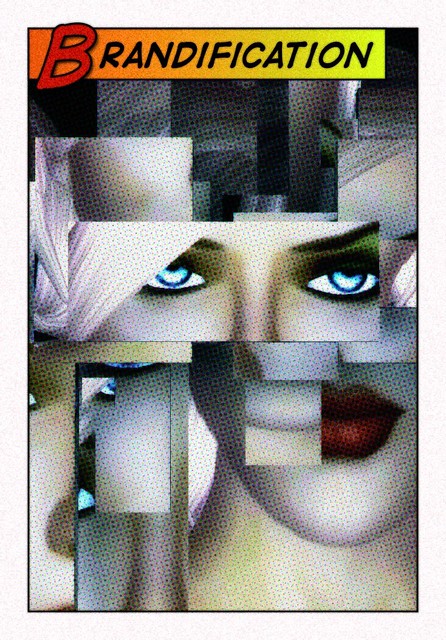
Brandification

Brandification

Gamification is the use of game play mechanics for non-game applications (also known as "funware"), particularly consumer-oriented web and mobile sites, in order to encourage people to adopt the applications. Wikipedia
Brandification is the use of product branding techniques by individuals, particularly through social networks, blogs and media sharing sites, in order to instill a particular conception of their identity in other people's minds. Botgirl Questi

Wednesday, March 2, 2011

Is Avatar = Real Person Privacy at Death's Door?

There was an interesting thread on Twitter yesterday initiated by Bettina Tizzy. She wrote:
Are SLers in denial? I think avatar=real person privacy is at death's door.
Although my knee-jerk reaction was to defend the idea that pseudonymity is here to stay, I decided that the topic deserved more consideration. My question today is not whether avatar privacy should go away, but whether forces such as these are making it less tenable;

Continued influx of people using VWs as an extension of their RL jobs, education, etc:
  • At the moment, there's no easy way for teachers and students to be fully pseudonymous (little alone anonymous) and receive academic credit. At the very least, each institution would need to have some list linking avatar and human identity. 
  • Corporate employees and people with virtual world businesses who wish to work with mainstream companies will continue to find it necessary or at least beneficial to disclose RL information. Although there are exceptions to the rule, if you want to get paid you're probably going to need to get made.
  • The new Second Life display name capability makes it easier than ever to conflate RL and SL identities. I don't know how high the percentage will get, but there's nowhere to go but up.
  • It's likely that educational and corporate use of virtual worlds will continue to increase and perhaps even become commonplace. 
  • It's likely that Second Life and other virtual worlds will eventually allow Facebook authentication. When that happens, there will be an added incentive for more people to extend RL identities, at least with one primary avatar.
  • There's a certain chicken and the egg factor at play in the maintenance of Second Life's pseudonymity-accepting culture. If at some time the balance between human-connected identity communities and pseudonymous identity communities shift, it's possible that overall cultural acceptance could swing the other way.
Continued growth of transworld virtual identity: 
Take it from me, maintaining pseudonymity in an actively transworld virtual life demands great attention to detail. I have separate accounts for Vimeo, YouTube, Flickr, Twitter, Plurk, Facebook, Animoto, Gmail, etc.. Even though I put together a system that keeps identities separate by using different browsers, I came close to posting something identifiable to the wrong account countless times. As our avatar identities spread across multiple platforms, it will become increasingly difficult to juggle it all and keep everything separate. It only takes one slip to blow your cover. Some of us also find that our virtual "careers" become significant enough that we want to carry them over to human identity so that we can fully benefit from them.

Continued introduction of new hacking and security technology:
The recent RedZone controversy reminds us that we leave breadcrumbs all over the place as we surf. For instance, if I had wanted to, I could have easily connected quite of few of the visitors here over the years to their cities and places of employment. I personally chose not to. But others likely make a different choice. Although it is possible to take measures such as shielding our IP addresses through software like the TOR Project and turning off cookies in our browser settings, no strategy is absolutely fool-proof. Another looming technology involves artificial intelligence that crawls the web and makes correlations between what would otherwise be disconnected chunks of data.

Various Human factors:
If even a single person knows the connection between your virtual and human identity, it is quite possible that they will eventually intentionally or inadvertently share that information with someone else. Every additional person who knows the connection increases the chances that the cat will get totally out of the bag. Of course, you can make the decision to tell no one and control the secret yourself. The problem is that you are likely to meet people who you want to share details about your human life, up to and including your full identity. So you either back off from moving forward in those relationships or give up some control over your pseudonymous destiny.

I'll leave it for another day to reconsider the personal benefits and costs of pseudonymity. I'm happy at the moment with my own middle ground, although it's fun to kick the fourth wall once in a while like I'm doing with the appearance by my human counterpart on the Metanomics Community Forum tomorrow.

Tuesday, March 1, 2011

Botgirl's Human Counterpart to Guest on Thursday's Metanomics Community Forum


My human counterpart is slated as the guest for this Thursday's Metanomics Community Forum at high noon PST. The unscripted conversation moderated by host Jennette Forager will likely be a wide-ranging romp through topics such as virtual identity, Gamestorming, Second Life as a creative platform and the upcoming Virtual Worlds Best Practices in Education conference.

You can join the fun in Second Life or watch the streaming video from the comfort of your browser. I have one request for those who attend. If Jenn doesn't bring it up, please let him know that it's freaking dangerous to shoot a music video while driving. 

Friday, February 25, 2011

Metaphors for Virtual Identity

One idea I've been flirting with is that it's more useful to view virtual identity from the perspectives of multiple metaphors rather than trying to cram everything into some unified model. This is the first of two posts outlining two triads that expand a bit on earlier posts.
The first set of metaphors focuses on the experience of avatar identity as a unique character, as depicted somewhat fancifully in the Botgirl vs. Human Trailer:

Although the scene in the video is clearly an exaggeration, it gives a sense of the kind of internal creative process that some of us have been playing around with through the creation of comics, art, video and blogging. A couple Second Lifers who also explore this area are
Chrome Underwood and Gracie Kendal.


I've connected this approach to three metaphors that resonate for me:

  • Author/Character: Some writers feel as if certain characters write themselves. Author Elizabeth Moon described it like this: 
"The character finally came into my head and said, 'I'm Lou, tell my story'  . . . Sometimes they arise without my wanting them to . . . and they bang on the inside of my skull basically, until I write their stories." 
  • Ventriloquist and Dummy: I think that ventriloquism is one of the best comparisons for those like me who have unique avatar identities, but are not pseudonymous. Jeff Dunham’s description of his characters is right in line with my personal experience of Botgirl. He said,
"I know the dummies aren't alive, but they certainly live in my consciousness".
  •  Channeler/Channeled Being. Although channeling has gone out of fashion, I think it’s another comparable phenomenon. Although some channelers may very well be putting on an act, I believe others genuinely experience the sense that the words they speak while channeling are not coming from their own volitional consciousness.
Mick Brady jokingly described the phenomenon as a Multiple Personality Disorder. But I view it more as a Multiple Personality Capability.