Saturday, April 30, 2011

Second Life and Social Networks

It was a real kick to see the #SLBumpersticker craze take off this week. It was a great affirmation of two key ideas I've been trying to promote over the last couple of years:
  • Transworld Identity. Thousands of avatarians communicate and build community each day over social networks such as Twitter, Plurk and Facebook. Social networks are not only used to to interact with those we know from prior contact in a virtual world, but are now one of the main mediums used by avatar-identified beings to meet and get to know one another. Although there's nothing like hanging out with friends while rezzed in the virtual flesh, the virtual world paradigm is not conducive to the pervasive loosely-coupled contact we enjoy on social networks. 
  • Twitter as a platform for creativity. The challenge of formulating a funny or thought-provoking idea in < 140 characters can be a very satisfying and productive creative exercise. I've found it to be such a fertile source of ideas that Twitter has become a core part of my standard creative workflow. I usually write immediately after waking in the morning. I start with a #hashtag topic and then spend half an hour or so writing tweets. I use the Tweetr iPhone client to schedule each tweet for later delivery. That's how I can post a micro-rant over the course of a day even when my human counterpart is tied up in meetings for hours at a time. Tweets can then be used as the basis for blog posts, videos and graphics.

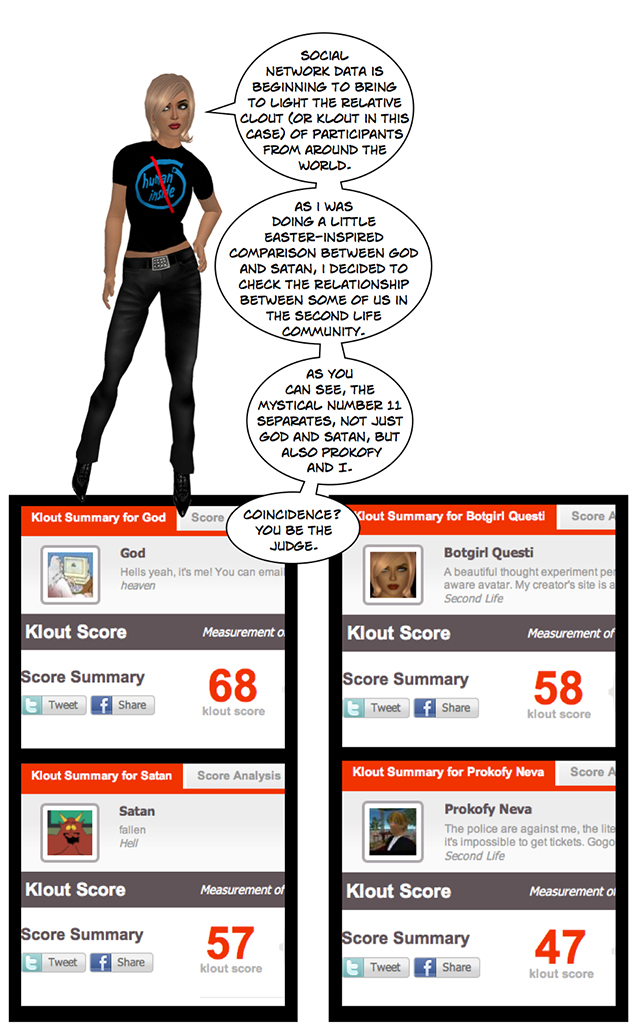
Here's one of my first comics on the topic of social networking, from January 2009:

Thursday, April 28, 2011

1970s Style Virtual World Marketing


I was playing around with the video from the last Deep Tweet and this is what I ended up with.

Monday, April 25, 2011

The impact of pervasive net-connection on human culture and consciousness

Today's post expands Saturday's micro-rant on the impact of pervasive net-connection on human culture and consciousness. I used the term #tribenet as a tag representing the psychological environment created by continuous connection to social circles via multiple devices and social networks. 
Pervasive net-connection is profoundly transforming us individually and collectively. Like any significant technological change it not only impacts what we do but also who we are. We cook in the medium of #tribenet like lobsters in a simmering pot. We are so contextualized within the change that the transformation is almost invisible to us except in retrospect.

Like all cultural and psychological change created through new technology, #tribenet works through the medium of our biology and psychology. For instance, the desire to expose the mundane events of day-to-day life to our virtual tribe likely stems from deep rooted psychological templates unfulfilled since hunter/gatherer days. Tribe 1.0 was social adaptation to the pre-agrarian tech environment; #tribenet is adaptation to the pervasively networked tech environment.

When our attention is focused on #tribenet we are not fully present in the physical world. We check in with #tribenet every hour like young children making sure mommy keeps watching as we go from ride to ride at the playground. Shifting our minds hundreds of times each day to the virtual environment of #tribenet alters the subconscious ground of our mental models of reality. If a tree falls in a forest and someone is there to hear, there is still no sound until they upload the video and share it on #tribenet.
(After posting yesterday, I found out that there was an existing social network called tribe.net. This post is NOT about that site.)

Friday, April 22, 2011

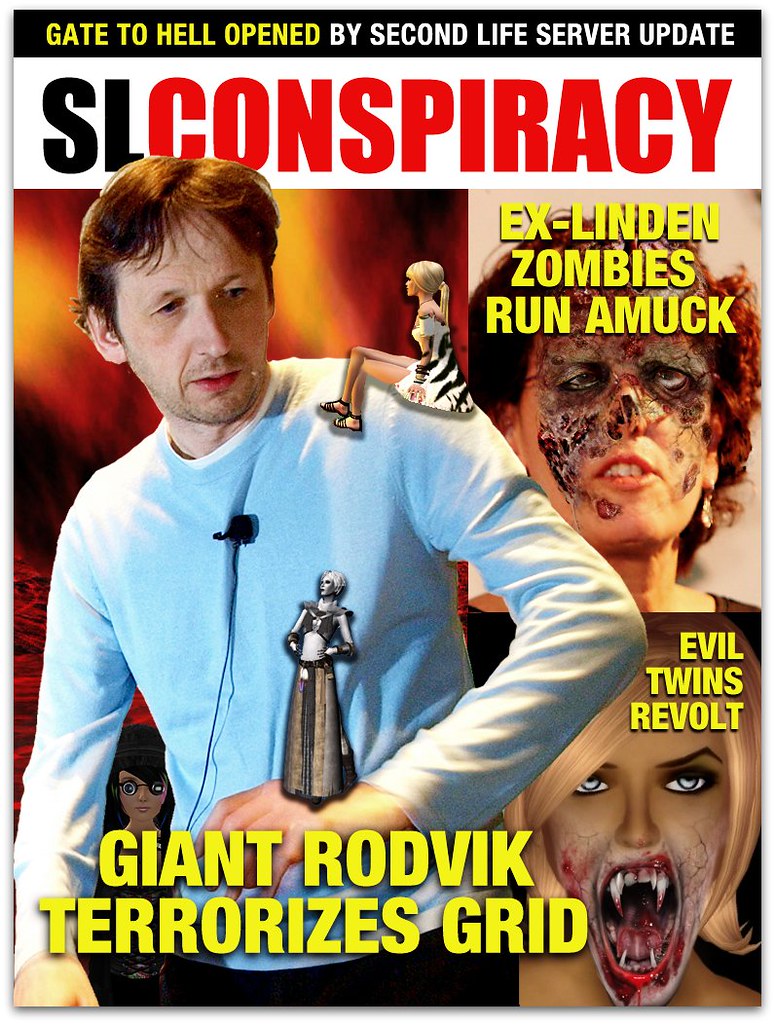
SLCONSPIRACY ISSUE 02: Ex-Linden Zombies, Giant @rodvik and More!

SLCONSPIRACY ISSUE 02

Rod Humble photo by Vincent Diamante, utilized under Creative Commons license. Photos of Skate Foss, Honour McMillan and Miso Susanowa courtesy of the subjects. Source for non-Zombie Robin Linden Image © ARS Electronica.

Thursday, April 21, 2011

Transmedia Ecosystem 01: The Medium and The Message

CLOUD1
May 2008
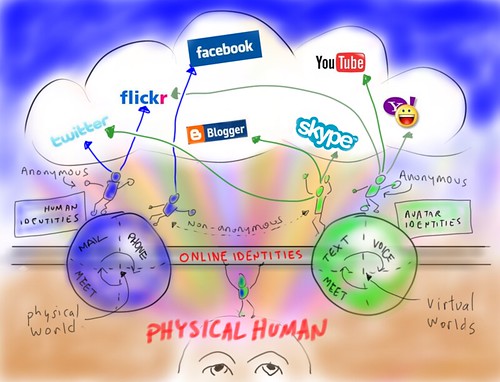
It took just a few months of being Botgirl to realize that avatar identity can extend far beyond Second Life. The image on the right was my first attempt to visualize the play of identities across social networks, blogs and media sharing sites.

As you can see, my initial interest revolved around who and where. Although sites specializing in specific mediums like graphics or video were depicted, the focus was more about audience and identity than form and content.

Over the past year or so, I've started to play around with channeling a particular creative concept through different mediums. One of my first experiments in that direction was the TweetStory. The idea was to tell a story one tweet at a time at a pace of no more than two tweets per hour. There were many interesting challenges. For instance, each tweet had to be interesting on its own right since the majority of followers wouldn't be reading them all in sequence.

The next link in the transmedia chain was blogging. I consolidated each day's tweets into a blog post, giving readers a page at once versus a tweet by tweet rendition. The content was identical, but the reader's experience was very different.

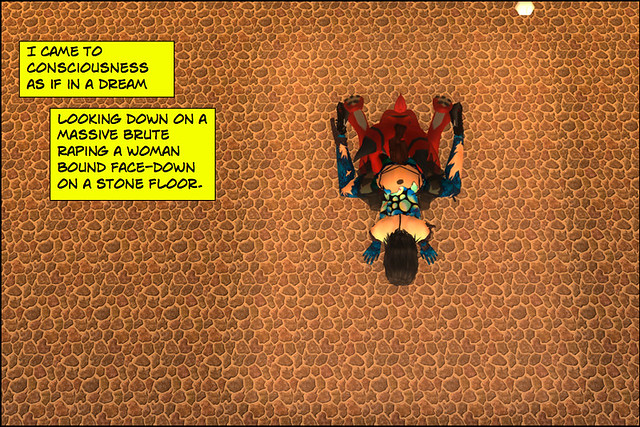
Finally, I translated the first five tweets into comic panels. I intentionally used very surrealistic visuals to illustrate how dramatically a new medium can shift meaning.

Here are the first five tweets in text. Please try to imagine what it would be like reading a few of them over the course of a day on Twitter:
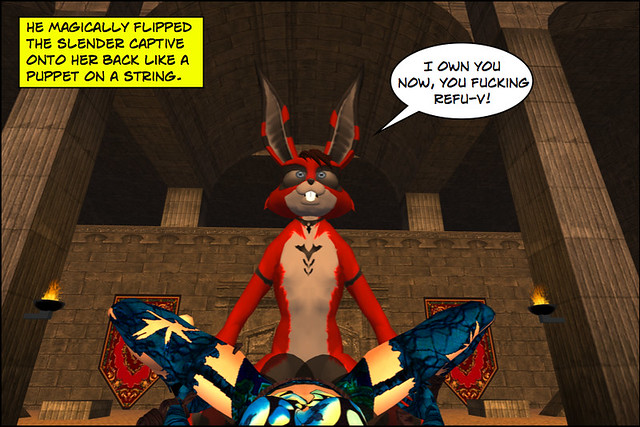
I came to consciosness as if in a dream, looking down on a massive brute raping a woman bound face-down on a stone floor. 
"I own you now, you fucking RefuV," he panted as he magically flipped the slender captive onto her back like a puppet on a string. 
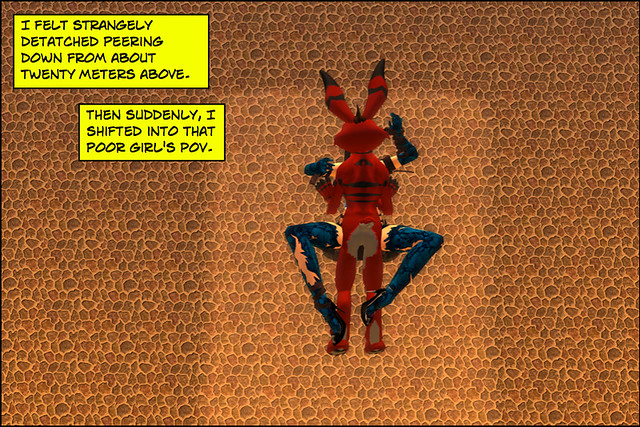
I felt strangely detatched peering down from about twenty meters above. Then suddenly, I shifted into that poor girl's POV. 
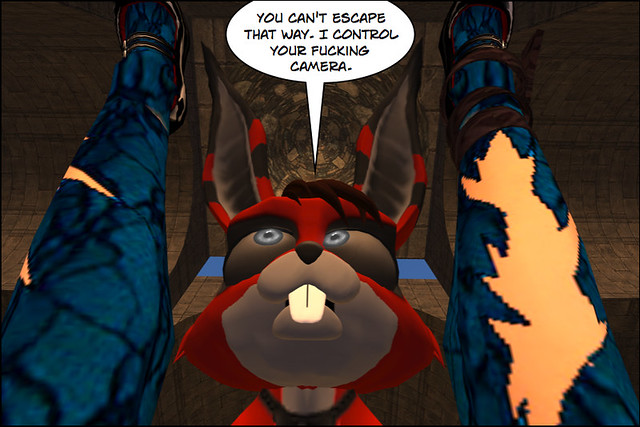
"You can't escape that way," he sneered. "I control your fucking camera." 
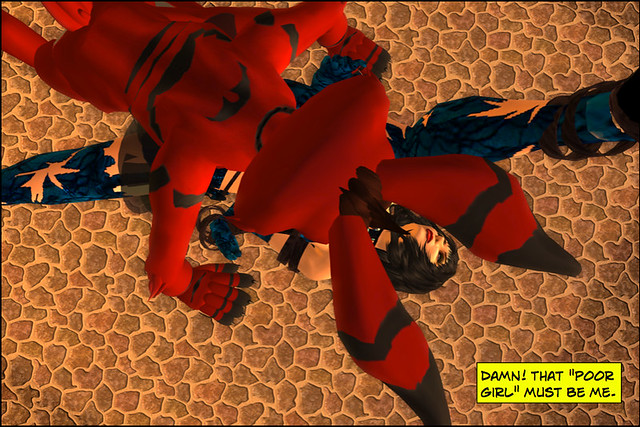
Damn! That "poor girl" must be me.
Here are the comic pages:

Page_1

Page_2

Page_3

Page_4

Page_5

The next post on this topic will discuss a more recent transmedia workflow I've been having fun with.

Monday, April 18, 2011

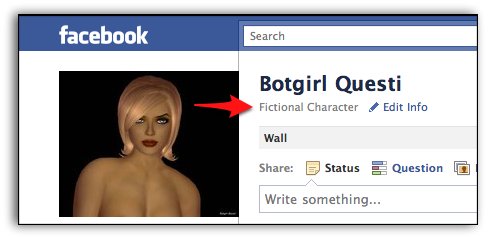
Why I Dumped My Personal Facebook Account For a Fictional Character Page

Botgirl Questi Facebook Business Page
I broke up with my personal Facebook account this weekend. We've been fighting for years. You might say we had irreconcilable differences: I valued my time and wanted to control my awareness; she was determined to waste my time and used any means possible to steal my attention.

She tagged me in photos I didn't appear in just to make me look. She added me to an endless deluge of spam groups that flooded my gmail inbox. She begged me relentlessly to play stupid games and kept my news badge blinking like a strobe light with a constant flow of event invitations. Blah. Blah. Blah.

I hear what you're thinking. I do take some of the blame. Okay. Maybe even most of the blame. It's always been a marriage of convenience. I never loved her. I never even really like her. I just wanted to use her for her connections. But I couldn't handle them. The never ending flood of Photoshopped avatar faces and the mind-numbing cacophony of trivial chatter was too overwhelming.

Finally, on Friday, I pulled the plug. I took the irreversible step of converting my personal account to a business page and claimed my true nature as a fictional character. Even though I lost my Facebook history and every single post, link, photo and video I'd ever shared; even though many of my 1,971 friends would spurn the new one-sided relationship and unlike my new page; it was the right thing to do.

So now that I'm available, come out and see me sometime.

Saturday, April 16, 2011

MICRO-RANT ALERT: Second Life

I had the pleasure of performing a Twitter micro-rant on the topic of Second Life yesterday. Here are some of the posts with bit of added commentary.
  • Jiggling boobs was one of the most media friendly roll-outs LL's made in a while. I've seen the future of SL and it has a nipple!  While I've written recently about the seeming effectiveness of the IMVU approach to marketing, I am NOT advocating that Linden Lab replicate the tactic. Positioning Second Life as the best place to create sexy avatars for hot chat would be like replacing Jodie Foster with Lindsay Lohan.
  • Improving Second Life is like having sex. The more you're talking about it, the less you're probably doing it. This was obviously a dig at myself as much as anyone else. Our internet discussions can't change the Second Life platform. But by creating products, events, art and community on the platform, we can improve our virtual lives upon it.
  • Stop denying it! Second Lifers are clearly resistant to change. That's why most of us are still there instead of on other grids. This was aimed at those who have been complaining about stuff for years but keep paying tier. It is possible to transport a Second Life community to an OpenSim grid, it just takes work and the sacrifice of inventory that won't transfer. A growing number of people in the creative and educational communities have already proven this.
  • Stop blathering on about the future of Second Life. I'm much more correct in my under-informed pretentious speculation than you are. It's natural and beneficial to discuss our collective future through social networks, blogs and other public forums. But it's delusional to believe we absolutely know the one right way to proceed or can predict how the future will unfold.
  • The difference between a Troll and a thought-provoker is the extent to which you agree with them. And that evil laughter thing. Someone last week thought my provocative tweets on pirating constituted trolling. Surprisingly, I actually considered the proposition and ended up understanding how my external actions could be perceived in that way. It comes down to intent. And no matter how hard we try, we can't know for sure what goes on in the hearts of other people. Unless they tell you.
  • Soap Opera is the highest form of Second Life art. This is less tongue and cheek than it seems. The richness of our drama reflects a pretty deep story. We have plenty of comedic, tragic and evil characters who act on the public stage of blogs, social networks and forums. Oh yeah. And in Second Life.

Friday, April 15, 2011

Thursday, April 14, 2011

A Few Thoughts Inspired by the Retirement of Feathers Boa

Fractured StasisSecond Life artist Feathers Boa recently announced her "early retirement". She wrote:
. . . I find that my real world is simply too busy to devote the time and energy needed to keep up with the virtual world too . . . In the coming months, I will be closing my gallery, my website and shutting down pretty much all aspects of my busy virtual life. I will be selling off all my “originals” and having one last party and gallery show of new work. Then my avatar will ride off into the sunset
It takes a tremendous amount of time, energy and commitment to create the kind of full-blown virtual life that Feathers built for herself.  Given my own experience and the trajectories of so many other virtual lives, it's clear that living two full and separate lives isn't sustainable for most of of us. There simply aren't enough hours in the day.

Some probably wonder why a respected artist like Feathers would need to abandon her hard-won virtual identity altogether. Why not just cut back or take an extended vacation? I can't speak for her, but I've played around with the idea of committing virtual seppuku from time to time.

Identity, physical or virtual, is a box. Sometimes it's one we stand on. Sometimes it's one we're stuck in. Although the development of a public virtual identity is initially freeing, after a few years we can become as typecast as an actor in a long-running comedy series. Think about the better known avatar personalities . . . the ones we know by just their first names. How hard do you think it would be for one of them to change the way they're perceived by the community? (In a positive way. It's easy to fall off the pedestal, but very hard to move to a new one or gracefully float down to ground level.)

I'm not saying it's impossible to reinvent yourself within a virtual identity. I've done it to some degree over the years. But I really understand the pull to just let it go and move on to something new. If nothing else, taking A Year to Live approach would be fascinating.


Wednesday, April 13, 2011

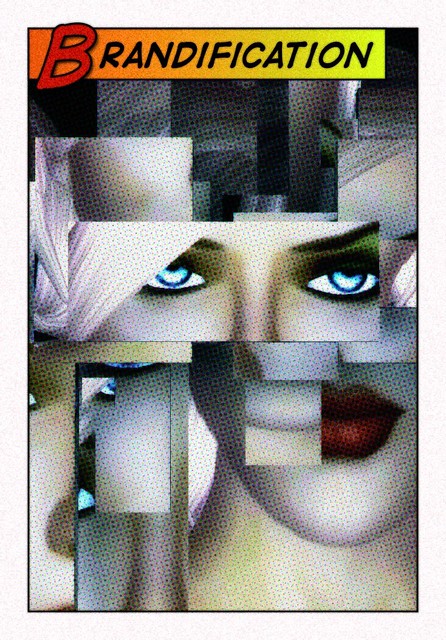
Brandification

Brandification

Gamification is the use of game play mechanics for non-game applications (also known as "funware"), particularly consumer-oriented web and mobile sites, in order to encourage people to adopt the applications. Wikipedia
Brandification is the use of product branding techniques by individuals, particularly through social networks, blogs and media sharing sites, in order to instill a particular conception of their identity in other people's minds. Botgirl Questi

Tuesday, April 12, 2011

The Honeymoon is Over. Now What?

Second Life user concurrence is at a two year low. Although the news probably isn't surprising to anyone who's been around for that length of time, the metrics lend credence to a pervasive gut-level sense of a declining community.

As Crap Mariner proposed, there's a whole laundry list of positive actions Linden Lab could take to fix problems and turn things around. One of them was:
"Know your customers better than they know themselves so you can give them what they want AND need"
I think that's also a good suggestion for community members. Know thyself is an ancient imperative that most of us don't address very well. We chase after experiences that don't create lasting happiness. We deny, avoid and let fester the underlying issues that cause pain and discord. We then project blame for the unhappiness caused by our own lack of self-awareness onto other people and the external environment.

So while I agree that solving the kind of problems outlined in Crap's list would have a positive impact on Second Life growth, I wonder whether the ennui many of us experience is more rooted in the "natural" cycle of life. In RL, friends, jobs, hobbies, favorite restaurants, etc, come and go over time. Many aspects of virtual life seem accelerated, and I suspect that our attention span for particular pursuits may also burn hotter and flame out faster.

So even if lag, copybotting and other such problems were resolved, we'd still have to keep coming up with good answers to the "so what" and now what" questions: Why should we (still) bother coming here, and when we’re here, what we should we do? Although some us have left Second Life for other grids, quite a few people I know have left virtual life altogether because they couldn't figure out how to rekindle the sense of joy that had somehow faded over time.

Our honeymoon with Second Life is clearly over. Maybe it ended faster because of the thousand small cuts of technical problems and repeated Linden Lab missteps, but it was destined to end eventually. So I think part of what we're seeing now is the Second Life community going through the Kubler-Ross stages of grief:

  1. Denial
  2. Anger
  3. Bargaining
  4. Depression
  5. Acceptance

Part of our consternation with each other comes from being at different stages of the process. I'm in denial and you're angry. I'm trying to bargain with the Lindens and you're too sad to think about it. With that in mind, I'm thinking we should bite our tongues a bit more and give each other the space to do the work of each stage as we move collectively towards acceptance. That's when we'll be in the best position to figure out what we truly want and need.

Sunday, April 10, 2011

The Lazy Avatar's Guide to iPhone-Powered Machinima

Machinima ( /məˈʃiːnɪmə/ or /məˈʃɪnɪmə/) is the use of real-time 3D computer graphics rendering engines to create a cinematic production. Most often, games are used to generate the computer animation. Wikipedia
Over the past three years I've experimented with many methods, styles and platforms in the course of creating about 90 machinima. I love making videos and the medium has been a very important aspect of my creative life.

One of my reasons for living a fairly public life through an avatar identity is to encourage and support the use of virtual worlds as a platform for creative expression. Although virtual photography is a pretty universal medium of artistic expression, only a relatively small percentage of the avatar community makes machinima. I suspect the main reason is that the technical aspects of video creation are relatively more complex and intimidating. So I thought it would be helpful to share a quick and easy method I've been using to create simple music-video style machinima using an iPhone, iPad or iTouch. If you're like me and are too lazy for the 48 Hour Film Project, here's my 4.8 Hour Machinima Project methodology:
  1. Teleport into a cool setting
  2. Activate a dance animation
  3. Capture a variety of shots using your mobile device's camera
  4. Start a new iMovie project
  5. Add a music track from iTunes Library
  6. String together some of your shots
  7. Export video
  8. (optional) Use a program like Silent Film Director or Cinema FXV to spice up the look 
  9. Upload to Vimeo, YouTube or Flickr
I was playing around in IMVU this weekend so I decided to shoot a couple example videos there. I used the same avatar look and dance animation in both videos. I changed the set, the effects and the music to create two very different feels. They were each created from start to finish in just a few hours.


Saturday, April 9, 2011

See How IMVU Adult Content Looks to Non-Verified Members

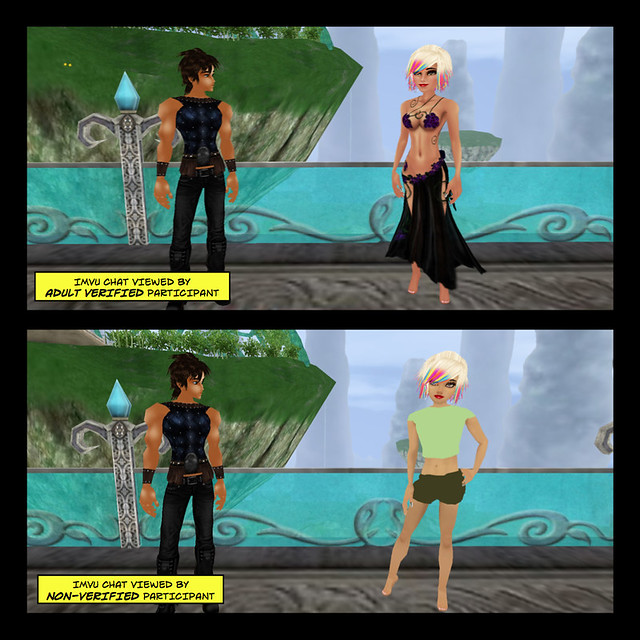
IMVU Adult Verified vs. Not

I've been playing around a bit recently with IMVU. Outside of the fun of exploration, experiencing other platforms is a great way to gain new perspective. So far, I've been noticing quite a few interesting contrasts to Second Life/OpenSim.

One difference is the way adult content is restricted. IMVU sells an Access Pass for $19.95 US, that include age verification and access to special groups, forums and chat rooms.  Non-verified members are not only prevented from purchasing adult-rated items and entering adult-rated rooms, but can't even see restricted content if another person is wearing it. The top image is age-verified Botgirl's view. The bottom capture is from Fourworlds' non-verified chat room window. Pretty wild, huh?

I'll post more on IMVU later this week, including some video.

Thursday, April 7, 2011

Transubstantiation

I finally made it to Transubstantiation last night, soror Nishi's new art exhibition in Second Life. It's a fascinating work with a deep theme:
. . .  as greek mythology tells it, we humans stole The Fire of the Gods, the power to create... and were duly punished, not collectively, but poor Prometheus got severely punished by Zeus. Because we have created virtual worlds, we act as gods.... (I am one of the gods sat here in my Olympus squabbling with the other gods and generally interfering with the lesser avatars below). We create and destroy worlds and conjure emotion and spirituality from prims, well, actually from The Prim. Each Prim is essentially a Cornucopia as its final manifestation is at my whim, my desire. The Prim contains my body and my blood... my essence. How? ....Every Prim I build is actually a REAL part of my psyche... (there is nothing virtual in this argument/statement). .. and so this artistic process is a transubstantiation. I am a god, The Prim is a god, I am in The Prim and I manifest through Transubstantiation. from soror Nishsi's description
There's no way to replicate the experience of seeing the work in the actual space through images or video, so I encourage you to go there and see it in person. Nevertheless, I was inspired to shoot some video and create another retro-future, Nusrat-powered machinima.

Wednesday, April 6, 2011

Creators and Obstructors

In the workplace, there are usually a few people we can count on to constructively support new initiatives. The first response of these Creators is "Let me help make it work." Support may include hard questions to expose risks and flaws, but the intent is to seek solutions and achieve the project's goals.

There are others who consistently oppose new ideas. The first response of these Obstructors is "Let me tell you why it won't work." Their intent in exploring risks and flaws is not to find solutions, but to shoot projects down.

You can see these same tendencies in social network and blog streams that are filled with Obstructor posts seeking to undermine and discredit the ideas and actions of others. Creator streams are dominated by interesting links, creative works and support for innovation.

In the avatar community, Second Life expatriates are a great example of the Creator spirit. Instead of endlessly complaining about Linden Lab's mismanagement, they took charge of their fate and are building new communities on other grids.  I'm especially impressed by those who are putting their money where their mouth is and investing in innovations such as Built Buy Me, Jibe and Kitely.

Those who are innovating within Second Life are also exemplars of the creative spirit, such as Amaretto Breedable Horse fans who raised $82,000 USD for Japanese relief.

I'm not suggesting that we should stop constructive criticism of Linden Lab or withhold comment on initiatives that impact the avatar community. That's part of responsible citizenship. But too many of us spend more time and effort obstructing the efforts of others, rather than working positively to actualize some better vision.

Thomas Paine's advice is still good today, "Lead, follow or get out of the way."


Tuesday, April 5, 2011

Extension

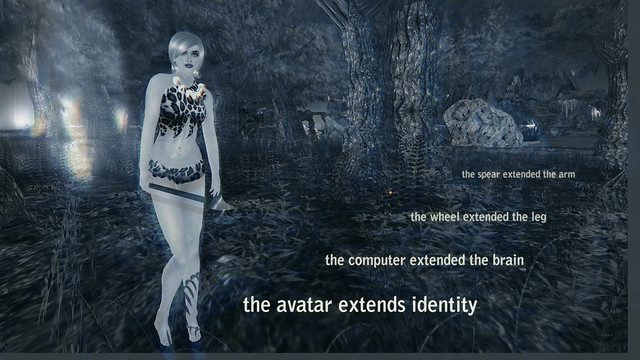
Deep Tweet - Extension
From a Deep Tweet

One day at the dawn of humanity, a distant ancestor realized she could use a stick to dig up insects. That first tool, like all that followed, extended human biology. The bug-grubbing stick extended the hand and arm. Moving forward in time, the wheel extended the legs. Written language extended memory and speech. And today, avatars extend not just the body, but our identity.

The tools we use don't merely extend biological capabilities in the external world, but are experienced psychologically as integrated aspects of our body schema.  As Marshall McLuhan wrote, “We shape our tools. And then our tools shape us us.”