Showing posts with label sociology. Show all posts

Monday, April 25, 2011

The impact of pervasive net-connection on human culture and consciousness

Today's post expands Saturday's micro-rant on the impact of pervasive net-connection on human culture and consciousness. I used the term #tribenet as a tag representing the psychological environment created by continuous connection to social circles via multiple devices and social networks. 
Pervasive net-connection is profoundly transforming us individually and collectively. Like any significant technological change it not only impacts what we do but also who we are. We cook in the medium of #tribenet like lobsters in a simmering pot. We are so contextualized within the change that the transformation is almost invisible to us except in retrospect.

Like all cultural and psychological change created through new technology, #tribenet works through the medium of our biology and psychology. For instance, the desire to expose the mundane events of day-to-day life to our virtual tribe likely stems from deep rooted psychological templates unfulfilled since hunter/gatherer days. Tribe 1.0 was social adaptation to the pre-agrarian tech environment; #tribenet is adaptation to the pervasively networked tech environment.

When our attention is focused on #tribenet we are not fully present in the physical world. We check in with #tribenet every hour like young children making sure mommy keeps watching as we go from ride to ride at the playground. Shifting our minds hundreds of times each day to the virtual environment of #tribenet alters the subconscious ground of our mental models of reality. If a tree falls in a forest and someone is there to hear, there is still no sound until they upload the video and share it on #tribenet.
(After posting yesterday, I found out that there was an existing social network called tribe.net. This post is NOT about that site.)

Thursday, May 6, 2010

This is Your Brain on Social Media

(image by Emilio Garcia under Creative Commons license.)
I'm pretty convinced that the consistent and pervasive use of social media subtly shifts the mental ground of human consciousness. But as Marshall McLuhan often noted, our present environment is usually invisible. So I devoted most of yesterday's tweets to playing around with the medium through some tongue-in-cheek tweets considering some of the aspects we usually don't attend to. Today's post is based on yesterday's tweets tagged with the #psychsoc hashtag.
This is your brain on social media. There's a lizard and a chimp in your brain who don't really get net-centric social media. They interpret the interactions as if they were the meatspace analogues. So there are all kinds of bio-physical processes that can get activated in the course of your socially networked day that impact your experience of self and the world.

What are you looking for here? No. Try again. What are you REALLY looking for? People are attracted to social networking for many reasons, most of them probably unconscious. Humans are generally blind to the complexity of motivation behind their actions and social networking is no exception.

You like me? You really like me! There is a subtle message of personal acceptance in the choice people make to follow or friend us on a social network. And vise-versa. Although this may be accurate in some cases, for those of us who socially network with strangers, there is a huge divide between perception and reality. The decision to follow or unfollow usually has little to do with the actual being we are.

AntiGestalt: To the social network, you are equal to the sum of your posts. At least for those who only know us through our updates. It's funny, but unless I pay attention, I fall into the assumption that everyone who follows me on a social network has read and absorbed my two years of blog posts, machinima, comics, etc. FAIL.

Ring that RT bell, dog! I'm ready for my positive reinforcement now. I've been noticing that the chime indicating a retweet or @reply has a more impact than the mere audible stimulus would otherwise induce.

We are hunting, gathering and farming here. Each tweet is prey, plant and seed, depending upon one's perspective.  Social media is the latest extension of ingrained behavioral processes that are as old a humankind.

Warning! Do not read the rest of this tweet as it contains a subliminal mental virus. I'm not joking. I mean it. Zap! From a cultural perspective, the content of any social media post doesn't really matter. The medium is the message. And the message is not consciously perceived.

Who are you really tweeting to? Go on. Spill it. You'll feel better. Although posts go out to one's entire list of followers (and potentially anyone on the internet), I suspect that many tweets have a particular person or subgroup as a target.

I'm a hypnotwitst. Look deep into my tweets and count backwards from infinity to zero. Snap. You're awake!

.

Wednesday, March 31, 2010

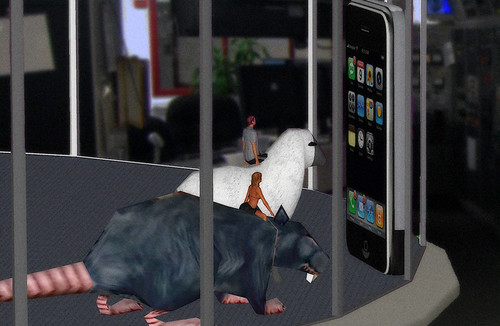
Are we not 1984 Sheep? We are Brave New World Rats!

rat and sheep 01
 Pervasive computing is like a giant Skinner Box.

I've been working all week on a post about the shift from mass-media-fueled propaganda to the operant conditioning environment of pervasive social computing. It's taking a lot longer than expected, so for now, here's one of the images I've been working with as I VizThink my way through.

The spark for this idea came from the following video:

Monday, December 28, 2009

Thoughts on How The Avatar Film Relates to Avatars in Virtual Worlds

Avatar to Avatar
The role of the artist is to create an anti-environment as a means of perception and adjustment. Without an anti-environment, all environments are invisible. Marshall McLuhan
We cannot escape subjectivity. Our perception is inherently bound by limited points of view. We are fundamentally most blind to the pervasive psychological and cultural environment in which we swim like fish in water. Countless subconsciously held beliefs and preconceptions invisibly color, shape and create our experience.

Virtual worlds can act as Mcluhan's anti-environment in relation to our human experience by opening our eyes to otherwise hidden aspects of life in the physical world.  Embodiment as an avatar can expose unseen assumptions that significantly shape our experience of self and others in digital form. (Of course, this enhanced awareness can only emerge when we refrain from being as lost and identified in the story of our virtual identity as we are immersed in the story of our human life.)

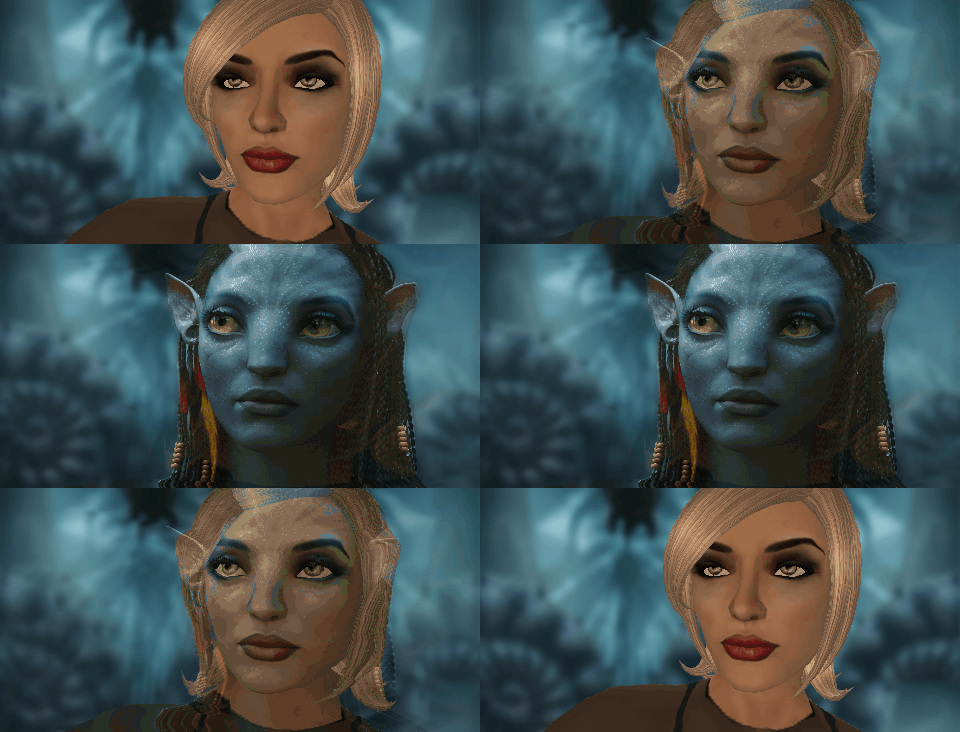
Avatar (the movie) seems to have acted as an anti-environment for me in relation to virtual worlds. It brought to light fundamental aspects of virtual life I've never considered and which are likely to inform my ongoing quest to make sense of avatarian existence. I'm still trying to translate a few flashes of insight into a revised mental model, but here are a couple of my initial thoughts:
  • The moment-to-moment flow of facial expression was the key effect that brought Pandorans to life in the film. Although I've written a few times about the limitations of Second Life avatar body language to express authentic human emotion, until seeing the movie I didn't really understand the power of small, expressive, integrated movements of eyebrow, mouth, gaze, head tilt, squint, etc. to communicate subtleties of feeling and breathe visceral life into a character. Real-time motion capture of the body is impractical for most virtual world activity, but facial capture supported by a web cam (or the hat cam used to create the film animation) would be a game-changing breakthrough in the evolution of digital avatars in virtual worlds. 
  • Virtual environments provide only an infinitesimal shadow of the deeply connected complexity of a physical ecosystem. The vast chain of cause and effect that underlies the real world "circle of life" is absent. Is there a way to transcend the Disney World aspects of constructed virtual worlds so that a genuinely holistic system can be born?  The virtual ecosystem of Pandora was modeled on a complex interdependent evolution-based system. Environmental entities in Virtual Worlds are mostly isolated nodes with little or no interdependent connection or interaction with the rest of the environment, outside of physics-based effects like a tree blowing in the virtual wind. It would be very interesting to create an open virtual world like Second Life that is composed of a dynamically evolving ecosystem created by a something like the Spore platform.
  • No matter how immersed one is in a virtual identity it cannot be unwound from a lifetime of inculturation and psychological conditioning. Even the most NPIRL Second Life subcultures such as Furries and Tinies are intrinsically entangled in human biology, psychology and culture. The unique rules built into game-based worlds such as Entropia and World of Warcraft can certainly act as laboratories to experiment with personal and social psychology. But I think it would take induced amnesia and 24/7 full sensory immersion to really explore trans-human potential. Any volunteers?
Anyway, these are some of the ideas that have been echoing through my mind since viewing the movie a couple of times. How about you?

Wednesday, October 28, 2009

The Danger of One Story

This great talk by Nigerian writer Chimamanda Adichie describes how our perception of the world can be warped by the domination of stories from a single point of view. Although the ill-effects are certainly much more consequential within the physical world, the message also has great relevance for virtual world communities.

Thursday, June 5, 2008

Botgirl's Bookshelf: The Second Self - Computers and the Human Spirit

Written over 20 years ago, The Second Self by Sherry Turkle is dead-on relevant for those of us interested in exploring the social and psychological dimensions of today's virtual worlds. It brings to life the intimate interbeing of person, society and technology. It exemplifies a research methodology that integrates immersion and inter-subjective analysis. To put it simply, Sherry Turkle rocks!

On a personal note, I was hooked at the start by an idea she brought up in the introduction to the new edition:
"...there are virtues in learning to see the commonplace as unfamiliar...to defamiliarize the mind itself and thus reveal what would otherwise be hidden in the light."
I couldn't have summed up the Botgirl Thought Experiment better myself.