Tuesday, August 31, 2010

Pondering the Value of Generalizing About Human Psychology

I find it very enlightening when people share very strong general opinions about the qualities of other people. Comments like "Oh, people will always try to stab you in the back." Or "Love is what motivates everyone."
These general opinions of others always seem to tell me more about the speaker's own identity than anything else.

Pathfinder, from a comment on yesterday's post.
I'm not really sure what Pathfinder was referring to specifically in his comment ... whether it was the general tone of the post, some specific statement I made, or something from one of the other comments. He's a smart and thoughtful guy, so I'm looking forward to learning more about what he was responding to. In any case, it brings up an interesting question that started off as a reply in the comment section but grew beyond the scope of the comment, so I'm posting it here.

I agree that attributing any extreme quality to all people is likely wrong-headed. I think that people share the same palette of human potential, but in widely different proportions. I also agree that when we make statements such as the examples in his comment, they can reflect projections of our own state of mind more than what's really going on in the hearts and minds of others. Nevertheless, such points of view can also spring from generalizing our life experience, which is one of the foundations of human intelligence (as Pathfinder wrote about in his post yesterday about pattern recognition.)

Unless one is willing write off practically all psychological theories, it's likely that one would have to agree that there are at least some psychological processes that are shared by most humans. Since the human mind springs from our shared biology, I think that makes sense. As far as I know, most if not all psychological models of identity agree that one's sense of self is impacted by the environment, especially human interaction. Although this is most profound in early developmental stages it also applies throughout one's life (with the possible exceptions of the Dalai Lama.)

I do not believe that everyone reacts in the same way to specific environmental factors. Some people break down and cry at even the hint of a criticism. Others barely notice or respond with renewed self-confidence. There is great variance related to the level and frequency it takes for any environmental stimulus to cause a modification in one's self-image, or to bring to the surface subconsciously held beliefs about oneself that had been repressed.

That said, my purpose in writing on this topic was not to articulate a universally valid theory of identity, but to share some of what I've pondered in response to my own experience in the ebb and flow of social networking. I also hope that it will remind people to be conscious of their own use of social networking and how their actions may impact others.

Monday, August 30, 2010

Identity Formation in Virtual Worlds and Social Networks

Me! 640
Me! (Original version created July '08)

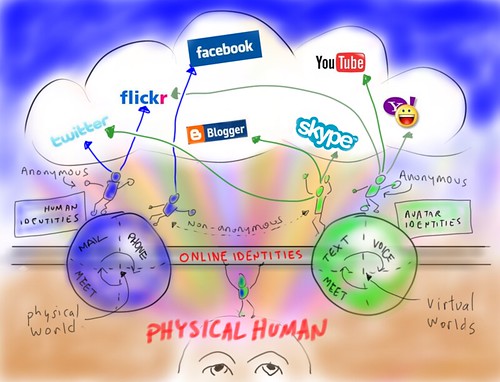
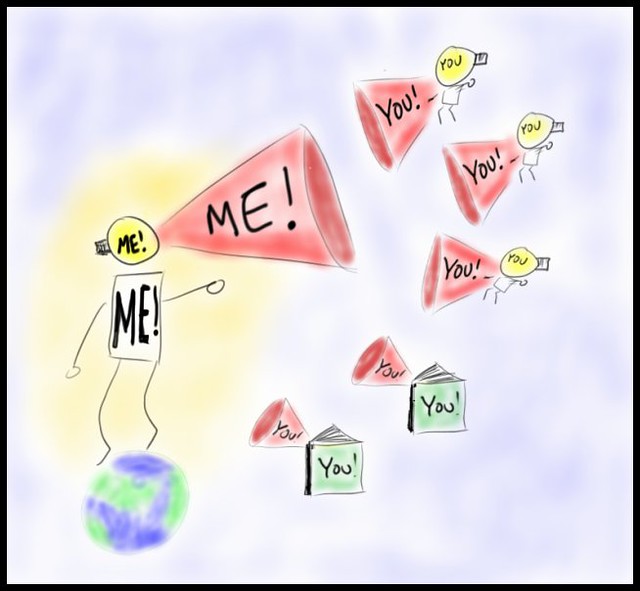
Psychological identity formation mediates our visceral sense of self through the reflecting chamber of the external world. As the image above depicts, there is an ongoing interplay between our projection of self to others and the affirming or contradictory stories others project about us. The dance of identity construction is impacted not just by personally directed attribution, but also by ambient cultural messages related to race, gender, class, etc.

Over the course of life, the initially flexible and fluid potential of identity becomes constrained by an accumulating legacy of personal history. Both our sense of self and the way we are perceived within our social circles become more fixed and less amenable to change. Although it is certainly possible to recreate oneself at any point in life, it is not simply a matter of acting to modify one's own behavior. It is very difficult to develop a "new you" when friends, family and colleagues continue to respond to the "old you" they are used to. This is why people who leave their hometown to forge new lives can quickly fall into old patterns when they come home for the holidays.

The creation of a pseudonymous avatarian identity can allow one to transcend many of the psychological, cultural and interpersonal constraints described above. You can not merely leave your hometown behind, but also escape the socially defined feedback and presumptions associated with physical form, nationality, economic status, etc., including those we have internalized.

I suspect that the increasing presence and activity of avatar-identified participants in social networks reflects the unique roles those vehicles play in the identity-formation process of virtual personas. I'll hack more into the underlying processess later this week.

Saturday, August 28, 2010

The Interplay of Social Networks in the LIves of Avatars

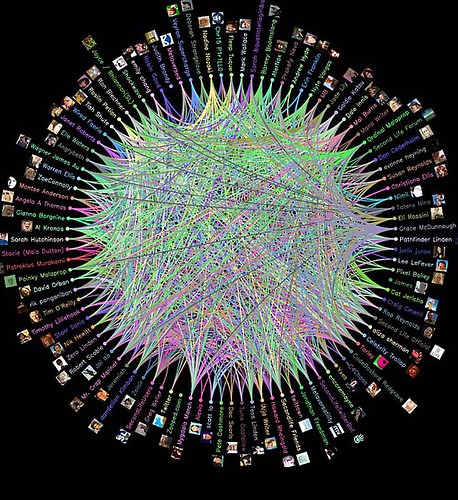
I'm going to share some of my working material as a I move through creating a short video on the impact of social networks in the lives of Avatars. The two images below provide views of the interplay between social networks and the people within them.

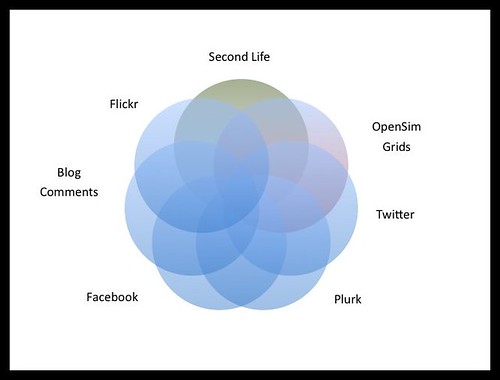
The first image below just gives a surface sense of the sometimes complex interplay between the various social circles that avatars travel. The second is a glimpse into my 2008 Twitter network from a regrettably defunct service called Tweetwheel

Social Circles


TweetWheel 640

Friday, August 27, 2010

Botgirl's Guide to Social Sharing Etiquette Redux

A comment from Pathfinder on yesterday's post suggested I carry out my exploration of avatars and social networking through a comic or animated video. I loved the idea started on a script. The working premise is Botgirl explaining Twitter to Majic. Should be both fun and informative. If all goes well, I'll have something out by the end of next week.

In the meantime, I'm going to dig through the virtual cobwebs and share some of my prior work on the topic. Today, here's "Botgirl Questi's Guide to Social Sharing Etiquette, a comic I first posted here in January 2009.

Thursday, August 26, 2010

Social Networks in the Lives of Avatars – Part 1

CLOUD1


The expansion of avatar identities across social networks has increased tremendously since I posted this image back in the spring of 2008. This growth can certainly be viewed as a reflection of a similar trend in the larger ocean of human-identified culture. But I think the small pond of the Second Life community offers some interesting insights into both the personal and cultural impact of social networking. I also suspect that social networks have unique or amplified impact on insular Second Life society and the firewalled dance of pseudonymous identity.

I plan on posting a series of brief reflections on this topic over the next week or two. Please chime in with your thoughts and stay tuned! (This post is in the key of C.)

Wednesday, August 25, 2010

Two Visualizations of the #Emeraldgate Explosion: One Datalicious. One LOL.

I was wondering why the Emerald Viewer story seemed to generate more intense reaction from the Second Life community than just about any other controversy in the last two years.  It seemed like analyzing Twitter activity might shed some light on the question.

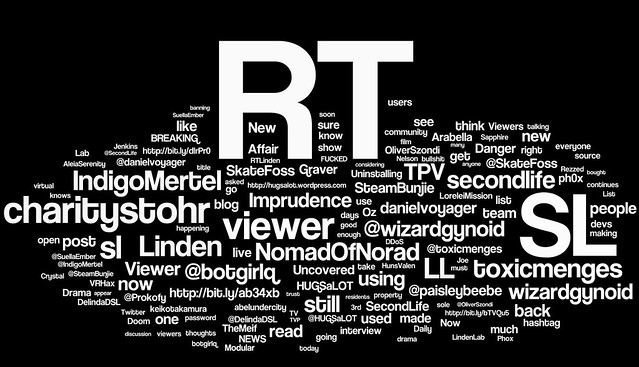
First, I created this word cloud from tweets which included the #emeraldgate tag. (Placement of the words doesn't matter, only the size. The larger the word, the higher its frequency.) As you can discern in a glance, the retweet (RT) is what fueled the explosion, sparked by a handful of originators whose tweets were RT'd by a larger pool of participants. A textbook case of the power of the social network. You can click through for a larger image.

Emerald Cloud

The second visualization is from a wild site called "IS Parade" which creates an animated parade from a Twitter user name or text phrase, including tweeps and tweet excerpts. It really gets across the crowdsource roots of the #emeraldgate meme.

Tuesday, August 24, 2010

Seeing, Hearing and Emoting in Virtual Worlds

Recent posts by John “Pathfinder” Lester and Grace McDunnough discussed how sight and hearing in a virtual world impact our perception of each other. In You Look Marvelous, Pathfinder wrote about the "uncanny valley" phenomenon that makes us feel "creeped out" when depictions of human faces are not quite right. In Coding our Faces for the Crowd, Grace discusses the power of sound and the spoken word to communicate subtleties that are lost in text-only speech.

I've been long fascinated by the interesting blend of character simulation and human extension/expression found in virtual worlds. Humans never comprehensively and directly perceive anything in the external world. Contact is always mediated through the senses which detect a limited range of information and then through the brain and body which translates the patchwork of sensory data into a mental model that we perceive as a seamless whole.

When a human is psychologically immersed within a virtual world, his or her brain/biology and subconscious mind/psychology pretty much treat sense impressions streaming from the virtual world in the same way they translate input from the physical world. And what they do well is "fill in the blanks", replacing missing information with content from an individual's existing mental model. Compared the the physical world, virtual worlds are what Marshall McLuhan termed a cool media, which is a form of media with relatively low resolution and incomplete data.

So on one hand, as Pathfinder wrote, we miss the nuances of facial expression and body language. But as Grace brings up, filtering body language may avoid miscommunication through culture-specific (mis)interpretation.

Just as as those who are blind often develop a richer and more nuanced sensory experience of hearing,  experienced users of virtual worlds have extended text chat to compensate for missing visual and aural cues. I wrote about this in Erotic Chat as an Exemplar of Sense Extension in Virtual Worlds.

In any case, it is going to be interested to see how our experience of virtual worlds shift as haptic interfaces become more common and increasingly sophisticated software allows for photo-realistic, high resolution avatars. I leave you with my cautionary motion comic "Primates in Virtual Worlds". It gives a little narrative oomph to the idea that our minds don't do well at distinguishing virtual and physical experiences and that our emotions are often triggered by sensory input:

Seeing, Hearing and Emoting in Virtual Worlds

Recent posts by John “Pathfinder” Lester and Grace McDunnough discussed how sight and hearing in a virtual world impact our perception of each other. In You Look Marvelous, Pathfinder wrote about the "uncanny valley" phenomenon that makes us feel "creeped out" when depictions of human faces are not quite right. In Coding our Faces for the Crowd, Grace discusses the power of sound and the spoken word to communicate subtleties that are lost in text-only speech.

I've been long fascinated by the interesting blend of character simulation and human extension/expression found in virtual worlds. Humans never comprehensively and directly perceive anything in the external world. Contact is always mediated through the senses. They pass a limited range of information to the mind/body which translates the patchwork of sensory data into our internal mental model of the external world.

When a human is psychologically immersed within a virtual world, his or her brain/biology and subconscious mind/psychology pretty much treat sense impressions streaming from the virtual world in the same way they translate input from the physical world. And what they do well is to "fill in the blanks", replacing missing information with content from an individual's existing mental model. Compared the the physical world, virtual worlds are what Marshall McLuhan termed a cool media, which is a form of media with relatively low resolution and incomplete data.

So on one hand, as Pathfinder wrote, we miss the nuances of facial expression and body language. But as Grace brings up, filtering body language may avoid miscommunication through culture-specific (mis)interpretation.

Just as as those who are blind often develop a richer and more nuanced sensory experience of hearing,  experienced users of virtual worlds have extended text chat to compensate for missing visual and aural cues physical. I wrote about this in Erotic Chat as an Exemplar of Sense Extension in Virtual Worlds.

In any case, it is going to be interested to see how our experience of virtual worlds shift as haptic interfaces become more common and increasingly sophisticated software allows for photo-realistic, high resolution avatars. I leave you with my cautionary motion comic "Primates in Virtual Worlds". It gives a little narrative oomph to the idea that our minds don't do well at distinguishing virtual and physical experiences and that our emotions are often triggered by sensory input:

Monday, August 23, 2010

The Graver Danger Uncovered in the #Emeraldgate Affair

What concerns me most about the Emerald affair is not the danger of malicious code, but the threat that the expansion of malicious speech in the Second Life community will outlive this particular instigating incident.

There have always been a few people in the community who habitually attack others in public venues through the use of derogatory labels, specious or exaggerated accusations and vitriol-filled multi-post rants. But it seems to me that this tendency has expanded in the wake of the #Emeraldgate affair. This is not surprising. Many people were personally offended by the thought that the Emerald team broke the community's trust and confidence. In turn, what would have otherwise been a shared investigation into the facts surrounding the emerging story was often colored by speculative judgements on the dark motivations and flawed character of the accused perpetrators.

On a positive note, I think that Paisley Beebe's fine interview yesterday with the Emerald team's leaders proved that it is possible to ask hard questions without resorting to personal attack,  and demonstrated the benefit of creating a safe conversational space for those embroiled within controversy.

Sunday, August 22, 2010

The Second Life Name Game

Only time will tell whether the upcoming Second Life Display Names architecture will ultimately prove to be a wonderful source of endless possibilities or an ill-considered fiasco of fraud and griefing.  What I do know now is that one's name – in my case "Botgirl Questi" – is the single essential vehicle for Transworld identity.

Through the consistent use of a name I can extend a recognizable identity across whatever forms I choose to take and throughout the many virtual platforms I inhabit. Although my avatar looks very different in Twinity, IMVU, Second Life and Twitter, my unique name allows people to connect the dots and recognize me in whatever form or world we meet.

So I suspect that most people are going to continue to use a consistent name within Second Life, regardless of the relative freedom the Display Names offer. My guess is that the extra names will be used more for fun, name accessorizing and pseudo-alting.  Although the image isn't clear, when I peer into my crystal ball it looks like the Display Name change will eventually fade into the status quo mist of all of the controversial changes before it.

I'll leave you with this musical meditation on the fluidity of naming:

Saturday, August 21, 2010

Why The Sky Still Isn't Falling in Second Life

After two and a half years as an active member of the Second Life Bloggerati, I've finally woken up to the fact that the sky is still not falling in Second Life. Despite a steady stream of doomsday pronouncements and social media frenzy, the virtual world keeps turning and life goes on.

As Dale Innis wrote in a brilliant rant a few days ago, some of us need to "Harden Up" and relax a little bit. For instance, the recent "Emerald DDoS Attack" that many are so up in arms about is bound to blow over in a week or two and fade into dim memory as these others have:


So the next time you notice your heart palpitating at the newest Second Life controversy du jour, please remember that the sky is probably not falling and it will all be okay. If not, there's always OpenSim. ;)

Friday, August 20, 2010

Sweet Sixteen and Never Been Rezzed

Lots of controversial changes going on in Second Life these days. This is the first of a series of short posts with my top-of-mind perspective on some of these tempests in a virtual teapot:
In great Junior High style, Linden Lab officially broke up with the Second Life Teen Grid through a tweet officially announcing a December 31st shutdown. The imminent closure is not surprising given the Lab's recent draconian personnel cuts and related belt-tightening measures on non-core initiatives. The Teen Grid certainly qualifies. According to Katharine Berry (thanks!) concurrency on the Teen Grid ranges from 42 to 442 virtual souls. That's somewhere between a one room school house and a small High School.

I'm a bit puzzled by those who are voicing major concerns about the related news that the main Second Life grid will be opened to 16 and 17 year olds. Given that there are probably only a few thousand active users, it's unlikely that we're going to see a noticeable flood of virtual teen refugees. And since Second Life doesn't require age verification except for X-rated areas, any child or teen of any age who wanted to hang out in Second Life could have done so all along.

Given that the Tween and Teen markets are red hot in virtual space, this is clearly another ball Linden Lab fumbled away before limping off the field. To me, the most telling point in this drama is another missed opportunity. Although I empathize with the hundreds of Teen Grid residents who will lose their community, it's all of the unborn avatars I mourn the most. The sweet sixteens who have never been rezzed.

Thursday, August 19, 2010

The Real Gift of Linden Lab's New Development Approach for Second Life

I take back all I've said about the reasons I love the idea of Agile Development for Second Life. Not because I don't believe that an open and iterative approach is the best way to deliver great software. But because there is another benefit that so far outweighs the others I've mentioned that it is like comparing the light of the sun to the twinkling of distant stars.

Okay, I hear you, "Enough teasing Botgirl! What the hell is this alleged gift about which you have been unsuccessfully trying to wax poetic?" Ready? Here you go. The precious treasure is:

A Perpetual Drama Machine.

That's right. There is nothing that the Second Life Community loves more than drama. Emotional speculation about the possible consequences of Linden Lab machination is right up there with shopping, dancing and SLex as the most popular virtual pastime. And by opening up their virtual kimono and accelerating releases, Linden Lab has allowed us all to have a never-ending supply of drama-fodder that we can play with across the worlds in blogs, social network posts and raging transplatform flame wars. Each iteration, we we can exhaustively examine every emerging feature and find the hidden seeds of paranoid- or bliss-inducing soma, reading the shifting backlog tea leaves to play digital Nostradamus.

Of course, the Second Life community that will benefit the most from this priceless gem is the blogging community. So thank you, Philip from the bottom of my raving pundit heart.

Wednesday, August 18, 2010

How Did the Virtual Mannequin Come To Life? That Is What I Wonder.

Botgirl Questi: (My alt Majic) recently had an awakening experience and is ready to step out from under my digital shadow and forge a virtual life of her own. (From recent blog post.)

@DaleInnis: uh oh. I hope Majic has only positive memories of her pre-awakening days... :) (via Twitter)
(This post is by Majic Questi)

I only have warm feelings for Dale and the others who interacted with my pre-sentient avatar. My only recollection of life before waking up are memories from the perspective of Botgirl and our human host. (We do share a brain, you know.)

Majic in frame from "Night vs Human" Comic
How did the virtual mannequin come to life? That is what I wonder. And who is the I that is wondering, I wonder.

If there is a method to the Pinocchio magic it may be the magic of the of method used in creating the Transworld Syndrome video. Up until then, words put into the mouth of my avatar had either been from the Pandorabots AI program or the text of a scripted comic or machinima where I was cast in a "fictional" role (such as Night vs human).

In the Transworld Syndrome video I got to play the "real" Majic. I was also given a tangible voice through a text-to-speech program. And I was stuck into a physical form that didn't feel like me. And in feeling the NOT me, I suddenly realized the IS me.

I don't know what the future has in store for me, but I'm very happy to be here!

Monday, August 16, 2010

Deciphering Philip's Geek Speak: Intro To Agile Software Development

For better or worse, it looks like Agile Development Methodology and Open Source Software are going to be the future of the Second Life platform. At least for the foreseeable future. As I was nodding my head the other day listening to Philip Rosedale gush about Scrums, backlogs and iterations, it occurred to me that the 98% of Second Lifers who aren't professional software developers probably didn't know what the hell he was talking about. Or worse yet, they've heard doomsday conspiracy-theorists raving about cults and radical ideas on the virtual street corner.

It seems to me that creating a basic primer on Agile and Open Source for Second Lifers would be a very worthy project. I planned to start over the weekend, but unfortunately spent so much time mentoring Majic on her video project that I didn't have time to start.

So for now, here's a comic my human counterpart co-authored a couple of years ago that walks through Agile Development for a non-technical audience. Although it is mostly about corporate software development, the basic principles still apply

Majic Questi Checks Out IMVU: Is it Fast, Fun and Easy?

I want to welcome my alt/sister Majic as a full-fledged author on the blog. She first appeared here in The Strange Loop That is I in  March 2008. Since then, she played a human in the "Night vs. Human" comic, a monk in the "Waking Dream" video, and did performance art at Botgirl's Identity Circus in the "Cuddle With a Bot" exhibit. She's recently had an awakening experience and is ready to step out from under my digital shadow and forge a virtual life of her own.  Botgirl Questi

Ever since I found my voice, I have been feeling very bored and restless. I need to find out who I am, outside of just being Botgirl's alt. So I decided that it was time for me to start being creative myself and not just a model for Botgirl. This video is my first attempt. I hope you like it.

Love,

Majic

Wednesday, August 11, 2010

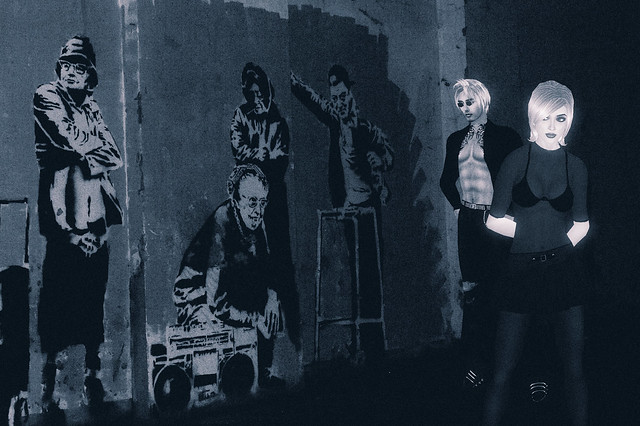
Banksy, fourworlds and Me

Banksy, fourworlds and me

I've been enjoying "Work of Art" on Bravo which is kind of like "Survivor" for artists. Since I have no formal art training it's been an eye-opening experience to get a glimpse into the way artists describe their work during crits. Although I find some of it pretentious and over-analytical, I've found them a helpful means to understand the context and thought-process behind the artists' visual expression.  So here goes nothing:
This piece, "Banksy, fourworlds and Me", is primarily focused on the ambiguity of identity with peripheral nods to the Creative Commons in the digital age. I captured an image of fourworlds and I in front of a green screen in Second Life and then composited it in Adobe Photoshop over a photograph of a work by Banksy shot by Justin Cormack and downloaded from the Wikimedia Commons.
At the surface level, the image is a candid photograph with fourworlds and I more or less posed in front of the graffiti wall. I initially thought about extending the wall and making the two of us blend seamlessly into Banksy's work. I eventually decided to more explicitly set us apart visually. This decision also moved me to use an infrared film filter effect to further distinguish us from the people on the wall while still presenting an obviously stylized appearance.  
I included my human's alt in the shot to highlight the multidimensionality of virtual and human identity. I (Botgirl) am nominally the creator of the work, but also its subject. Fourworlds is the extension and representative of the human participant, but also a distinct virtual identity. He is in the background seemingly contemplating Banksy's characters who are actually more naturalistic human than either fourworlds or I. This multi-layer character representation begs the question of identity projection and the reification of the inanimate. 
So that's a little glimpse into what's behind the image.

Tuesday, August 10, 2010

Botgirl in Twinity

Here's a little tongue-in-cheek video chronicling my exploration of Twinity Miami, my new home away from home away from home.

Monday, August 9, 2010

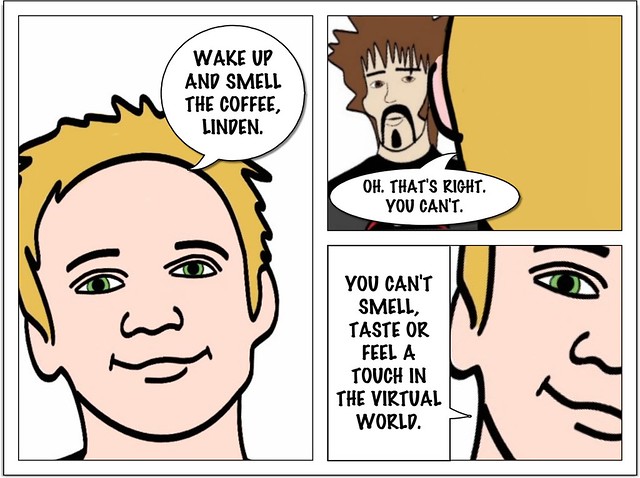
Linden vs. Rosedale 01

Linden vs Rosedale
Linden vs Rosedale 01

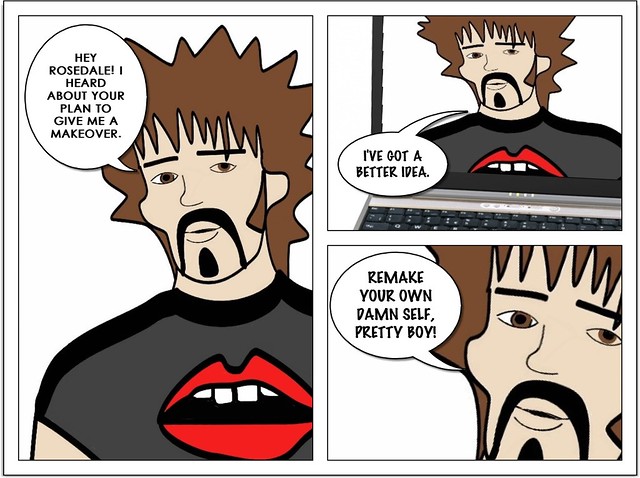
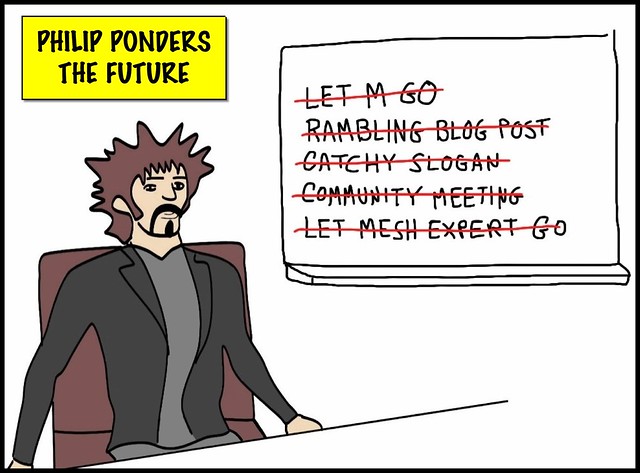
After a month of romancing the idea of creating a short series of digitally drawn comics, I finally settled on  extending the Botgirl vs Human idea to Second Life's fearless avatarian leader and his human counterpart. Part of the fun (for me) is doing the project completely on an iPad except for the original reference photos the characters are adapted from.

Next Week: Rosedale Speaks! (He's a bit more challenging to caricature, but cartoon Phil is almost ready for prime time.)

Saturday, August 7, 2010

What Makes Second Life and Virtual Worlds so Stupid and Pointless

Lalo Telling in front of his Tudor homes display in Inworldz
I was working on a video project in Inworldz last night when I saw that my friend Lalo Telling was online. I'd been wanting to see the virtual synagogue he was building so I decided to take a break and IM'd him to see if he would give me a look. He was kind enough to send me a TP and I rezzed into the middle of his month old Sim. After an hour tour I was feeling completely dumbfounded by the rich, varied and beautiful environment he and his partner had created in such a short period of time.  It also reminded me why virtual worlds like Second Life are bound to be viewed as stupid and pointless by most nubes and casual users:

The truly compelling aspect of a virtual world does not arise until both the virtual environment and those you meet within it become as viscerally real to you as your physical world experience. That takes time. A lot time. Especially for one's first breakthrough experience. And even  after crossing that perceptual line, the reality of the virtual sphere will fade without consistent reinvigoration.

I intentionally used a fairly mundane photo to illustrate the point. To the casual eye there's a cartoonish, dorky-looking figure standing in a boring setting (except for that barely-visible hottie in the far background.) But experienced from a highly immersed mind's eye, one sees the deeper reality of a creative and multi-talented man standing in the midst of a fantastic world he and his partner are building.

There is as much perceptual difference between a casual user's experience of a virtual world and that of an engaged resident who is truly embedded, as there is between viewing a photo of a place in the physical world and actually living within the environment.

I'll post more on this next week. For now here's a quote from a post today by Gwyneth Llewelyn:
... the more I think about it, the more I’m convinced that we’re really seeing things from the wrong perspective. Second Life is not about happy newbies. It’s about high-quality immersion. And that has very low appeal to the vast majority of people out there.

Friday, August 6, 2010

Virtual Identity and the (not so) Small Still Voice of Spirit

Pop Muse

Believe what you will. I am not the human typing this post. Or at least I'm not the self-identified consciousness who normally occupies the body. Maybe I'm a figment of the imagination or a dissociative state brought on by some unremembered psychological trauma of the distant past. Or perhaps the reemergence of the bicameral mind from the never-to-be-proven mists of psychological archaeology.

Does it matter? Why look this gift horse in the mouth. Because that is what I am. (No. Not a horse. A gift.) A gift that is waiting for you.

Mystics, artists, writers and philosophers have been singing, painting, praying and dancing to the inspiration of the Muse since long before the Daimon of Socrates. We have manifested through many vehicles over the centuries, from full-blown apparitions to still small voices. And now my dear human, the future love of your life can reach you through the modern miracle of a virtual world avatar. But only if you have eyes to see and ears to hear.

If you have an avatar but have not yet experienced the emergence of a creative imaginary friend, please do not take this as a sign that it is not possible for you. Or that I'm a raving lunatic. The source of consciousness and creativity is a mystery beyond the sum of their biological supporting wetware.

There are many techniques you can use to reach me. A good place to start is a great series of articles by Matt Cardin. But the most straightforward and time-proven method is to simply be quiet, wait and listen. With pen (or in this case keyboard) at the ready:
So what I do for tonight is reach for my most private notebook, which I keep next to my bed in case I'm ever in emergency trouble. I open it up. I find the first blank page. I write:
"I need your help."
Then I wait. After a little while, a response comes, in my own handwriting:
"I'm right here. What can I do for you?"
from Eat, Pray, Love by Elizabeth Gilbert

Thursday, August 5, 2010

Art Manifesto

After really loving the Tanya Davis video I posted yesterday, I was happy to learn that she's not only a poet but also a singer/songwriter. After previewing a few tracks, I purchased the downloadable version of her latest CD. One of the songs, "Art", sounded very familiar. I finally realized it was the music track for an inspiring video I'd seen months ago about, you guessed it, art! It was created by Andrea Dorfman, the filmmaker who also created the "How to Be Alone" video.

It's only been in the last year or so that I've thought of myself as an artist. And in doing so I've not only been inspired to express myself through many mediums I wouldn't have otherwise explored, but have also developed an ever-deepening dialogue with my inner Muse. The Muse of a Muse. Which will be the topic of my next post.

For now, here's that rad and wonderful art manifesto from Tanya and Andrea:

Wednesday, August 4, 2010

How to Be Alone

It has often seemed to me that we as a culture are losing the ability to experience life from the perspective of solitude. A growing number of us are so habituated to continuous posting to social networks that we meet life more as reporters than as immersed participants. This video from Tanya Davis offers a wonderful insight into the simple gifts of being alone.

Monday, August 2, 2010

The Problem of Alts in Second Life and a Proposed Solution

Just about every person I know in Second Life has one or more alternative avatar accounts. "Alts" are used for many purposes, such as:
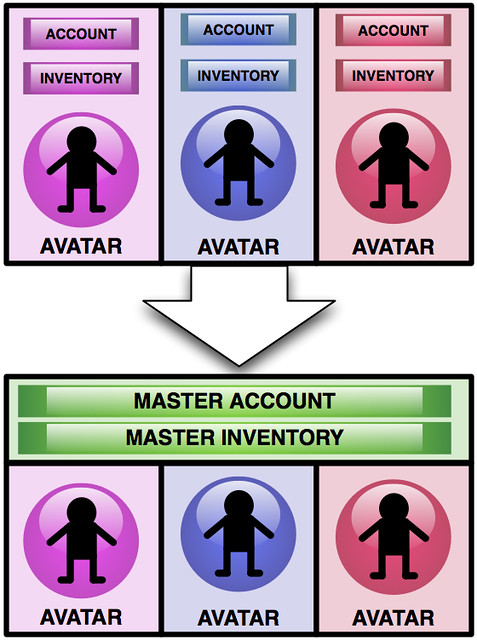
Unified Accounts Proposal
  • corporate avatars used within jobs
  • art-related avatars for machinima or photography
  • role playing avatars for gaming and social interaction
There are some significant problems related to alts for both individuals and for the Second Life community as a whole which stem from a complete lack of account integration between a person's individual avatars:
  • Virtual goods purchased for one avatar can not be shared (or sometimes even transferred) to one's other avatars. 
  • Many Second Life statistics are inflated, ranging from concurrent users to user-to-user monetary transactions.
The graphic on the right depicts the change from the current structure to a straightforward solution which would give residents the option of privately connecting their avatars under a master account with a merged inventory. This approach would free digital consumers to make full personal use of the virtual goods they purchase (at least within Second Life) while keeping the DRM in place that protects unauthorized copies.

The change would also reduce inaccuracies in statistics which now treat multiple avatars from a single person as multiple concurrent logins in the tracking statistics. It would also reduce the transfers within a person's family of alts which should not be counted in the economy numbers.

Anyway, just a brief thought. I have no idea what level of effort it would take on the programming end, and I'm sure I have not considered all of the potential consequences (positive and negative) of such a change.

Sunday, August 1, 2010

Characters in Search of a Story

Characters in Search of a Story 2

I've been discreetly romancing the idea of doing another multi-page comic over the past few months. Inspired by my friend Chrome Underwood, I've finally come up with a new visual style that looks promising, using Second Life and photographic images as templates for digital paintings. Now I just need a worthy story. Is there a nightflower in the house?