Friday, July 30, 2010

Why Philip's Talk Makes Me Optimistic About the Future of Second Life

Fast Easy Fun

No, this is not a parody. Although he didn't have me at "fast", I was pretty sold on Philip's vision and strategy after the first ten minutes of today's hour long inworld community meeting. Although I was tempted to make a joke about fast/easy/fun when I first heard the slogan, I'd be hard pressed to come up with a better mantra to guide development.

Of course, a catchy slogan doesn't take you very far without a concrete plan of action. And I liked what I heard there too. Focusing for the next few quarters on stability, bug fixes and speed makes perfect sense. The reference to specific metrics was very reassuring. Throughout the talk, he repeatedly talked about the importance of finding meaningful ways to measure and evaluate their performance.

I've been advocating the idea of Agile software development for Second Life over the past month so I was very happy to hear Philip talk about moving to shorter, iterative development cycles with user feedback guiding ongoing development.  He also committed to an open development process so that the community can see and comment on what is being worked upon each cycle and so that the open source community can contribute in a meaningful way. I think that if they really put the user into the customer role in their Agile process (which I don't think has been the case up to this point) and adhere to the fast/easy/fun litmus test for business decisions, the gap between our low expectations and high hopes might be bridged.

My Take on an Achievement System for Second Life

As much as I love the wonders of the brave new social stream world there's something about gaming systems that make me feel, um, gamed. Allowing a badge or points system (like Plurk karma) to influence behavior seems really icky. Here's a video I made on a different topic, but provides some relevant imagery.

Thursday, July 29, 2010

How To Save Second Life in One Simple Step

Hamlet/Wagner Au posted an article today in Social Times on "How to Save Second Life in Seven Easy Steps." As a responsible pundit, I thought it was my duty to come up with a more efficient approach to save the beleaguered virtual world from doom. Why bother with seven steps when you can get the job done with just one. The 80/20 rule is so pre-millennial.

My brilliant plan takes the core aspects of the most successful social networking and gaming ventures and injects them into a single paradigm-changing action:

Change the name from "Second Life" to "SocialMediaGamingVille 3D!"

Brilliant, huh?  It is much easier to change the name than to change the platform, the culture or even the CEO. This is something we can implement immediately. Since Second Life has almost complete global name recognition, I have to assume that anyone who isn't in there yet has some sort of negative association with the name Second Life. So let's give our world a name that reflects the cutting edge of modern times.

It could work. For the price of a couple thousand business cards and some minor design changes, we can be in business!

Moving Between Worldz

In Transit
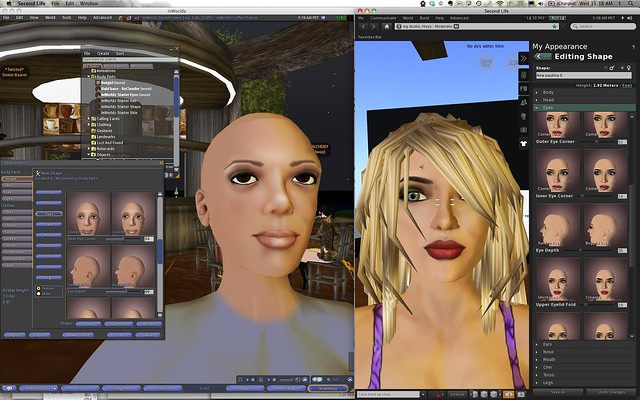
Screen Capture During Manual Transfer of Shape from Second Life to Inworldz Avatar
After reserving my name on Inworldz last week I finally downloaded the software and logged on. It reminded me what a pain in the virtual ass it is to move between worlds. Guess I need to go find where I left my Second Inventory installation.

Wednesday, July 28, 2010

The Impact of Pseudonymity on Second Life Growth

Become Your Avatar Banner
One of the "Become Your Avatar" Marketing Banner for Second Life
I've been somewhat puzzled by the recent focus of Second Life marketing on look-alike avatars. Although there's an untapped market for virtual mirrors, there's really no easy way for a nubie to acquire one. Certainly not as polished as the doppelgänger depicted in banners like the one above. So it seemed like attracting people to Second Life on the basis of something they would quickly find untenable was a bad idea.

I've also been a bit confused by the push to make Second Life more like Facebook. Very few of the people I know who are avid Facebook users seem very interested in Second Life. And those I know who are active in Second Life seem unlikely to want to bump into their mom or neighbor while in avatar form.

So why was M. and his team so hot on creating an influx of people who connected their human and virtual identities?  Well, I can't speak to their actual motivations, but I've come up with something that makes sense to me.

From a marketing standpoint, the most compelling benefit of increasing the number of Second Life residents who will connect their human and virtual identities isn't merely that they comprise an untapped market. The game changing factor is the potential for Second Life to tap into the type of word-of-mouth marketing that has fueled Facebook's viral growth.

Most businesses depend upon personal referrals to supplement their own marketing efforts. But the high level of pseudonymity within Second Life undermines this "natural" process of growth. Many (most?) residents extend "What goes on in Second Life stays in Second Life" to the fact that they even visit the virtual world. So word-of-mouth is untenable.

Despite the positive potential of word-of-mouth marketing, I still think it's a very risky idea for Linden Lab to take actions that significantly increase the percentage of non-pseudonymous residents. If there's one thing that would cause a massive exodus of current residents to other virtual worlds, it would be a change in culture that makes them feel uncomfortable in their pseudonymity.

Tuesday, July 27, 2010

Scapegoats and Magic Beans

For every complex problem, there is a simple solution. And it's always wrong. (Paraphrased from quotes from H. L. Mencken and Albert Einstein)
The space between the departure of M. Linden and the upcoming community meeting with BK and Philip has left a vacuum many of us have filled with analysis and speculation about the future of Second Life. I do believe that an unexamined virtual life is not worth living. But when we move from evaluating our own thoughts, feelings, actions and motivations to judging the inner-workings of the world around us we must be especially careful not to fall into the realm of fairy tale. Because in the absence of complete information, our mind tends to fill our mental models with the archetypal magic of the subconscious. We can become blind to the gaping chasms we jump over in our leaps of logic.

I was reminded of this process while contemplating the conversation over the weekend in the blogosphere about the reason for Second Life's land and population woes. Here are a couple of the many magical story elements that tend to run through  our discussions:

  • Scapegoats. Whether it's the FIC elites or the high cost of land, we tend to put a microscope on some real or imagined culprit as the root of all (or at least most) evil. The fairy tale is that if we would just kill the scapegoat everything would be fine and we could live happily ever after. This tendency is exaggerated by the polarizing nature of net-based conversation and communication. I'm doing it right now.
  • Magic Beans:  The other side of the coin is the idea that if Linden Lab management would just plant this one magic bean, Second Life would be lifted from its fallen state and claim its lofty potential at the summit of the virtual world pantheon. Examples of magic beans include first hour experience and the elimination of lag.

My point is not that we should stop thinking about how we can help solve problems and create solutions within our virtual existence. What I'm suggesting is that we check in with ourselves from time to time and examine our own stories for fictional elements that we treat like facts, especially any scapegoats and magic beans that are in the picture.

Saturday, July 24, 2010

Why Cost Isn't the Reason for Second Life Land and Population Woes

A post yesterday in New World Notes discussed Darrius Gothly's contention that creating a lower priced non-commercial land tier would help create a "Rebirth of Second Life":
It is my belief that if Linden Lab were to produce a Residence Only Sim product, price it more in line with what non-business people can pay and equip it with all the same Prim Counts, Script Limits, etc. that a full size Sim has now … they would almost overnight save their precious Virtual World. We would see an increase in people willing to spend time at “home” because they would HAVE a home. We would see sales of merchandise going up because you suddenly have a lot more residences to fill up, and we would see a rebirth of social activities because there are enough people logged in to actually make an event successful.
I'm all for lower pricing, but saving potential residents $10, $20 or even $50 per month isn't going to bring new people flocking into Second Life or keep discouraged residents coming back. The problem for most people isn't that Second Life isn't worth their money, but that it's not worth their time.

People who can afford broadband and Second Life-worthy computers have enough disposable income to pay a bit of tier. Most of them spend $100+ per month on entertainment such as cable television, movies, Netflix, books, etc. So if they are choosing to stay out of Second Life, it's not because they can't afford it, but because they choose to spend their time in other ways.

So if there's going to be a "Rebirth of Second Life", it's going to come from figuring out how to increase the perceived value, rather than how to decrease the price. A few things that come to mind are:
  • Improved search, maybe adding the type of algorithms Netflix and Amazon use to recommend likely options
  • Interest-based marketing, training and promotion
  • A new client that actually decreases the learning curve, perhaps configured for specific interest groups. 
  • More Linden Lab support for existing communities.
It's true that Second Life is losing some of their most cost-conscious residents to lower-priced OpenSim competitors. But given their place in the market and overhead structure (even after layoffs), Second Life isn't going to win out by being the cheapest virtual world, but by being the most valued.

Friday, July 23, 2010

Reworking Second Life: Lessons for Linden Lab from 37 Signals

A recent post by Zha Ewry about the latest release of the Second Life 2.x viewer is another reminder of Linden Lab's endemic struggle with server and client software problems. I think Philip and the gang would be well served by putting into practice some of the key ideas from Rework, a great new book on building, running and growing a software business by the founders of 37 Signals.

The book contains dozens of short chapters headed by pithy aphorisms that are almost all poster-worthy. Here's a taste and some brief comments:
  • Build half a product, not a half-assed product. I propose that this replace P. Linden's "Back to Basics" mantra and be the smell test for any development plans.
  • Why grow? I think that a lot of the problem related to Second Life over the last couple of years can be attributed to Linden Lab management being more concerned about growth and new markets than quality and their existing customers.
  • Don't confuse enthusiasm with priority. I wonder how much management mindshare and corporate resources went into chasing after peripheral endeavors such as Avatars United.
  • Good enough is fine. The massive make-over of Second Life's website look-and-feel was not only peripheral to their product, but ended up making Second Life look like every other competitor
  • Planning is guessing. The Second Life Enterprise Platform is a good example of how the best laid plans of avatars and men often go awry. To conclude this little post, here's a video that dramatizes how a savvy management might handle board pressure for a 5 year plan:

Thursday, July 22, 2010

Ghost Dancer


This was with an iPhone 4 after noticing the reflection of the laptop keyboard on the screen. No compositing, just a bit of wide time.

Wednesday, July 21, 2010

The Now of the NetStream: Facts vs Story; Platform vs Muse

The river is everywhere at the same time, at the source and at the mouth...in the ocean and in the mountains, everywhere, and that the present only exists for it, not the shadow of the past, nor the shadow of the future. from Siddhartha by Herman Hesse
I am a child of the NetStream where the eternal present rules, subsuming both past and future in its infinite flow. Although this is most obvious in the ceaseless aggregated tide of the social network and newsreader, the now also dominates each individual blog, not only for the readers but for the writers as well. So it was only through an impulsive browse through my recent posts, that I realized that:

a) almost every one was primarily visual or audio-visual; and
b) they were created through over a half dozen platforms:

    • Assorted RL action figures and dolls in a comic and a video
    • iPad sketches
    • FriendsHangout video
    • iClone video
    • GoAnimate video
    • OmniGraffle chart
    • Web screen capture

Facts vs. Story
In retrospect, I see my ongoing shift to imagery as an expression of my ever-growing belief that visual storytelling is a much more effective means to communicate than textual argument. I'll take a picture over 1000 words any day. Perhaps I'm lost in the The Shallows, but I hardly ever make it through reading a blog post more than a screen in length.

Platform vs. Muse
It is a bit ironic that my most recent videos about virtual worlds aren't even machinima and only one post in the last month included an image from Second Life (and it was composited with a RL image). But I think it is just a sign that my commitment is to the present-moment inspiration of my Muse rather than allegiance to any particular platform or subject-matter.

Anyway, enough virtual navel-gazing for now. Thanks for listening.


Thursday, July 15, 2010

Video Commentary on "Transworld Syndrome"

Video commentary on posts by Lalo Telling and sororNishi on the "Transworld Syndrome", which is the tendency for those with avatar identities to maintain a consistent form across worlds such as Second Life, OpenSim, Twinity, etc.


Video created using iClone. Botgirl avatar transported from Evolver.

Monday, July 12, 2010

The Trinity of Virtual Life Activity

Virtual World Trinity

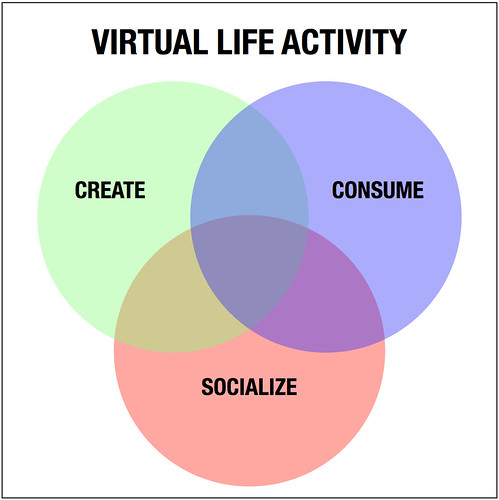
Just about everything one can do within a virtual world can be categorized somewhere in the chart above. I suspect that our virtual experience becomes a virtual life (within a particular world such as Second Life) when we spend a fair amount of time somewhere near the sweet spot of the center.

Quite a few people I've met over the last few years in Second Life have either left the world or expressed a pervasive malaise that makes them wonder why they bother to keep going back. I've experienced this myself. I now think my personal ennui is largely due to my movement towards the green periphery over the last year.

How is your virtual experience balanced? 

Thursday, July 8, 2010

Anthropomorphism: Short Example 1

video
Anthropomorphism is the attribution of human characteristics to animal or non-living things, phenomena, material states and objects or abstract concepts. Wikipedia

Tuesday, July 6, 2010

Second Life AdSense Marketing Leverages Recent Twilight Movie Opening

Second Life vs. IMVU AdSense Imagery

Here's one more set of images related to today's earlier post on virtual world marketing and branding. These are screen captures of two current ads running through Google AdSense.

Second Life Marketing and Brand Challenge: Picture is Worth 1000 Words

virtual-world-brands
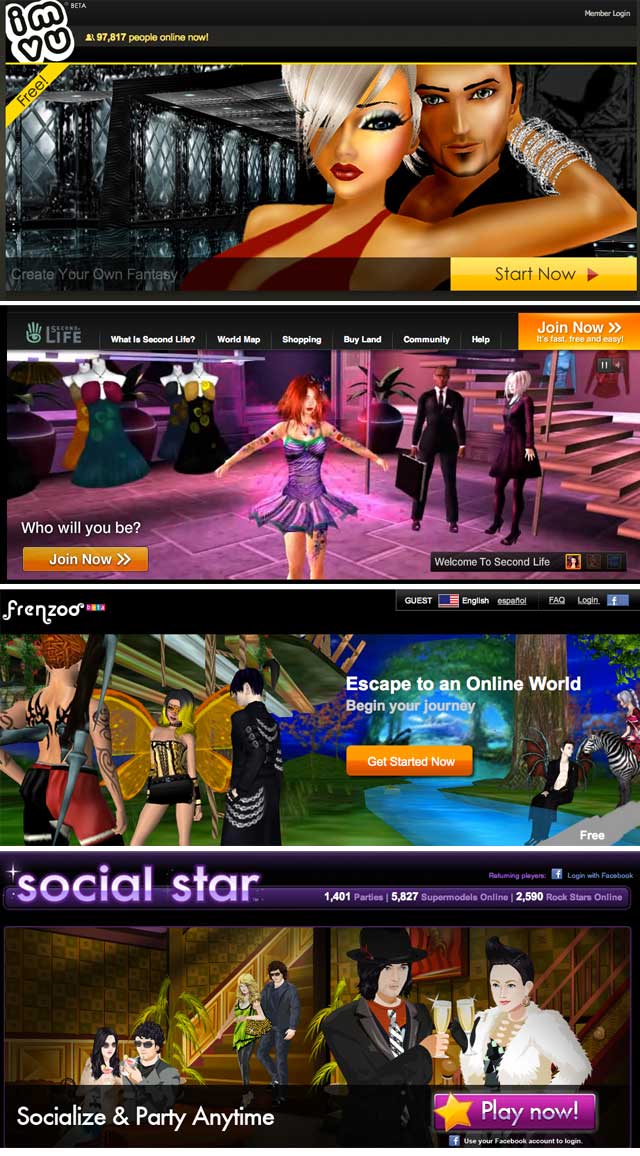
These are screen captures from the home pages of Second Life and three competitors. So what is Second Life's unique brand identity?

Friday, July 2, 2010

Mirror World Twinity Gets its Pole Dance On!


As Second Life has been moving in a more conservative direction, Twinity seems to be pushing the envelope of its "Powered By Real Life" tagline. I received an email today that included the image above. Now that I think of it, mirror worlds don't have to be all museums and landmarks. Maybe in the future we'll see a virtual Amsterdam with a Red Light district and decriminalized digital drugs. Maybe not.