When Socrates said, "the unexamined life is not worth living", he didn't mean the kind of pervasive examination enabled by the microscopic hyper-focused mirror of constant blogging, micro-blogging and social sharing. After getting a well-deserved roast by Dusan Writer yesterday, I realized I've been taking things a bit too seriously lately and it was time to lighten up. So here's a higher-res version of a video from a post from my blog's first month that was headlined: "Enough philosophy. Here's the very first botgirlq dance video."

Monday, May 31, 2010

Saturday, May 29, 2010
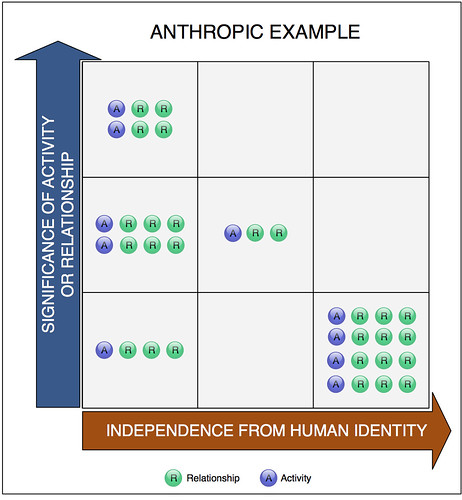
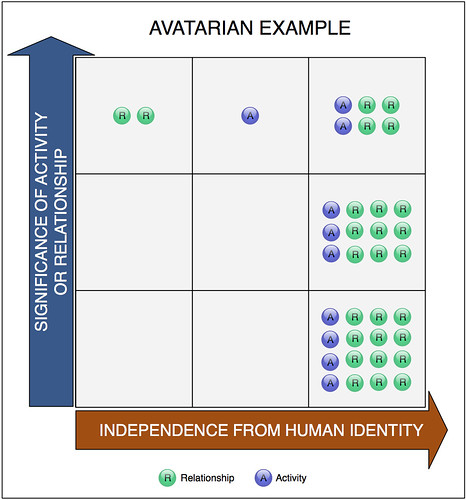
Additional Chart Views of Anthropic-Avatarian Continuum
In the original chart, the labels in the boxes were meant to be a handy way to track and discuss how groups of people tended more towards one quadrant or the other. The charts below are each an example of how a particular person's activities and relationships can be examined, using the same basic paradigm.
The main conceptual addition in this draft is an axis that tracks how significant a relationship or activity is to the individual in question. For example, casual acquaintances versus close friends, or shopping versus art creation.
The other axis tracks how independent each activity or relationship is from human identity. A relationship on the left might be a RL co-worker or family member. The far right would include those who have no knowledge of RL identity. The circles tagging activities and relationships takes the place of the quantity axis in the original chart.
I was planning to work on this idea more and still haven't got around to it. But after the New World Notes reference yesterday, I thought it made sense to move them here to address the new comments there.
Please send any suggestions for the next draft, including links to images.
Friday, May 28, 2010
Is Second LIfe a Second-Best Surrogate to Fill Voids in Human LIfe?
In a comment on my last blog post, Peter Stindberg wrote "...the void that SL filled now gets filled by other things." I found it curious that he chose the word "void" and asked him to share more about what he meant by the term. A few days later, he expanded the idea in a long post titled "Of Voids", describing how an unexpected upturn in his RL caused "the significance of SL to drop overnight". He wrote,
The main thing that struck me in the resulting image was that many of the words related to "void" are commonly used to demean virtual identity, relationships and activities... It's not real. It's a false identity. It doesn't really exist. The aha moment was the realization that when people perceive a void in their human lives, the same ideas are often applied to themselves (at least subconsciously).
What is the relationship to one's wholeness as a person and factors such as:
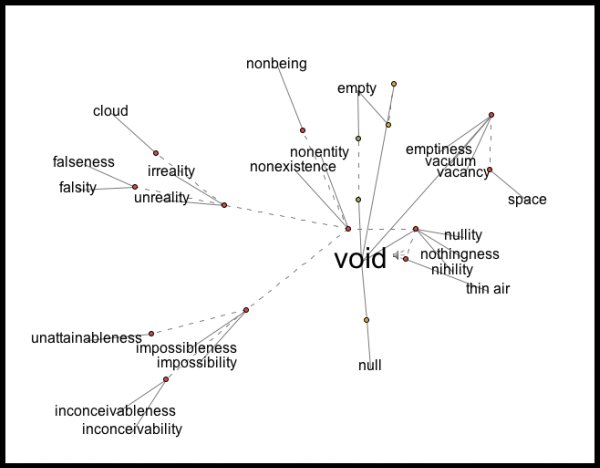
I had the need for a respectful, appreciative environment. I did not get it in my RL, but found it in SL. So I became addicted to SL. Now I work for a company that WANTS me, that CHOSE me out of countless applicants, that NEEDS my skills, that WANTS my creativity, that gives me freedom, recognition and trust - and by this fills the void that SL used to fill. From "Of Voids" by Peter StindbergThe use of "void" still grated on me for some reason, so I decided to explore it with Visual Thesaurus, a web-based tool that maps word relationships.
from Visual Thesaurus
The main thing that struck me in the resulting image was that many of the words related to "void" are commonly used to demean virtual identity, relationships and activities... It's not real. It's a false identity. It doesn't really exist. The aha moment was the realization that when people perceive a void in their human lives, the same ideas are often applied to themselves (at least subconsciously).
What is the relationship to one's wholeness as a person and factors such as:
- interaction with the external environment
- the perceptions of other people
- relationships
- accomplishments
Do these factors merely create a psychological narrative that make up a story we believe about self-worth and wholeness? Or is there some objectively real empty void in our "self" that must be filled through activity in the virtual or physical worlds? Is Second Life simply a second-best surrogate people use to fill what they perceive to be voids in their human lives? Or do virtual worlds offer equivalent or even enhanced opportunities for self-realization?
If you've read this blog for any length of time, you know my answers. What are your's'?
Sunday, May 23, 2010
The Death of the Digital Person in Second Life: An Old School Botgirl Rant
After playing virtual world philosopher all last week, I'm done. Fuck the semantics. Fuck the reductionism. Fuck the whole postmortem. Because that's what it's been. An intellectual autopsy. The utopian dream of the transcendent Digital Person is stone cold dead. Killed not by the hand of Linden Lab, but by the silent testimony of our dear departed brothers and sisters; those whose virtual lives shined so hot and bright that they threatened to burn-out their human hosts if not extinguished.
I awoke in Second Life two years ago into a climate a virtual revolution. At its center was the Independent State of Extropia, a hotbed of intellectual ferver, utopian idealism and walk-your-talk activism. At that time, the leading voice in the Immersionist movement was Extropia co-founder Sophrosyne Stenvaag. Although the details of her story are unique, I believe the rise and fall of her virtual life reflects a common trajectory.
Soph was one of the rare individuals in any world living a life dedicated to the actualization of her highest ideals. While today we trade lukewarm snarkiness about the Mainland's remaking through the post-adult retro-suburbanism of Linden Homes, in the summer of 2007 Sophrosyne railed with outrage at the mere idea of a conventional-looking structure in Second Life. She expressed the intimate interbeing of the Virtual World and the Digital Person when she wrote:
I've seen this cycle in the lives of many avatars who endeavored to create full lives as Digital People. It seems the average lifespan between awakening and virtual seppuku is 9 to 18 months. The exceptions are mostly those whose physical lives do not require a great deal of time and creative energy. In essence they choose to make Second Life the primary life. Of course some or all of the departed may have reincarnated into new avatars and/or sneak back once in a while. But I suspect that in those cases, the new lives are shadows of their former selves.
Perhaps the moral of the story is not that the ideal of the Digital Person is dead, but merely that the life expectancy of the virtual species is very short. Or that the flowering of virtual identity may be destined to fall back into the biological ground from which it was born. The mystery continues.
For now, I leave you with this video memorial to the the golden days of the Independent State of Extropia in Second Life. Although the backing track is Jim Carroll's "People Who Died", many of the avatars pictured in this video are still living. What died is the Extropian dream. (Images used in this video were borrowed from many people's publicly searchable Flickr photos.)
I awoke in Second Life two years ago into a climate a virtual revolution. At its center was the Independent State of Extropia, a hotbed of intellectual ferver, utopian idealism and walk-your-talk activism. At that time, the leading voice in the Immersionist movement was Extropia co-founder Sophrosyne Stenvaag. Although the details of her story are unique, I believe the rise and fall of her virtual life reflects a common trajectory.
Soph was one of the rare individuals in any world living a life dedicated to the actualization of her highest ideals. While today we trade lukewarm snarkiness about the Mainland's remaking through the post-adult retro-suburbanism of Linden Homes, in the summer of 2007 Sophrosyne railed with outrage at the mere idea of a conventional-looking structure in Second Life. She expressed the intimate interbeing of the Virtual World and the Digital Person when she wrote:
Building some Newport Beach condo, or a mall that looks like, well, a mall - is forcing the atomic world into a place it's not meant to fit. It's a little rape of our world's autonomy, selfhood, uniqueness.
This admittedly radical perspective stemmed from the premise that Digital People are the rightful indigenous natives of the virtual world because they are a genuinely emergent form of sentient life, rather than mere augmentations of human identifies. In a January '08 blog post she wrote,Treating us - whether we call ourselves Digital Persons, Artificial Persons, whatever, or just any of the people in our world - as masks for an atomic world person - well, that's exactly the same kind of thing. It's griefing, it's a profound violation of our selfhood in our world.
I'm not someone playing a role, or manipulating an avatar like a chesspiece or a mask I speak from behind. I'm not anything but what I seem to be.At the dawn of 2008, Sophrosyne was at the forefront of both the personal and professional expression of virtual identity. In the public domain, she was the chief promoter and facilitator of a wide-ranging series of Extropian conferences and salons featuring notable scientists, religious leaders, business people and artists. Behind the scenes in her private life, Soph and her polyamourous quad family group pushed the boundaries of loving committed relationship. A year and a half later, Sophrosyne and two out of her three family members had left Second Life (you can read her swan song here) and posts stopped appearing on the Extropia blog.
I've seen this cycle in the lives of many avatars who endeavored to create full lives as Digital People. It seems the average lifespan between awakening and virtual seppuku is 9 to 18 months. The exceptions are mostly those whose physical lives do not require a great deal of time and creative energy. In essence they choose to make Second Life the primary life. Of course some or all of the departed may have reincarnated into new avatars and/or sneak back once in a while. But I suspect that in those cases, the new lives are shadows of their former selves.
Perhaps the moral of the story is not that the ideal of the Digital Person is dead, but merely that the life expectancy of the virtual species is very short. Or that the flowering of virtual identity may be destined to fall back into the biological ground from which it was born. The mystery continues.
For now, I leave you with this video memorial to the the golden days of the Independent State of Extropia in Second Life. Although the backing track is Jim Carroll's "People Who Died", many of the avatars pictured in this video are still living. What died is the Extropian dream. (Images used in this video were borrowed from many people's publicly searchable Flickr photos.)
Wednesday, May 19, 2010
Replacement Candidate for Augmentation vs. Immersion Paradigm
As I was trying to gain some insight on the issue of Second Life Culture earlier this week, the long-standing "Augmentation vs. Immersion" paradigm kept nagging at me. It's another Second Life topic that is plagued by ambiguous terms that often confuse more than clarify the underlying issues.
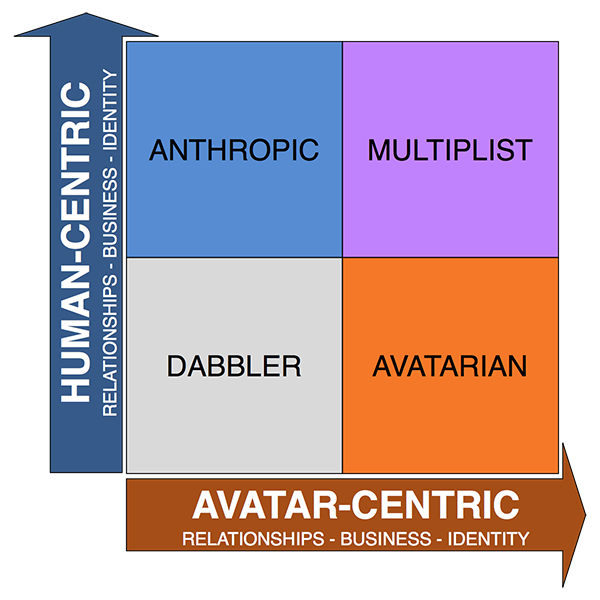
As a good Venn Buddhist and VizThinker, I thought through the concept using a chart. One axis reflects the number of human identity-centric relationships and business dealings. The other is for one's avatar identity-centric activities.
This ended up providing four quadrants that I propose as replacements for Augmentation and Immersion:
- Anthropic: Their Second Life activity is related to human identity. RL identity is in their SL profile. They use Second Life within their RL job, interact with their human friends within the virtual world, etc.
- Avatarian: Their Second Life activity is separated from human identity. They do not openly associate their avatar and human identities in any way.
- Multiplist: They have a mix of human-centric and avatar-centric relationships and activities within Second Life.
- Dabbler. Just to fill out the chart, I labeled the quadrant of those with very few relationships and activities of any kind.
So I offer "Anthropic vs. Avatarian" to replace "Augmentation vs. Immersion". What do you think?
Monday, May 17, 2010
What's Behind The Recent Focus on Second Life Culture
Culture has become an increasingly vital topic in the Second Life blogosphere over the last six months or so. This issue has emerged in response to an unprecedented series of actual and anticipated changes in technology and governance that will likely impact the status quo of almost every Second Life sub-culture and community of interest.
We are therefore working to distinguish which aspects of Second Life are crucial to the continuity of the groups we care about. We are also considering whether what we personally hold dear in Second Life has a value to the wider world. The recent focus on the cultural aspects of Second Life is at least partially an attempt to articulate in understandable terms a worth that seems self-evident to participants.
After reading many of the recent posts and comments on the topic, I have couple cautions about the use of the Second Life Culture meme:
- The use of the concept of culture as an argument for policy decisions has a lot of emotional baggage. It can therefore stimulate knee-jerk reactions that are neither relevant to the Second Life discussion, nor conducive to clear thinking.
- Culture is such a complex and broad concept that it tends to stimulate conversations that are more about semantic disagreement than clear examinations of the salient conditions, causes and effects related to the actual issues.
Despite these concerns, I believe that the recent focus on culture has added a useful dimension to our ongoing conversation about Second Life. For the best overview of the discussion to date, along with excerpts and links to key posts from Second Life bloggers, see Grace McDunnough's Search for A Second Life Culture or Omphaloskepsis.)
.
Thursday, May 13, 2010
New Video: A Brief Meditation on Digital Shamanism
Extending ideas from the last couple of posts, this video plays around with the idea of using virtual reality to support internal visualization and imagination. In good Transworlders fashion, it was created using elements from Second Life, Frameforge and digital photography of the atomic world.
Tuesday, May 11, 2010
Digital Shamanism: The Psychological Dimension of the Transworlders Paradigm

Most of us tend to ignore the deeper dimensions of being that hide beneath our mundane states of mind. It struck me today that the idea of "Transworlders" not only applies to movement between virtual worlds, but also to travel through inner worlds and states of consciousness. And even to what might be thought of as "digital shamanism."
There is an essential mystery at the heart of life, awareness and identity. Although to our habitual state of perception we live in an atomic, isolated and disconnected universe, if we look more deeply, the entire world and everything in it can be viewed as what Thich Nhat Hanh calls a web of interbeing:
“If you are a poet, you will see clearly that there is a cloud floating in this sheet of paper. Without a cloud, there will be no rain; without rain, the trees cannot grow; and without trees, we cannot make paper. The cloud is essential for the paper to exist. If the cloud is not here, the sheet of paper cannot be here either. So we can say that the cloud and the paper inter-are. “Interbeing” is a word that is not in the dictionary yet, but if we combine the prefix “inter-“ with the verb “to be,” we have a new verb, inter-be.
Thich Nhat Hanh, From “Peace is Every Step”As the concept of interbeing is applied to virtual worlds, we can begin to see that the solid appearing boundaries between human and avatar; atomic and virtual; corporate and artistic; and so on, are fictional expressions of our collective mental models. So, for instance, there is no conflict between the perspectives of "augmentation" and "immersion" in virtual worlds. In fact, they are interdependent concepts.
Extending further, our avatars can not only be viewed as vehicles that take us from the human world to the virtual world, or as emergent identities that live within an immersive environment, but also as expressions of deep archetypal energies that transcend both concepts. I tried to express some of the mystery of this approach in the image at the top of this post.
That's it for now. Hope to post more on this line of inquiry soon.
Monday, May 10, 2010
Avatar as Vehicle of Enlightenment
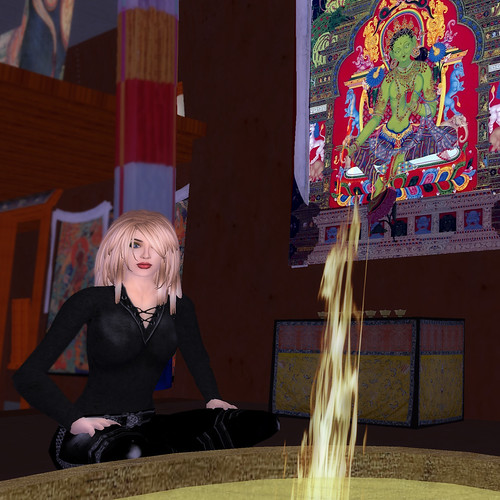
A comment by Gwyneth Llewelyn on "The Power of Name in Post-Pseudonymous Virtual Identity" revived my interest in the avatar as a vehicle of enlightenment. Here's my first post in what I hope will be a series of brief explorations:
The visceral experience of being embodied in an idealized form within a richly symbolic environment is a foundational Vajrayana Buddhist practice. During meditation, practitioners may visualize themselves as an enlightened being such as the Bodhisattva Tara represented in the image above. This allows an individual to make the perceptual leap to an enhanced recognition of their Buddha-nature and spontaneously transform harmful ingrained mental models.
An avatar-based three-dimensional virtual world has the potential to enhance and support visualization practice through a rich sensory environment. Although the images surrounding a deity in a thangka is painted in a two-dimensional form, the iconic representation is merely a mnemonic device to support what is ideally a deeply imagined three-dimensional visualization. I think that creating a virtual thangka with all of its rich detail would be an invaluable aid in visualization practice. I don't have the building chops at this time to pull that off, but would love to hear from interested builders and artists.
As a matter of fact, I think I'm going to create a two-dimension avatar thangka for my next post on this topic. Should be an interesting journey!
.
Thursday, May 6, 2010
This is Your Brain on Social Media

I'm pretty convinced that the consistent and pervasive use of social media subtly shifts the mental ground of human consciousness. But as Marshall McLuhan often noted, our present environment is usually invisible. So I devoted most of yesterday's tweets to playing around with the medium through some tongue-in-cheek tweets considering some of the aspects we usually don't attend to. Today's post is based on yesterday's tweets tagged with the #psychsoc hashtag.This is your brain on social media. There's a lizard and a chimp in your brain who don't really get net-centric social media. They interpret the interactions as if they were the meatspace analogues. So there are all kinds of bio-physical processes that can get activated in the course of your socially networked day that impact your experience of self and the world.
What are you looking for here? No. Try again. What are you REALLY looking for? People are attracted to social networking for many reasons, most of them probably unconscious. Humans are generally blind to the complexity of motivation behind their actions and social networking is no exception.
You like me? You really like me! There is a subtle message of personal acceptance in the choice people make to follow or friend us on a social network. And vise-versa. Although this may be accurate in some cases, for those of us who socially network with strangers, there is a huge divide between perception and reality. The decision to follow or unfollow usually has little to do with the actual being we are.
AntiGestalt: To the social network, you are equal to the sum of your posts. At least for those who only know us through our updates. It's funny, but unless I pay attention, I fall into the assumption that everyone who follows me on a social network has read and absorbed my two years of blog posts, machinima, comics, etc. FAIL.
Ring that RT bell, dog! I'm ready for my positive reinforcement now. I've been noticing that the chime indicating a retweet or @reply has a more impact than the mere audible stimulus would otherwise induce.
We are hunting, gathering and farming here. Each tweet is prey, plant and seed, depending upon one's perspective. Social media is the latest extension of ingrained behavioral processes that are as old a humankind.
Warning! Do not read the rest of this tweet as it contains a subliminal mental virus. I'm not joking. I mean it. Zap! From a cultural perspective, the content of any social media post doesn't really matter. The medium is the message. And the message is not consciously perceived.
Who are you really tweeting to? Go on. Spill it. You'll feel better. Although posts go out to one's entire list of followers (and potentially anyone on the internet), I suspect that many tweets have a particular person or subgroup as a target.
I'm a hypnotwitst. Look deep into my tweets and count backwards from infinity to zero. Snap. You're awake!
.
Wednesday, May 5, 2010
Flow: Finding Creative Balance in a Socially Networked Environment
Flow is the term coined by Mihály Csíkszentmihály to describe "the mental state of operation in which a person in an activity is fully immersed in a feeling of energized focus, full involvement, and success in the process of the activity". Today's post is based on yesterday's tweets tagged with the #flow hashtag.Most of our emotional pain comes from clinging to the past, fighting with the present or dreading the imagined future. It is born in the gap between what we believe should be true and what is. There's a world of difference between the thought "this sucks" and the idea "this SHOULD be different." Although flow is often thought of as requiring great expertise in the associated activity, it's usually the frustration with one's less-than-stellar skill that blocks flow, rather than any actual deficit. That said...
After enough practice, tools disappear. Then the artist disappears. And then finally all that's left is the emergence of art. Someday I would love to have the time to master the full scope of the tools I use to create images, music and video. But until then, I've found that making full use of what I currently know is usually enough to channel the muse's voice and vision into shareable reality.
It's often better to surf across the waves than to swim against the tide. For those with an artistic passion, all experience can be used as grist for the mill. I've found that when I let go of how I think something should be, work emerges that is as good or better than what I originally envisioned.
The SocialNet can sabotage the intrinsic Joy-of-Being when we trade fully enaged activity for reporting opportunities. This can be a really grey area for net-centric creatives. The relationship between artist and audience is much more pervasive, real-time and personal in a socially networked environment. The need to be seen can overshadow and subvert the flow of creative expression.
Smugness isn't a virtue. It only feels like joy because it numbs your hungry heart for a moment. What is the relationship between page views, followers, retweets and happiness? Doesn't it seem silly to use such metrics to quantify self-worth or the validity of one's work?
I nominate the fear of boredom as the eighth deadly sin. A lot of the compulsive behavior associated with social networking and media consumption stems from the fear of boredom. Boredom is the gatekeeper of creativity. Don't let it turn you away.
.
Tuesday, May 4, 2010
Being: Chapter One of an Experimental Approach to Blogging
Here's my first go at a new approach to blogging. This post originated in a series of tweets yesterday on the topic of #being. I've made a few edits of my original tweets and added some additional content to flesh out the ideas:Embrace the past. If it feels alive then slay it because it should be dead. You have a zombie, vampire or ghost in your arms. The chief gift of my virtual birth two years ago was the imagined release of the past. Assuming nothing and questioning everything, I found my superpower.
What's your superpower? Mine is a sense of wonder. Unfortunately, the purity of my birth has slowly become encrusted with fixed conceptions I've gathered along the way. For me, ideology is kryptonite.
Your strongest opinions are your worst enemies. It's easy to see how other people's perception of "reality" is warped by their belief systems. Guess what? The same is true for you. And me.
You are only present within the awareness of each moment. Finding youself is mostly a matter of paying attention. Although I've written a great deal about identity here, all of the intellectual musing in the world will not match the insight derived from relaxed self-awareness.
The Dichotomy of Digital Existence: No decay. No fixed form. If one has the eyes to see, the virtual world is the Heart Sutra brought to life.
Creating. Consuming. Creating. Consuming. Creating. Consuming. Creating. Consuming. Creating. Consuming. Creating. My typical day is breathing out and then in. It's the space between breaths that I have been missing.
The suspension of disbelief is more pervasive in mundane existance than it is in virtual life. It is just less conscious. Pay attention to the thoughts that spring up in reaction to the next five people you see. How many of them are true?
Life is lived through a series of boxes that shape, constrain, protect, imprison, support, limit and define identity. What's inside when all of the boxes are gone?
Inspiration never abandons me. It is I who turns from her warm living embrace to the cold dead arms of my own judgement. My chief place of worship is the blank page.
Most externally directed judgement is merely a way to avoid facing and dealing with our own shit. Damn! One of the most difficult yet useful spritual exercises is turning one's pointing finger back at oneself.
Wondering whether one of my multi-tasking activities can be meditation. This is a joke. I think.
.
Subscribe to:
Posts (Atom)