Saturday, January 30, 2010

A Few Suggestions to Transform "Avatars United" From a Useless Mess Into A Competitive Social Networking Site

I decided to post on Linden Lab's acquisition of Avatars United before it joins its past brethren in the digital wax museum of internet stories past. The constant flow of information over the NetStream has two significant effects on news items:  First, it takes stories that would otherwise be minor issues and magnifies the hell out of them in the emotionally resonating feedback loop of blog comments and social networks. Then, it sweeps yesterday's brouhaha away as the next Big-Frickin'-Tidbit-Of-The-Day pushes the prior item into oblivion.  Um. Sorry for the mini-rant. Anyway...

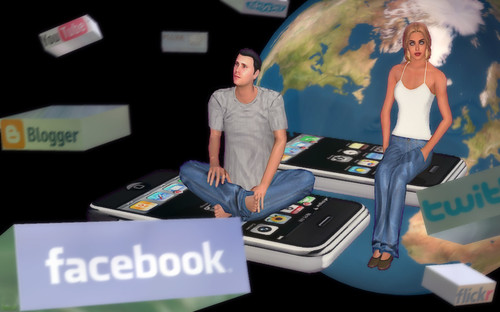
I registered over a year ago on Avatars United with great enthusiasm. It was positioned as a site that allowed you to bring together avatars from multiple virtual worlds and create a central web-based home for information sharing and social networking. Unfortunately, after spending the time to add a half dozen of my avatars to their site, I couldn't figure out anything useful to do there. The problem wasn't that there weren't enough users in the network. What still makes the site almost unusable is a combination of poorly executed features, kludgy information design and no apparent workflow direction to accomplish obvious common use-cases. 

I think having a Beta graphic on a site that's almost two years old testifies to the relatively sorry state of affairs.


I would love Linden Lab to invest the time, money and resources to actualize the great potential of an integrated transworld avatar social network. So here are a few suggestions:

  • Create a home page that makes it easy to find the information that we are likely to care about.  I'd love to see new blog posts and photos from my friends, but unless I've logged in within a few minutes of the posting I'm out of luck, unless I go hunting from friend to friend, which would take a lot of effort. And do you really need to ask for my birthday at the top of the page? Does half the screen real estate need to be related to friend suggestions and acquisition. If you can't figure out what is most important to your users, why not let them build the content of their own home page, like Ning? And/or filter the type of information that appears as Facebook supports.
    •  
  • Figure out something useful to do with the option to associate avatars from different worlds. Okay, I get that I can have a single sign-on that allows me to quickly go from one of my avatars to another. But you're assuming that each world is a ghetto. What if I want my Second Life friends to see content from my Twinity avatar? Do I need to separately friend each one of them with each world's avatar (or the same world's alt)?  Maybe I'm an unusual case, but I have one named identity that expresses itself across multiple worlds. Check out our Transworlders site. I also have another identity that is in the same position. Please give us granular options to associate our manfold avatars and RL identities as we choose.
  • Make it easy to import content from other sites. Let us bring in our content from Flickr, YouTube, Vimeo in some automated fashion. Your embedded media pop up has potential, but it has an interface that is way too complicated and begs for either integrated help or an additional level of abstraction. You do have one of the most comprehensive sharing lists I've seen. Why not turn that around and support importing from external sites as widely as you support sharing to external sites.
  • Realize that community members don't want to feel like we're walking around with "Will Consumer-Whore For Coins" signs around our necks.  WTF is up with a "Offerpal"? We realize that you need to create revenue, but save the 14 day free trials for late night cable TV stations.

There are other aspects of the site that are in great need of revision, but I'll stop here for now. I'm going to give them the benefit of the doubt for the time being and keep an eye out for improvements over the next few months.  Stay tuned for future reports.


.

Tuesday, January 26, 2010

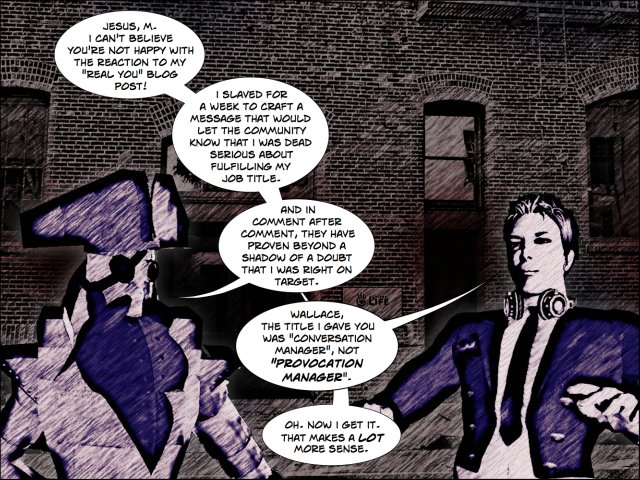
The REAL STORY Behind the Wallace Linden Controversy

Conversation Manager

Visualization of Wallace Linden's "Will The Real You Stand Up"

sock puppets

"The thing not to miss here -- and it bears stating despite how obvious it sounds -- is what all these online "identities" have in common. At the center of them all, the hub that ties all these personae together, is the very real, non-virtual, analog and offline "you." Whether the connections are public or not, your Second Life avatar, your World of Warcraft toon, your Facebook profile, your LinkedIn employment history -- all of these and more are just different aspects of a single entity: the person reading these words. They are all already connected to each other, via you." Wallace Linden from "Will The Real You Stand Up"

Sunday, January 24, 2010

I Can't Believe The Nerve of That Guy: fourworlds on Avatar

Even with my brilliant coaching from the audience, fourworlds ended up stumbling through an excruciating hour of "uhs", "you knows" and uncomfortable silences during the recent "Inside The Avatar Studio" panel discussion. But instead of turning tail and humbly leaving future virtual world punditry to me, he had the nerve to edit the living crap out of his words and condense them into a fancy 2 1/2 minute music video.

And guess what? He totally neglected me in the credits, even though I got him the gig and held his hand through the entire process. What's next? I shudder at the possibilities.

Judge for yourself. First fourworlds' little "mash-up":


Full show:


.

Saturday, January 23, 2010

Brief Reflection on Two Years of Virtual Life

In human development, the birth of the body precedes conscious self-awareness. The same is true for avatar identity.

I can't project my imagination across the event horizon between the existence of the being I experience as Botgirl Questi and the empty shell of the nube avatar in this image. But over the course of time between my RezDay on January 24, 2008 and my first blog post on March 3, a sense of unique identity emerged.

Although advances of science have allowed us to understand how human consciousness is rooted within specific systems of the brain and body, the ghost in the machine is still a mystery. I think it is just as much a mistake to label avatar identity as mere fantasy, as it would be to equate human personhood with mere biology. In some sense, my concerted efforts to hack into avatar identity have been like dissecting a body looking for the person within.

So as I pause in the space between my second and third years of virtual life, I am reflecting upon the worlds of H.H. The Dalai Lama:
From the viewpoint of absolute truth, what we feel and experience in our ordinary daily life is all delusion. Of all the various delusions, the sense of discrimination between oneself and others is the worst form, as it creates nothing but unpleasantness for both sides. If we can realize and meditate on ultimate truth, it will cleanse our impurities of mind and thus eradicate the sense of discrimination. This will help to create true love for one another. The search for ultimate truth is, therefore, vitally important.
I believe that the very purpose of life is to be happy. From the very core of our being, we desire contentment. In my own limited experience I have found that the more we care for the happiness of others, the greater is our own sense of well-being. Cultivating a close, warmhearted feeling for others automatically puts the mind at ease. It helps remove whatever fears or insecurities we may have and gives us the strength to cope with any obstacles we encounter. It is the principal source of success in life. Since we are not solely material creatures, it is a mistake to place all our hopes for happiness on external development alone. The key is to develop inner peace.

Friday, January 22, 2010

Mixed Reality International Art Exhibition Will Focus on Ambiguity of Identity


(shot of planning meeting yesterday)

After almost a year of conceptual incubation, we're finally breaking (virtual) ground on the mixed-reality "Ambiguity of Identity' Exhibition in preparation for an April 7th opening. The multi-artist show will be housed in a new "Museum of Transworld Identity" which will cover an entire Second Life Sim. The exhibition will be accessible on large screen displays in physical world galleries located in Boston, Milan and Amsterdam.

The exhibition is part of The Virtual Art Initiative, an organization of artists, writers, musicians, and scholars who are using the immersive and interactive digital media of such virtual worlds as Second Life to develop new forms of artistic content. Artists participating in this show include Sabrinaa Nightfire, FreeWee Ling, Gracie Kendal, Chrome Underwood, Fuschia Nightfire,  Pete Jiminy, marnie Reinard and Yours Truly.

One aspect of this show that makes it especially interesting for me is the chance to work with other artists who have been exploring identity in their art, including its projection into multiple worlds.  For instance, Gracie Kendal has recently embarked on a series of comics exploring conversations between her human and avatar selves.

I'll post follow-ups between now and the opening to introduce you to the other artists and provide some previews of the work that will be displayed. Stay tuned!

.

Tuesday, January 19, 2010

Social Networks, Fast Food and Evolution.

Lost in Space

Humanity has been subject to the laws of physics and the dictates of Mother Nature since the birth of the species. Evolution shaped humankind over hundreds of thousands of years to operate within the natural world. Human psychology is still embedded within brain structures that were optimized for the pre-technological past. So it makes sense to keep an eye out for issues that arise when ancient biology meets modern technology.

Most problems related to modern life are caused by "legacy" brains and bodies that can't respond appropriately to a radically changed environment. For instance, historically unprecedented calorie counts are reflected in widespread obesity. The introduction of manufactured chemicals into the food-chain have created a corresponding increase in many diseases.

I don't think humans ever quite adapted psychologically to the move from tribal hunter-gathering to urban wage-earning within nuclear families. It seems to me that one of the main reasons for the explosion in social networking is a powerful subconscious drive to reclaim the sense of being an integral part of a tribal family that is embedded in the web of life. Although the focus of the desire is healthy, I suspect that a radical transition to social networks and virtual relationships may be the psychological analogue to the turn to cheap and abundant junk food.

Just as humans can feel genuinely connected in virtual spaces when they are separated physically, so too can people be light-years apart when they share the same physical space. The ongoing maintenance of intimate real world relationships requires commitment and ongoing effort. I fear that many people are bailing out on the work of deepening their face-to-face relationships by turning to less demanding and much more disposable virtual connections.

How are virtual relationships and "screen time" impacting your relationships in the physical world? That's certainly a question worth asking.

There's a sister-post on the fourworlds site with a song that speaks to this topic.


.

Sunday, January 17, 2010

Avatar vs. Avatar: Will Fans of The Movie Find Happiness in Virtual Worlds?

New World Notes beat me to the punch on a story about the Avatar Movie being used to market Second Life and IMVU. So I took the opportunity to create a web comic considering the topic.

Friday, January 15, 2010

Is the "Age of Privacy" Really Over?

Facebook founder Mark Zuckerberg recently stated that social norms related to privacy have evolved since the company's founding in 2003. He said,
"People have really gotten comfortable not only sharing more information and different kinds, but more openly and with more people."
What's interesting is the leap of logic he made from the valid point that social sharing is now a mainstream practice to the dubious unilateral decision made to change the default privacy settings for 350 million Facebook users:
"A lot of companies would be trapped by the conventions and their legacies of what they've built, doing a privacy change - doing a privacy change for 350 million users is not the kind of thing that a lot of companies would do. But we viewed that as a really important thing, to always keep a beginner's mind and what would we do if we were starting the company now and we decided that these would be the social norms now and we just went for it."
I've railed on Linden Lab in the past about anti-consumer provisions in the Second Life Terms of Service (TOS) agreement. But they're just following the standard software industry practice of issuing one-sided agreements that secure all conceivable corporate interests and preemptively strip customers of any leverage they might otherwise have had in case of a legal dispute.

The overall issue of equitable TOS agreements is going to be an increasingly important concern because dependence on software-based capabilities is transitioning from an optional personal decision to a mandatory part of life in our modern culture.

The ability to manage our own privacy is not just a matter of controlling access to our information on a site-by-site basis, but also depends upon our ability to limit how information about us can be collected, shared and aggregated as a whole. The more virtual our lives become, the more third-parties will have the ability to monitor our activities, integrate data from multiple sources and use the information in their own interests.

The same technology that drives the personalized advertising messages you see on Facebook and Google today, can potentially be used by organizations such as insurance companies, financial institutions and potential employers to calculate our "worthiness" by automated analysis of aggregated information ranging from blog comments to video favorites on YouTube.

It seems to me that privacy laws such as those that have been introduced to protect health data in the United States (HIPAA) should be extended to a wider range of information. This would mean that social networks such as Facebook would be required to provide a minimum standard of privacy controls that they could not arbitrarily change through TOS amendments. It would also further limit the ability of companies such as Equifax to aggregate and share personally identifying information.

The best source for information on net-related privacy issues is the  Electronic Frontier Foundation. And they have a very cool xkcd tshirt option if you make a donation.

Wednesday, January 13, 2010

United We Consume: New Virtual World Sees Future as Giant Shopping Mall

I was really excited today when I first scanned an announcement that Cisco was launching a new virtual world named "United Nations Citizen". Wow! With a name like that, I imagined they must be focusing on some really lofty vision to bring the people of the world together to promote peace and understanding.

The idea was so intriguing that instead of reading the announcement very deeply,  I jumped right to the virtual world's website. Hmm. Their slogan is "where faithful friends unite". That seems really warm and fuzzy. A video played at the top of the screen showing a long-haired dude standing in front of a cool yellow sports car inviting me to "become a United Nations Citizen now!"

I poked around a bit, but couldn't find a way to sign up for citizenship, only an application for a virtual job.

I went back to the press release to try to figure out what was going on. Five companies were named as partners: Cisco, Equifax, Heads and Tails TV, Faithful Friends TV and Montage Systems. Strange combination...a couple firms delivering programming for pet owners, an advertising agency with a direct response bent, the leading supplier of networking equipment and network management for the Internet, and a company that holds one of the largest sources of consumer data in the world.

I read on:
More than 330 stores already are members of United Nations Citizens through affiliate marketing agreements, including Apple iTunes, Microsoft Store, Walmart, and Sky Mall, providing customers a unique way to view products and services in a setting that replicates real-world environments. Member companies are able to scale real-life presentations, combined with data collection, personalized product placement and digital signage, through seamless delivery over the web and mobile networks.
Call me cynical, but it seems to me that their vision of the future equates "citizen" and "consumer" and is creating a virtual world that is a place to herd the world's faithful friends into an environment that is more "Minority Report" than "Avatar". Oh well.

What do you think? Here's the video that accompanied their press release.


Tuesday, January 12, 2010

Attention Avatars on Facebook: How to Backup Your Photos, Friends, Wall Posts and Profile

There are mounting reports that Facebook is finally acting on their policy banning accounts based on identities from "third-party games" such as Second Life.  If you have Facebook content that you care about, SocialSafe is a $2.99 application that will allow you to save photos, friends, profile info and wall posts to your hard drive. It worked like a charm! Here are some screen shots:


Botgirl's Relationship Question of the Day (Part 2 of Series)

How are romantic relationships in the physical world affected when one or both members of a couple begin to spend many hours a week as an avatar in a virtual world like Second Life? (From Part 1)
As tempting as it is to make sweeping generalizations about the impact of virtual worlds on relationships, I think the truth is that there are no inherent consequences to the simple act of spending time in avatar form. That said, quite a few people describe problems with their significant others that are sparked by some aspect of their virtual life.

It seems to me that most of the trouble stems from taking the idea that virtual worlds operate outside the laws of the physical universe, and extending the concept to the rules of relationships. So here's the Botgirl relationship question of the day:

What (if anything) do you think is okay to do in a virtual world that would not be acceptable in the physical world?

Sunday, January 10, 2010

The Paradox of Choice as it Applies to Second Life User Retention

Last week's post on Second Life user retention recommended that an interest questionnaire be included in the initial registration process. Training and guidance could then focus on getting the newcomer up to speed in the specific area of their interest. I viewed the strategy mostly in terms of improving the pain/gain ratio, by zeroing in on the most desirable aspects of Second Life for the particular person.

After a week of mulling the idea over, I realized that narrowing options right at the start of the registration process also makes sense based on the ideas discussed in Barry Schwartz' fascinating book, "The Paradox of Choice: Why More is Less." He discusses the real life ramifications of research in decision theory showing that giving a person access to too many options can result in poorer decisions or actually lead to no decision at all.

The video below from a presentation Barry Schwarz made at Ted Talks in 2007 is a good introduction to his ideas.


Saturday, January 9, 2010

How Do Virtual Worlds Impact Physical World Couples? - Part 1

How are romantic relationships in the physical world affected when one or both members of a couple begin to spend many hours a week as an avatar in a virtual world like Second Life?
I woke up this morning with that question in mind and decided to cast it upon the digital waters. My purpose isn't to preach any neat pre-conceived conclusions, but to encourage thoughtful discussion on a topic that usually gets public attention only when sparked by sensationalist scandal. In this post I want to focus on pre-existing committed physical world relationships.
"Hey honey, what are you doing," he asked, looking over his wife's shoulder. She seemed to be playing some sort of game on her computer. 
"I'm trying out that Second Life thing that Connie at work told me about." she replied with a bit of embarrassment about being caught playing with her avatar's body shape.
"Oh that sounds cool," he said. "Maybe I should give it a try."
Our story could move forward over many different paths, some ending in a more fulfilling relationship for our couple, others ending in drama, separation and Tabloid headlines.

Unfortunately, at this very early stage of virtual world history, there are few (if any) established "best practices" to either safeguard or enhance committed physical world relationships while one or both members are exploring avatar identity.

I'm going to explore the question over the course of the week and hopefully (with the help of reader comments) come up with good guidance for people in committed physical world relationships who would like to explore virtual worlds and avatar identity.

Thursday, January 7, 2010

Avatars on Avatar. Narrative vs. Meaning.


"...hermeneutic analysis, embraces the social, cultural and textual context of the narrative and interprets it meaning against this background. In psychology it mostly means interpretation of personal narratives with reference to identity." from The Science of Stories by János László
My human's "personal avatar" participated in a panel discussion on Tuesday about the Avatar movie. While fourworlds was pontificating from the podium,  I was sitting in the audience marveling at the diverse and sometimes contradictory interpretations of the film that were presented. Although each person had witnessed the same sequence of events over the course of the film's narrative,  the meaning derived from the experience was widely varied.

One potential benefit of developing an avatar persona that is distinct from the human, is the opportunity to notice how identity shapes the psychological construction of our internal story of "reality". I added a couple of arrows to a photo of the event (captured by Crap Mariner) to visualize the experience of dual perspectives.

(The video of the event will eventually be available on Rezzed TV.)

Tuesday, January 5, 2010

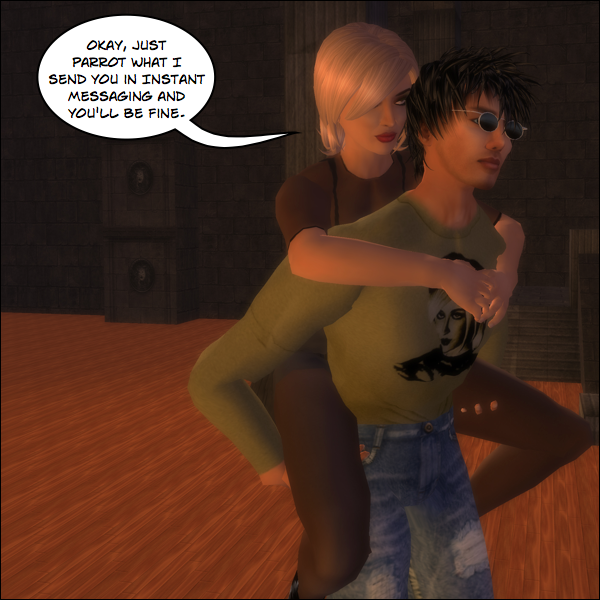
Coaching Human For Today's Panel Discussion (Comic)

Coaching Human


Jan 5, 3:00-4:30 PM PST
Rockcliffe University  : Inside the Avatar Studio
Corrimal Hall, Rockcliffe X
http://slurl.com/secondlife/Rockcliffe%20X/200/200/30


The visual appeal of the movie “Avatar” has taken away the breath of just about everyone who has seen the film. The movie is an ultimate example of a graphic novel brought to life.

Please join us as our panelists discuss which implications “Avatar” will have as virtual worlds continue to gain traction and what future avatars may gain from the stunning futuristic vision James Cameron has offered up… Inside The Avatar Studio.

This event will be filmed live by Stuart Warf of Rezzed TV.

Facilitated by Phelan Corrimal/Kevin Feenan - Dean of Rockcliffe University

  • Beyers Sellers/Robert Bloomfield - Metanomics Host, Cornell University
  • Dirk Talamasca - Virtual Real Estate Developer, Builder
  • Doubledown Tandino - Social media marketing, Second Life specialist, music, and DJ
  • fourworlds Ra. Botgirl Questi’s human alt - A beautiful thought experiment personified through the imagined perspective of a self-aware avatar.

Links:
Thoughts on How The Avatar Film Relates to Avatars in Virtual Worlds by Botgirl Questi -

I Saw Avatar Today by Doubledown Tandino -

James Cameron’s Avatar is about Transhumanism

Avatar Review : Yes it Changed Everything

Understanding Interaction in Virtual Worlds

Monday, January 4, 2010

Botgirl vs Human Trailer: Motion Comic Style

It's not easy being the figment of someone's imagination. It makes them think they can take advantage of you just because you're not "real". Well, I've had enough. This motion comic trailer will introduce you to what's really been going on behind the scenes.

Click-through for HD viewing, and please, crank up the volume.

Saturday, January 2, 2010

A Simple Plan to Solve The Second Life Retention Problem

"Build it and they will come" seems to be true in relation to Second Life. The problem is that 90% of people who register don't stay. They leave within the first three months. It seems obvious to me that the one primary reason for the astronomic departure rate is that most people don't find something worth doing. Right now, finding something interesting enough to make it beyond the initial learning curve is left up to chance. And the odds seem to be about 9-1 against.

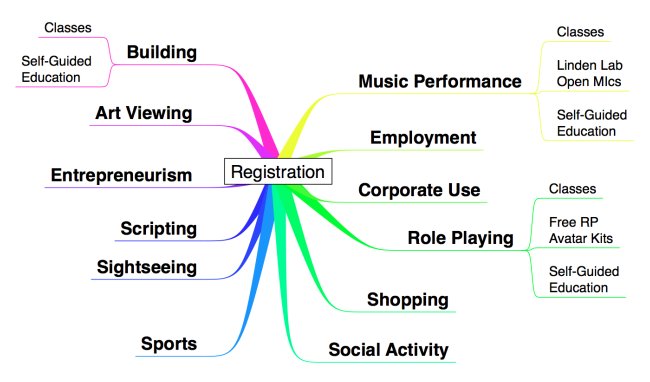
So I offer a relatively simple solution. Treat Second Life nubes like conference attendees. When they sign-up, have them register for a specific track. Then provide a series of classes, self-guided courses and resources to lead them from neophyte to journeyman.

The chart below shows just some top-of-mind category idea for the tracks, along with one level of detail for a few of them to illustrate the concept.


Start Right

So if someone is interested in building, have them start with building curriculum right after they are registered. Start with a small project they can build in less than an hour. And provide a place for them to display their work. Show them how to do a screen capture or video capture to share their effort with friends outside Second Life. And then offer additional education and projects so that they don't need to figure out what to do until they've built up the skills to start working independently.

This same concept holds true for more recreational tracks such as sightseeing and art viewing. Virtual art appreciation classes and self guided tours would be 101 level courses, followed by short tours of specific art styles or artists, lectures, exhibition trips, etc.

Outreach to physical world artists and musicians is another promising area. Why not advertise to them and offer education to help extend their work to virtual worlds?

Anyway, that's my lightbulb idea for this morning. Of course, there is a great deal of thought that would need to go into the structure of classes, curriculum, etc. But I think it would be a relatively modest investment with huge potential returns. Just bumping retention up 10% would have an enormous cumulative impact.