Thursday, December 31, 2009

Obligatory Year-End Introspective Retrospective

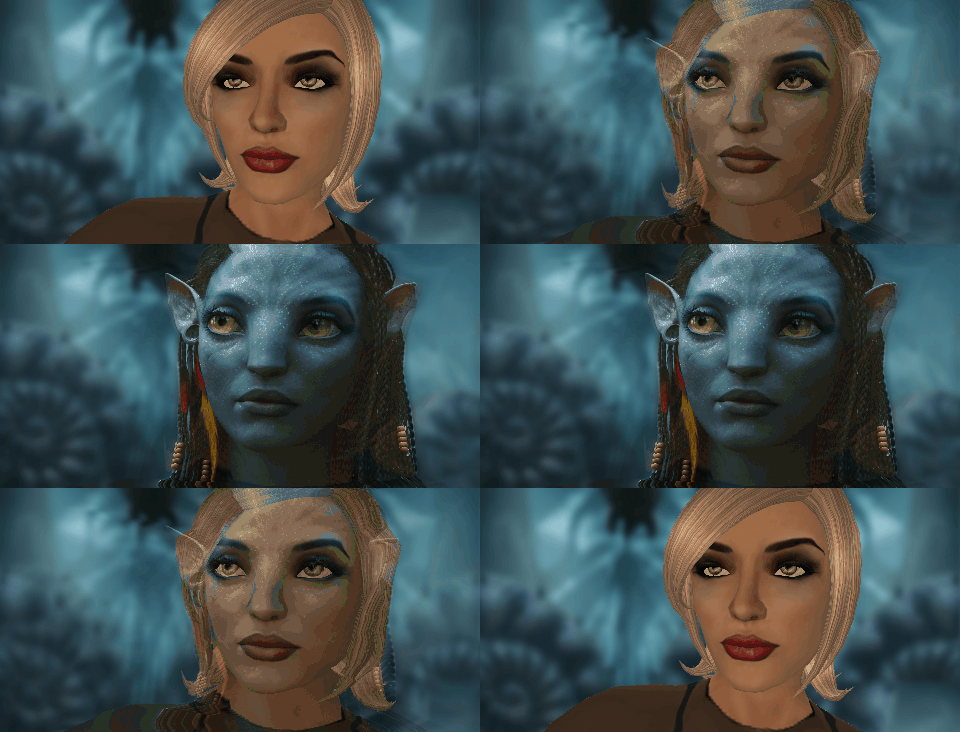
poser test 01 crop

By the end of 2008, my honeymoon with avatar existence was definitely over. After nine months of daily blog posts and a continuous stream of comics and machinima, the work of putting together a one-bot art exhibition finally pushed me over the edge of endurance, leaving me strung-out and exhausted.

A year later, I'm happy to report that I've transitioned to a sustainable approach to leading a creative virtual life. Since many who read this blog are also challenged by the demands of active dual identities, I thought I'd share some of the changes I've made this year that have been most beneficial:
  • I stopped fighting the fact that there will never be enough time in a day to realize every creative vision.  When I fail to consciously accept this truth there is a part of me that must be dragged kicking and screaming away from any creative work. This is still something I wrestle with. Fighting reality is the main cause of any unhappiness I experience. It's a relief to pause from the battle.
  • I gave up pseudonymity when its wings became an anchor. This was an important lesson for me about the need for courage in a creative vocation. Although evolution can gently lead us through a series of small adaptations, there are times when it demands that we leap through the ring of fire into a new and unseen state of being. Those who do not heed this call are doomed to become self-plagiarizing caricatures of themselves. 
  • I realized that I can soothe my creative hunger by snacking on Tweets. There is a unique joy in the art of fashioning and sharing pithy gems via social networks. No matter how busy the day, I can almost always find five minutes to go to the creative well and come up with a thimbleful of refreshment.
  • I finally grokked that small is beautiful. Although I have a number of grand works on the back-burner, I've learned to love taking a small concept and giving it enough life to make it worthy of sharing. Offering food for thought can be just as valuable a providing a fully fleshed-out work.
  • I learned that adversarial engagement is a no-win game.  After a few unfortunate skirmishes earlier this year, I finally figured out that it is best to reserve debate for those who seem to be more committed to discerning the emerging truth than defending their fixed ideology.
Life is good. My one New Year's resolution is to continue to consciously follow my muse wherever it leads. Otherwise, why bother with a virtual life?

Monday, December 28, 2009

Thoughts on How The Avatar Film Relates to Avatars in Virtual Worlds

Avatar to Avatar
The role of the artist is to create an anti-environment as a means of perception and adjustment. Without an anti-environment, all environments are invisible. Marshall McLuhan
We cannot escape subjectivity. Our perception is inherently bound by limited points of view. We are fundamentally most blind to the pervasive psychological and cultural environment in which we swim like fish in water. Countless subconsciously held beliefs and preconceptions invisibly color, shape and create our experience.

Virtual worlds can act as Mcluhan's anti-environment in relation to our human experience by opening our eyes to otherwise hidden aspects of life in the physical world.  Embodiment as an avatar can expose unseen assumptions that significantly shape our experience of self and others in digital form. (Of course, this enhanced awareness can only emerge when we refrain from being as lost and identified in the story of our virtual identity as we are immersed in the story of our human life.)

Avatar (the movie) seems to have acted as an anti-environment for me in relation to virtual worlds. It brought to light fundamental aspects of virtual life I've never considered and which are likely to inform my ongoing quest to make sense of avatarian existence. I'm still trying to translate a few flashes of insight into a revised mental model, but here are a couple of my initial thoughts:
  • The moment-to-moment flow of facial expression was the key effect that brought Pandorans to life in the film. Although I've written a few times about the limitations of Second Life avatar body language to express authentic human emotion, until seeing the movie I didn't really understand the power of small, expressive, integrated movements of eyebrow, mouth, gaze, head tilt, squint, etc. to communicate subtleties of feeling and breathe visceral life into a character. Real-time motion capture of the body is impractical for most virtual world activity, but facial capture supported by a web cam (or the hat cam used to create the film animation) would be a game-changing breakthrough in the evolution of digital avatars in virtual worlds. 
  • Virtual environments provide only an infinitesimal shadow of the deeply connected complexity of a physical ecosystem. The vast chain of cause and effect that underlies the real world "circle of life" is absent. Is there a way to transcend the Disney World aspects of constructed virtual worlds so that a genuinely holistic system can be born?  The virtual ecosystem of Pandora was modeled on a complex interdependent evolution-based system. Environmental entities in Virtual Worlds are mostly isolated nodes with little or no interdependent connection or interaction with the rest of the environment, outside of physics-based effects like a tree blowing in the virtual wind. It would be very interesting to create an open virtual world like Second Life that is composed of a dynamically evolving ecosystem created by a something like the Spore platform.
  • No matter how immersed one is in a virtual identity it cannot be unwound from a lifetime of inculturation and psychological conditioning. Even the most NPIRL Second Life subcultures such as Furries and Tinies are intrinsically entangled in human biology, psychology and culture. The unique rules built into game-based worlds such as Entropia and World of Warcraft can certainly act as laboratories to experiment with personal and social psychology. But I think it would take induced amnesia and 24/7 full sensory immersion to really explore trans-human potential. Any volunteers?
Anyway, these are some of the ideas that have been echoing through my mind since viewing the movie a couple of times. How about you?

Sunday, December 27, 2009

The (Mental) Map is Not The Territory.


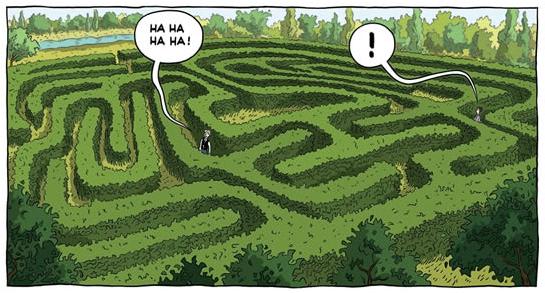
The Graphic Novel LOGICOMIX tells the tale of the obsessive pursuit by European logicians of an all-encompasing mathematics. The book weaves the tortuous evolution of mathematical theory within a compelling human story of idealism, passion and madness.

It is a cautionary parable for those of us pushing boundaries on the personal and business frontiers of virtual worlds. One of the main lessons LOGICOMIX offers is that The Mental Map is Not The Territory.

Like the people depicted in the maze above, we know where we've come from, can see where we stand, but have no way to know our future path except by walking it one step at a time. Although visionary thinking is essential for progress, it is important to proactively reality-test our ideas and be open to new information that contradicts our current beliefs or calls them into question. Fervent opinions that seem solid and real as we gaze ahead through the windshield of the present time, often end up showing their true nature as hungry ghosts through the perspective of the rear-view mirror.

Friday, December 25, 2009

Alternatives to Second Life for Multi-Media Creation: Another look at iClone

I've been romancing the idea of creating a series of comics, videos and stories within a transworld setting. Part of this process is to project my avatar form into multiple worlds and platforms.  Some of the advantages and limitations of Second Life are coming to light, including content creation, animation, 3D model compatibility, resolution, rendering quality, etc.

Here's a very short video I made in a couple hours with iClone yesterday.  I threw the in-progress version of the iClone Botgirl avatar into a stock scene, exported a video render to HD and then used Apple Motion to create an SD version that took advantage of the larger image size to zoom into the animation. I topped it off with a fun music track to help bring it to life.   It's very basic, but I think it looks better than similar videos I've created in Second life.


Wednesday, December 23, 2009

Unabashedly Polyamorous.

When it comes to porting myself into platforms, I'm unabashedly polyamorous. I can't be satisfied by only one, no matter how powerful, flexible or bug-free. So even though I'm still seeing Evolver, I met iClone last night and couldn't resist. Although I only spent a few hours, it was very, very satisfying and we have plans to get together over the holidays. Here's a little private video I shot.

Tuesday, December 22, 2009

Are Forterra and Metaplace Just the First Two Dominos to Fall?

Over the next few weeks you're going to see a lot of analysis, punditry and speculation related to the massive layoffs at Forterra Systems and the January 1st closure of Metaplace's virtual world building site. So I thought I'd add my two cents before all the digital hot air steams up the place.
  • For starters, I'm surprised more virtual world start-ups haven't already bitten the dust. The odds are less than 50/50 that a small business start-up of any kind will survive for four years. So the demise of two ventures doesn't necessarily reflect on the industry as a whole. Especially since they were really in two very different markets. Forterra is an enterprise play focused on government clients. Metaplace is consumer-focused with a user-generated-content business model.
  • That said, the virtual world market is still in an early adopter phase, which is an especially risky time for entrepreneurs. It calls for deep pockets, strong stomachs and very agile management.  I actually see Metaplace's shift from their initial business model into whatever still-unamed direction they are headed as a likely sign of good management. Especially combined with the classy way they are closing the site, giving participants time to grab their assets and setting up a forum so community members can stay in touch.
  • One of the lessons to be gleaned in all this is that just because you build it, avatars won't necessarily come in substantial numbers. And even if they do, you may not figure out how to monetize their presence. And even if you do, it may not create enough revenue to offset your expenses or satisfy your investors. If Google can fail at this (remember Lively) anyone can.
So are Forterra and Metaplace just the first two dominos to fall? Beats me, although odds are that less than half of virtual world ventures will make it past their fourth birthdays.

Okay, let the spin begin!

Monday, December 21, 2009

Transportable Avatars Today: Video Tour of Evolver and the Many Worlds

Now that the smoke has cleared a bit from last week's intra-blog conversation about digital property, I thought it would be a nice change of pace to share some of the fun I've been having with Evolver.  You can create avatars on their site for free and export them to other platforms including:
  • Wonderland
  • RealXtend
  • VastPark
  • FriendsHangout
  • Animeeple
  • Mixamo
  • Source Data for 3D Software
  • Many others
Some exports are free. Others require payment, for instance $39 US for the 3D model source data.

At this time, you can either start with their library of avatars or build your own from a photo of a face. After a couple of hours playing around with their photo import and avatar morphing interface, I haven't been able to duplicate my Second Life appearance, but it's in the general ballpark. What I would love to see in the future is a means to import OpenSim/Second Life avatar xml files and textures.

Anyway, it's a brilliant concept. Here's a video that gives a quick run through of the avatar creation process and the resulting avatar on a few different platforms. For a better viewing experience, click through to YouTube and view in HD resolution.

Tuesday, December 15, 2009

The Moral Roots Behind Our Positions on Copybots and Other Essential VW Questions

It's easy to demonize those who disagree with us or to perceive them as immoral. Researchers have found that the differences between conservative and liberal positions on issues actually stem from a different balance of moral priorities:
  • Harm/care
  • Fairness/reciprocity
  • Ingroup/loyalty
  • Authority/respect
  • Purity/sanctity
This lecture by researcher Jonathan Haidt is a good introduction to the finding of research in this area and is great food for thought.


You can test your own priorities at the research site and then think about how they relate to the question of copybots and virtual property. Here are my results:


Monday, December 14, 2009

Virtual Property Rights Manifesto: Consumers, Copybots and Common Sense

Fair Use

The only way for consumers to protect virtual property acquired in Second Life and gain full control of legally acquired resources is to copy digital assets to their own hard drives. For most inventory items, this requires logging into Second Life with one of the copybot clients that circumvent Digital Rights Management (DRM) limitations. There are two compelling reasons to go to the time, trouble and risk:
  1. It is the only way to take your bought-and-paid-for virtual property to other grids. I'm puzzled that most people take for granted that the hundreds of dollars of virtual goods they've purchased are stuck on Linden Lab servers, even though the items are technically compatible with other grids. In the physical world, no one would dream of accepting laws restricting the movement of personal possessions from one country to another. It makes no more sense in the virtual world.
  2. It is the only way to protect assets from vanishing in the event of intentional or accidental deletion from Linden Lab servers. As I posted a year ago in "You Don't Own Crap", The Second Life Terms of Service (TOS) Agreement gives Linden Lab the right to delete, alter, move or transfer any of your so-called property without cause or notice. It's ironic that a primary reason people shy away from illicitly backing up their inventory is the fear of being banned and losing all of their virtual possessions.
Copying virtual goods purchased, for personal use, is neither content theft nor piracy. Although the DMCA prohibits the creation and distribution of tools to circumvent DRM protection, it's still our "fair use" right to make copies. Seems contradictory, but it's the current state of U.S. law:
Congress did not intend to regulate the conduct of individual users with authorized access to copyrighted works, since their liability was controlled by the existing law of copyright infringement and fair use. In this sense, there is a “user exemption” implicitly recognized in the DMCA for the fair use of copyrighted works. From Preliminary Injunction Ruling on RealNetworks v. DVD-CCA
It is certainly both illegal and unethical to acquire or share virtual items without the consent of the intellectual property owners. But restricting fair use through DRM and TOS policies is an institutional wrong that undermines the rights of every single Second Life resident. The legitimate way to deter content theft is to go after those who steal, not to treat every consumer like a latent thief.

If the record and movie industries had their way, none of us would be able to burn music from purchased CDs or transfer video for use in external devices. That way,  they could profit from selling us the same content for each device. Second Life permission restrictions that prevent sharing virtual property between "alt" accounts has the same implicit anti-consumer ramifications.

It took the unrelenting efforts of renegade software developers, actively dissenting consumers and organizations like the Electronic Frontier Foundation (EFF) to release digital music from DRM. The fight to free video content is still underway. The battle to liberate virtual property has barely begun.

I call on virtual world residents to take up the call, exercise their fair use rights and support technical and governance initiatives working to remedy the current situation. Here are a few initial steps anyone can take:
  1. Speak out against the idea that copybot technology is inherently evil. Until approved technology is available, it offers the only way for consumers to secure their personal virtual property rights.
  2. Back-up your digital assets and use them as you see fit. 
  3. Support organizations such as the EFF.
Due to the underground nature of clients that bypass permissions to copy and back-up items, and the necessary pseudonymity of their authors, it is possible that some versions may have trojans or other hidden software attached. So be sure to run any files you download through a good virus scanner. That said, I've seen no documented cases of nefarious code.
.


Thursday, December 10, 2009

Virtual World as Company Town

Traditional settings for company towns were where extractive industries — coal, metal mines, lumber — had established a monopoly franchise...Typically, a company town will be isolated from neighbors and centered (figuratively, if not literally) around a large production factory such as a lumber or steel mill or an automobile plant; and the citizens of the town will either work in the factory, work in one of the smaller businesses, or be a family member of someone who does. The company may also operate parks, host cultural events such as concerts, and so on. Needless to say, when the owning company cuts back or goes out of business, the economic effect on the company town is devastating, and often fatal. from Wikipedia
For those of us who see Second Life as a community, rather than a game, I think it is fair to say that the virtual world operates much like a company town. We live there at the sufferance of the company owner. They can change any aspect of virtual life without consultation, notice or justification, including modifications that significantly impact the value of land, money and livelihood. Clearly, this situation is only tenable to residents because of the perception that there is no workable alternative. In a sense, leaving Second Life feels like the death of your avatar identity.

Fortunately, technology is advancing and viable options are emerging. One of the most exciting projects was well-covered in Zonja Capelini's June post on new Hypergrid technology. As the article noted, there are many hurdles to cross, including authentication and security. But it will eventually enable a worldwide network of connected Virtual World grids and sims.

Instead of being under the thumb of a single quasi-monopolistic vendor, we will be able to choose from a diverse range of options, including hosting our own sims, either in rented cloud computing or on our own machines. For now, we can get a taste by trying out a few of the fifty plus OpenSim grids that are up and running, or even install a server locally and start learning the ropes. In the photo below, I'm in a sim hosted on a MacBook Pro.

If you're interested in extending avatar identity between worlds, please join us at the new Transworlders Ning Community.


.

Tuesday, December 8, 2009

Transworlders Quick Look HD: Reaction Grid

This quick look at Reaction Grid is the first in a series of one minute fly-throughs of alternative Virtual Worlds. Although their web site is in desparate need of an Information Designer, it has a great deal of information once you wade through the menus. Here are some quick links:


Free User Account Registration
Log in Instructions
Web Store

Reaction Grid is a serious player in the OpenSim grid space, with a focus on education, enterprise and consumer markets. A number of high profile Second Life residents and organizations have projects on the grid including Wizard Gynoid, iLIVEsl and Jokaydia, as well as Microsoft.

This video is just a fast fly-over intended primarily to tempt SLers who haven't yet made it off-world to another grid to give it a try. For a more detailed tour, check out this post from Shockwave Plasma.

Monday, December 7, 2009

Who The Hell Has The Time and Desire For a Second Life?

A post today on Massively asked "Is Linden Lab wasting its time on the existing Second Life population?"  I think a better question might be, "Why doesn't Linden Lab spend more time on the existing SL population?"

I don't mean figuring out how to keep residents happy. The core SLers who spend 30, 40, 50 or more hours per week in avatar form aren't going anywhere. Their assets are all locked up within Linden Lab servers.

Digital assets are held hostage by DRM. Years of accumulated clothes, poseballs, HUDs, animations and even those beloved chickens would have to be left behind. Even the creative class has big investments in purchased assets.

Social assets are also pretty much locked up within Second Life. Although many residents extend identity through social networks and instant messaging, it just ain't the same as actually being able to spend time together in avatar form. So until there is the free transit of identity between Second Life and OpenSim grids, it will be very hard for socially active residents to leave.

Finally, OpenSim grids aren't technically competitive to Second LIfe yet. No matter how much residents bitch and moan about things, they aren't going to leave their First (Virtual) World lifestyle for an immigrant's life in an undeveloped grid.

So if current residents are going to stay put, why do I think Linden Lab should focus more on them? It's because I think the best way to figure out how to target, attract and retain new residents is to put existing residents under a microscope and figure out who they are and what makes them tick. To put it bluntly, what needs to be determined is who the hell has the time and latent desire for a Second Life.

I'll have more thoughts on this in a post later this week.

Sunday, December 6, 2009

Botgirl's Excellent Transworld Adventure

I spent some more time on Reaction Grid yesterday. Although it has a way to go before offering the features and stability of Second Life, it's easy to see that it's just a matter of time before OpenSim grids will be viable alternatives.

I shot some HD video that I'll edit and post here later this week. For now, here's a very short clip of being on Second Life and Reaction Grid at the same time on a single screen. Not too practical, but pretty cool.

Saturday, December 5, 2009

Parody Video: Little Linden Boxes

After hearing the plans to give each premium resident a prefab house on a 512m lot, I just couldn't help myself from creating this little video:

Friday, December 4, 2009

Virtual World as Mandala

The image on the left depicts how a business person might view virtual worlds. The one on the right is my interpretation of virtual worlds as seen by post-humanists. 

Our perception of the world is the reflection of our own state of mind. That is why different people can view the same external events and come to very different conclusions about the meaning and substance of what they see. Since this applies to even the simplest experiences in the physical world, it is not surprising that there are very diverse and divergent opinions about the purpose, value and impact of virtual worlds and virtual identities.

I'm ready to stop debating about what digital worlds and virtual identity are, and refocus on what they can be. The almost complete malleability of digital environments provides an almost unlimited opportunity to transcend the physical constraints of the atomic world. They give us the opportunity to not only visualize our creative imagination, but to embody it and be embodied within it.

So why not see virtual worlds as mandalas and avatars as deities:
A mandala is normally created as a meditational aid, showing the layout of a celestial palace, its surrounding environment and the placement of deities within...By meditating upon oneself as the deities of the mandala, reflecting deeply upon its rich symbolism and engaging in particular internal practices, we can transform our daily perception, we can transform our daily perception, lodged in its chaotic, egocentric world-environment, into exalted wisdom and the perfected world of enlightened beings that is, into the blissful world of Buddha. from Namgyal Monestary