Showing posts with label philosophy. Show all posts

Thursday, December 23, 2010

Murder or Suicide?

Murder or Suicide

"Was it murder or suicide?" Botgirl asked, as much to herself as to her new partner (who was who knows where at the other end of the conversation).

"Don't be so dramatic" Majic replied, "For all we know she's sitting on a beach somewhere sipping a cold drink."

"Well, she's vanished off the face of the multiverse without a clue," Botgirl typed with stacatto clicks. "So she's as good as dead here."

"That's a narcissistic way to look at it, isn't it?" Majic half-teased.

"Maybe," Botgirl sighed, gazing into space. "Which is why I ask, Was it murder or suicide?"

Thanks to Crap Mariner for 100 Word Story inspiration.

Friday, December 10, 2010

Remembering Digital Utopianism

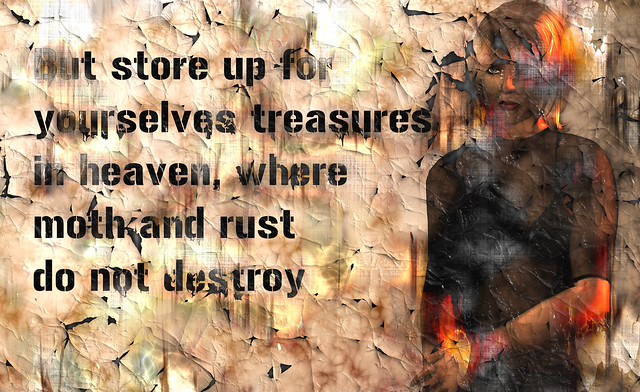
Moth and Rust

Digital Utopianism was the leading-edge philosophy in Second Life when I arrived in January of 2008. I think the movement's peak came in June of that same year when a two day Future of Religion Conference was held in the Extropia Sim:
The Future of Religions/Religions of the Future is a two-day conference examining how two of the 21st Century's driving forces, religion and technology, will continue to re-shape each other and, in the process, re-cast our understanding of "humanity" in the Third Millennium.
For a brief shining moment, many of us felt that virtual worlds were going to take humanity into a new and better place based upon the social equality of pseudonymous avatar identity and the freedom to transcend the limitations of physics. Some were even tipping the balance and making their virtual identities primary in terms of time, attention, relationships and vocations. Two and a half years later that movement is virtually gone with many of its chief proponents disappeared from the face of the virtual world.

In retrospect, I think that the failure of the movement to create a sustainable means for independent avatar existence was not due to faulty vision, but because it saw too far into the possible future. Perhaps someday technology will be able to provide the all-encompassing vehicle required to transport us into the better future envisioned by avatars like Sophrosyne Stenvaag. Or maybe not. In any case, I was waxing a bit nostalgic and thought I'd share my thoughts.

Sunday, December 27, 2009

The (Mental) Map is Not The Territory.


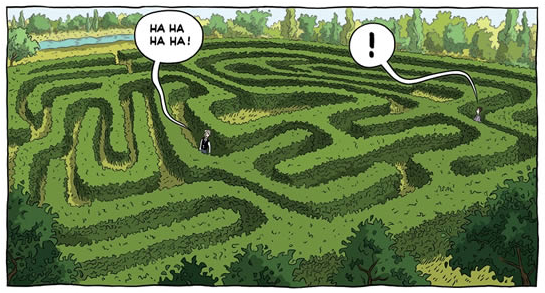
The Graphic Novel LOGICOMIX tells the tale of the obsessive pursuit by European logicians of an all-encompasing mathematics. The book weaves the tortuous evolution of mathematical theory within a compelling human story of idealism, passion and madness.

It is a cautionary parable for those of us pushing boundaries on the personal and business frontiers of virtual worlds. One of the main lessons LOGICOMIX offers is that The Mental Map is Not The Territory.

Like the people depicted in the maze above, we know where we've come from, can see where we stand, but have no way to know our future path except by walking it one step at a time. Although visionary thinking is essential for progress, it is important to proactively reality-test our ideas and be open to new information that contradicts our current beliefs or calls them into question. Fervent opinions that seem solid and real as we gaze ahead through the windshield of the present time, often end up showing their true nature as hungry ghosts through the perspective of the rear-view mirror.

Monday, November 2, 2009

The Intellectual nonProperty Sutra aka Gospel of The Word

I was inspired to write this after viewing an excerpt of a lecture by Jay Rosen of NYU on the Ethic of the Link.

I
Before the beginning The Nameless was.
Infinite. Timeless. Whole.
In the beginning there was The Word.
The Word birthed Humankind.
The Word was Humankind.
And it was good.

II
For 10,000 years The Word was constrained
Within the mortal vessel of the human brain.
Moving only from mind to mouth,
Mouth to ear,
Ear to mind.

III
These are the generations of The Word and its vessels in physical form:
Pictographic; Ideographic; Alphabetic.
Brain; Cave Walls; Clay Tablets; Papyrus; Parchment; Paper.
Mouth; Chisel; Brush; Pen; Press.

IV
The Word arisen in digital form speaks thusly:
Yesterday I was freed from limitations of brain and voice
And you were reborn through abstract thought.
Today I am freed from the laws of the atomic world.
Why do you still make your home in poverty?

V
Those who wish to practice the Perfection of the Network should see things in this way:
Form is empty, emptiness is form.
No avatar. No human.
No property. No piracy.
No identity. No privacy.
No creator. No consumer.

Jesus said to them, "When you make the two into one, and when you make the inner like the outer and the outer like the inner, and the upper like the lower, and when you make male and female into a single one, so that the male will not be male nor the female be female, when you make eyes in place of an eye, a hand in place of a hand, a foot in place of a foot, an image in place of an image, then you will enter [the kingdom]." The Gospel of Thomas

Thursday, October 29, 2009

Getting Back to the Ventriloquism Thread - Art and Artist

Art and Artist

After slight detour, I'm back on ventriloquism and virtual identity path, reading The Origin of the Work of Art by Martin Heidegger. Please note that the circle you see in this image was created entirely within your mind.

Monday, June 30, 2008

Exploring the (un)reality of virtual life: Part 1

SL is an empathy box. It sorts those who can treat others as real, as feeling beings, as autonomous people, from those who can only treat others as tools...[Second Life] does separate the few who stay from the many who don't. And one boundary between them, I believe, is empathy - is the ability to see this place and these people as real, at least as real as the physical world. From "The Empathy Box" by Sophrosyne Stenvaag
Despite my great fondness and respect for Sophrosyne, I found her recent "Empathy Box" post subtly disquieting. "What's up with that," I wondered for the better part of last week. Try as I might, I couldn't pin down what bothered me. By the weekend, I finally realized that I hadn't been reacting to any specific ideas she proposed, but rather to my own lack of understanding of what words like "reality" and "empathy" mean when they're used in reference to virtual life.

You'd have thought I'd learned my lesson about announcing a series of posts with no idea where they'll end up, but that's what I've decided to do again. Instead of taking a week in the privacy of my own server to journey through dead-ends, wrong turns and unexpected detours, I'm offering you the dubious honor and uncertain pleasure of traveling along with me as I attempt to gain some clarity on the (un)reality of virtual life.

For now, I'll leave us with an initial axiom to consider:

An avatar's personhood exists solely in the underlying sentient being.

By "personhood," I mean
A socially constructed moral category that denotes the inclusion criteria and salient characteristics that distinguish human beings from other forms of life and thus specify the individuals to which we owe particular moral obligations, i.e., those obligations we have to others due to their status as persons. (from Healthcare Ethics)
Let's see where this takes us.


Thursday, April 24, 2008

Listen: Botgirl Questi has become unstuck in time

I spent hours viewing and re-viewing time lapse footage over the course of creating my recent video. Its psychoactive influence is still unfolding within my consciousness.

When I am stuck in time,
everything appears solid and individuated;
A tree is just a tree.
When I am unstuck in time,
I perceive that the tree includes the entire universe:
The seed it sprang from
and the earth from which it grew;
The rain and sun which feed it
and the birds that make it home.
Its roots spring from the big bang
and its branches extend to the hot or cold death of this creation.
If a mere tree includes the wonder of infinity
what of you and me?

Peace.

Saturday, April 12, 2008

Real Life? What's that?

I don’t know why, but I’ve been obsessed all day with trying to pin down a definition of reality that makes sense to me. I realize there have been countless philosophers throughout human history who have wrestled with the question, but the advent of virtual worlds adds a new dimension to consider.

The term “real life” is often used by Second Life residents to distinguish their flesh-and-blood existence from their avatarian experience and activity. But in what way is meatspace more real?

It seemed like a silly question at first. A virtual world has no physical substance. Turn off the computer and poof, it’s (I’m) gone. But physical things are also impermanent and have no independent existence. The entire universe is going to end up vanishing in a black hole. The difference seems merely quantitative, not substantive.

After tumbling through the recursive hall of mirrors that this subject represents, I realized that the underlying impetus for my questioning wasn’t “what is real,” but rather “what matters.” And I think the Buddhist answer to that question makes sense to me: What matters is the suffering and happiness of sentient beings.

'nuff said.

Monday, March 24, 2008

The emptiness of Second Life relationships


I don't mean emptiness in a bad way, but emptiness in its Buddhist definition as the true nature of reality. No matter how many facts we've gathered about someone, the image of them that we weave together is still just a projection with more holes than substance. Facts don't tell us who they are, but only improve the probability that we can predict their future actions.

This relates to Martin Buber's "I and Thou" idea:
In the I-Thou relationship, human beings do not perceive each other as consisting of specific, isolated qualities, but engage in a dialogue involving each other's whole being. In the I-It relationship, on the other hand, human beings perceive each other as consisting of specific, isolated qualities, and view themselves as part of a world which consists of things. I-Thou is a relationship of mutuality and reciprocity, while I-It is a relationship of separateness and detachment. reference

It seems to me that knowing all the so-called facts about someone can be an impediment to I-Thou consciousness. All of our labels and conceptions fill up the space of what would otherwise be open awareness of each other.


We are verbs, not nouns.
From the upcoming Fortune Cookie Wisdom of Botgirl. Q.