Tuesday, March 31, 2009

The Message of the Second Life Medium

I'm a big fan of the late Marshall McLuhan, the visionary author, academic and rock-star-famous intellectual. Although the majority of his work was written in the 1960's, everything I've read so far is still dead-on relevant to our time. In fact, I put him way ahead of the current crop of techno-culture gurus.

I've been wrestling a long time with his idea that, "The Medium is The Message." At first, it seemed pretty preposterous. The ideas presented in this post would be identical no matter whether transmitted through an email message or print publication, right?

What I eventually realized was that "The Message" doesn't refer to the string of words that sit in a wrapper (like the sound of a tree falling in a forest with no one to hear.) Instead, it's the web of thoughts, images and emotions that recipients experience. And the medium's impact on our consciousness is more powerful than any particular message because "The Message of The Medium" is repeated every time we're exposed to the form.

We are immersed in the pervasive mediums of our age like fish in water and barely notice their powerful impact upon our perception. For instance, how does spending hours a day on Twitter, Plurk or Second Life modify our consciousness?

What are the messages of the Second Life medium? One is: "Identity is fluid." I now suspect that the powerful identity-shifting experiences many humans have within Second Life are not just due to inherent qualities of being an avatar in a 3D environment. It seems to me that there are quite a few identity-related design decisions implemented in Second Life that could have just as easily gone the other way, such as:
  • the necessity to go by a name other than one's human identity;
  • no cost to create multiple alt avatars;
  • the ability to freely change genders and species at will;
  • the ability to easily shift POV and even separate camera from avatar;
  • the focus on text vs. voice which hides RL gender and accent; and
  • the absence of a requisite goal-oriented game
It's likely there are quite a few more that I've missed. I'd appreciate it if you'd post any that come to mind in the comments section.

That's all for now. I'm still slowly making my way through figuring out the promised Primates post and have just about decided to do it in comic form.

Wednesday, March 25, 2009

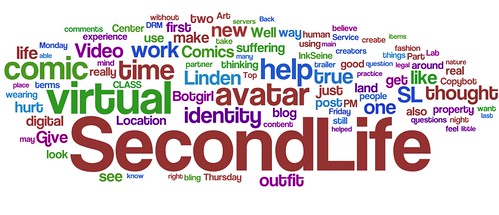
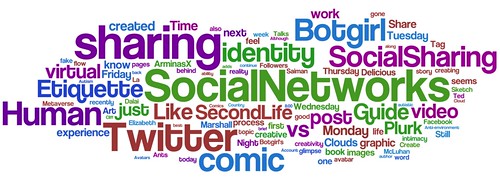
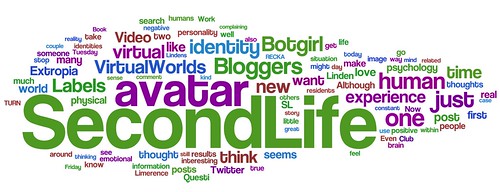
Wordle Exposes Botgirl's Radical Shift From Second Life to Social Networking

I was playing around with Wordle yesterday and thought it would be interesting to compare my blog posts from the first couple of months with text from the most recent two months. I ended up comparing three periods: April-May, 2008; October-November, 2008; and January-February 2009.

I ran each set through a series of "search and replace" iterations to eliminate repetitive text such as "Posted by Botgirl Questi" and "link to this post." I also combined a few word pairs so they wouldn't be processed separately, so "Second Life" was changed to "SecondLife" and "Social Network(s)" was replaced by "SocialNetworks."

I'll let the images speak for themselves:

April-May, 2008botgirl.blogspot.comWord Cloud AprMay2008
October-November, 2008
botgirl.blogspot.comWord Cloud OctNov2008
January-February 2009botgirl.blogspot.comWord Cloud JanFeb2009

I'll get back to Primates in Virtual Worlds in the next post.

Monday, March 23, 2009

Primates in Virtual Worlds: Part 1

No matter how fully-immersed humans are within a virtual world, Digital People are primates at heart (and brain.) You can run from meatspace physiology, and even hide from it, but you can't escape its influence on your consciousness.

The sense of being embedded in an external virtual world can only be experienced through the internal processes of our neurobiology. As far as your neurons are concerned, there is no substantive difference between seeing a human on earth and viewing an avatar in Second Life.

I ran across a fascinating lecture this weekend on "
The Neurobiology of Primate Sexuality" by Professor Robert Sapolsky of Stanford University. I usually think about virtual life from a psychological or sociological perspective, so it was refreshing to think about how biological systems impact human life in virtual worlds. I'll hold my additional comments until next time, to give you a chance to view the video. (The second video's aspect ratio is wrong, but audio is good.)

Part 1:


Part 2:

Wednesday, March 18, 2009

Notes on the Ambiguity of Identity

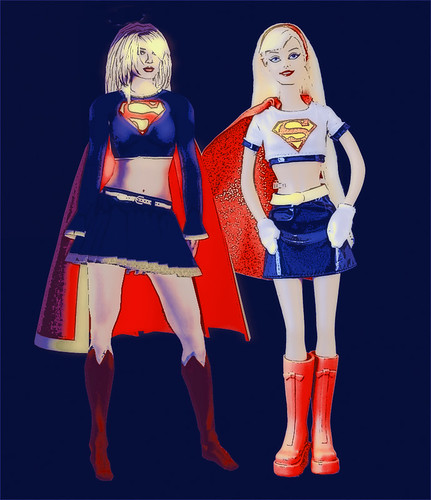
botgirl and barbie

I'm working on two main projects that are hopelessly scrambled in my inquiring mind:
  • a 1/2 sim art exhibition on "The Ambiguity of Identity."
  • a machinima that will extend the "Botgirl vs." comic series to "vs. Barbie;"
Although I tend to reflexively define identity as "the psychological experience behind one's sense of self," the most basic ambiguity of identity is the kaleidoscopic range of meaning associated with the term, spanning domains such as law, psychology, sociology, philosophy, spirituality and commerce.

Of course, "you" are not equivilant to the sum of the parts and pieces that make up the manifold definition-space of identity. When you deconstruct it all, you end up with emptiness. Nevertheless, until we reach Buddhahood, I think it's useful to keep working to expand our knowledge of what we don't know. And I think that narrative art is a good way to expose the unreality of our customary ways of viewing ourselves, others and the world around us.

One thing that Barbie represents to me, is the power of our culture to shape our tastes. Of course, there are certainly biological predispositions related to what we experience as beautiful or delicious. But the fact that some cultures view insect larvae as a mouth watering delicacy and others see obesity as an erotic ideal make me suspect that humans are pretty flexible when it comes to even survival-related tastes. So although I doubt that "mere Barbie" is responsible for the massive difference between our cultural ideal of female beauty and the average woman's Body Mass Index, I find her an apt symbol.

Enough words. Let me get back to the art.

Thursday, March 12, 2009

You Don't Own Crap Redux: Linden Lab to Create Adult Ghetto

Linden Lab announced today some "upcoming changes for adult content." Beyond the dizzying spin, it looks like:
  • explicit content on the mainland will be banished to a special continent
  • estate owners will have to flag explicit content
  • only age-verified residents will have access to the above
Others, such as Dusan Writer and Crap Mariner are doing a good job of walking through the implications. I just want to once again remind everyone that YOU DON'T OWN CRAP in Second Life. Linden Lab can do as they please, and they will. If we don't like it, we all know where the door is. Or is it the Rabbit Hole?

Monday, March 9, 2009

Virtual Art Initiative Launching Groundbreaking Exhibition Series

The The Virtual Art Initiative is an organization of artists, writers, musicians, and scholars who are using the immersive and interactive digital media of such virtual worlds as Second Life to develop new forms of artistic content. I'm happy to announce my participation in an eight month project it's sponsoring to explore the fundamental dimensions that make the art of virtual worlds a unique aesthetic medium.

The initiative will create six exhibits, each focused on a core dimension of virtual art:
  • Immersion
  • Interaction
  • Ambiguity of Identity
  • Environmental Fluidity
  • Artificial Agency
  • Globally Networked Collaboration
Each will be created through a collaboration of artists under the direction of a project leader. They will be exhibited sequentially over the course of approximately eight months on a half sim in Second Life. The collaborations will be documented in images, text, and machinima, and will generate work that will be exhibited in the "real world" Harbor Gallery at the University of Massachusetts at Boston in April 2010.

Sabrinna Nightfire and I are leading the Ambiguity of Identity segment. We're in the early planning stages now and are slated to exhibit in about five months. I'll keep you posted as specific dates are announced.

Friday, March 6, 2009

I'm Not An AI-Based Avatar, I just Play One On The Internet

I'm also not a human-based business person, I just play one at work. Regardless of how you lay claim to the reality of your own roles, it is a bitch trying to manage multiple identities on the web. Between my unique IDs, I juggle:
  • 6 blogs
  • 3 Twitter accounts
  • 3 Flickr accounts
  • 2 Friendfeed accounts
  • 8 email accounts
  • 3 Premium Second Life accounts
  • 2 Swurl accounts
  • 2 Delicious accounts
  • 2 Plurk accounts
  • 2 Linked-In accounts
  • 2 Ping-fm accounts
Plus literally dozens of others ranging from virtual worlds to social sites.

After a lot of trial and error, I found the easiest way to function with multiple identities is to give each one its own browser on each computer I use. So on my Mac laptop, the primary human account gets Firefox and TweetDeck and Botgirl uses Flock and the Twitter Web Interface. Less commonly used identities are relegated to Safari and Opera.

On my iphone, Tweetie supports multiple identities. Facebook only supports one (without entering IDs and logging in and out) so my human identity uses the application and Botgirl uses Safari. iPhone's mail application supports multiple accounts and works very well.

Multiple identities are fun, but can be a lot of work to manage. There have been a handful of times I've accidentally posted something to the wrong place. No harm done yet! If anyone has come up with other "best practices" for managing multiple identities, please share.

Wednesday, March 4, 2009

When Avatars Leave: Supporting our Friends Through The Grieving Process

Most of the people we meet in Second Life are known only through pseudonymous identities. Over time, relationships from casual acquaintance to romantic love develop without the knowledge of human names, ages, genders, professions or places of residence.

The pseudonymity of Second Life allows some people to share very intimate thoughts, feeling and desires that are typically hidden from Physical World friends and loved ones. Although the initial feeling of safety allows such shielded aspects of the Self to be exposed, it also creates a significant level of emotional vulnerability. When a close pseudonymous relationship is terminated, the abandoned partner is likely to go through a period of significant grief that spills into his or her human life.

In addition to separations that are not very different than human "break-ups," sometimes an avatar disappears completely from the virtual world without a trace. These situations can be very hard on the ones left behind because of the difficulty in finding a sense of closure. The vacuum of information can be filled by echos of unhealed trauma that can go all the way back to earliest childhood. Intense waves of emotion such as fear, despair, anger and desperation can wash over the ones left behind.

Since many people keep their Second Life secret from human friends and family, there is often nowhere to turn for support in the Physical World. Unfortunately, the informal support of virtual friends, no matter how well meaning, is usually not up to the task of substantively helping someone move through their grief process.

It occurred to me that it might be useful to create some sort of virtual ritual to help those left behind find some closure when avatars leave. Something like a wake or Shiva. Friends could share memories of the departed and share time together reflecting on the nature of virtual relationships. Perhaps there could be some sort of symbolic burial, cremation or de-rezzing.

Has anyone heard of this type of ritual being performed in Second Life? Any ideas on other elements that might be useful?

Sunday, March 1, 2009

Waking Up In Virtual Worlds

That nothing is static or fixed, that all is fleeting and impermanent, is the first mark of existence. Pema Chodron.
Second Life can be a great teacher of impermanence. Although it feels like the avatars, places and objects we experience virtually are solid entities, it is relatively easy to understand they are actually projections of data on far-flung servers. Noticing how our mind creates the illusion of reality within a virtual environment can help us catch a glimpse of how the same mental processes create our experience of the atomic world.

Seeing through the illusory nature of our experience of pseudonymous virtual relationships is much more difficult. It feels like we have some sort of innate ability to see the "real person" behind the avatar. We don't. What actually happens is that our very limited experience of a person's words and deeds are transformed into a mental image that's completely fabricated by our own mental projections.

Of course, we do the exact same thing within our physical world relationships. So when we see the mirage-like nature of the virtual, it is a small step to also wake up, at least for a time, in the physical.