
Showing posts with label vwbpe. Show all posts
Showing posts with label vwbpe. Show all posts
Thursday, April 17, 2014
Video Edition of Message of the Virtual World Medium
Excerpts from my comments on The Past Present and Future of Virtual Worlds panel at this year's VWBPE. You can view the unedited two hour video here.

Wednesday, April 16, 2014
The Message of the Virtual World Medium

Two of his ideas are especially useful in framing how we think about virtual worlds. The first is that each successive technology extends one or more biological human capabilities. The concept is simple. The wheel extends the leg; the alphabet extends speech; paper extends our memory; and so on. Virtual worlds extend multiple human capabilities. Avatars extend our physical bodies; realtime video and audio extend our voice and our sense of sight and hearing; and virtual identity extends our singular wallet name identity. When a new medium becomes dominant in society it can shift the balance of our senses. The alphabet, for instance, shifted the dominance from sound to sight. Shifts in sensory balance impact the underlying perspective through which we perceive the world.
The second idea is, “the medium is the message” which means that the overall influence of a technology has vastly more impact than any particular product, vendor or content. Its influence doesn't just include the technology itself, but the entire service environment that surrounds it. For instance, the automobile medium includes highways, gas stations, the oil industry, the aftermarket, etc. Our pervasive use of the automobile is vastly more consequential than anywhere in particular we drive. It has contributed to revolutionary societal change, ranging from the rise of the suburbs to wars in the Middle East. Another example is the invention of the phonetic alphabet, which advanced human ability to think abstractly. That baseline enhancement of human potential is much more significant than any particular book that's ever been published.
So what’s the message of the virtual world medium? I don’t think it’s been voiced yet. Virtual worlds are used by maybe a million people worldwide. Compared to the approximately 1.5 billion users of social networks and smartphones, virtual worlds barely show up on the map. New technologies succeed to the extent that they provide those who use it with a quasi-evolutionary advantage over those who don’t, or what is now referred to as disruptive change.
So far, virtual worlds have not provided the type of clear-cut advantage that propelled smart phones and social networks to ubiquity only a few years after their introduction. The main limiting factor is that existing technology doesn't integrate virtual worlds with the rest of our physical and virtual lives. Imagine if you could launch into a virtual world as easily as you enter into chat on Facebook or rez into a multi-media enabled VR conference room from a GoToMeeting link. Two mundane examples, but I believe that it will take those type of relatively pedestrian use-cases to pave the way for virtual worlds to become a mainstream medium with the potential to expand human capacity. Virtual worlds can not change the world until a critical mass of people spends part of their lives within them.
From my own personal experience, creating a “second life” within an open virtual world can actualize latent potential for creative expression and provide significant insight into the human condition. Unfortunately, like falling in love, it is a very subjective transformation that can not be communicated well to those who have not experienced it for themselves. I hope that the next wave of virtual worlds will make it easier for newcomers to participate and better support the integration of the experience with the rest of their life.
Thursday, April 10, 2014
My Take on Rosedale's Keynote

In 2006, virtual worlds were hyped as the next big thing. Many of us in the virtual world community thought that people would soon be routinely using virtual worlds in the normal course of their day-to-day lives. Eight years later, the use of avatars within virtual 3D environments has gained little widespread traction outside of games. Over that same time period, mediums such as social networks, Web 2.0 meeting services and mobile apps have all exploded into mass market ubiquity. How were we so wrong?
Philip Rosedale tried to answer that question in his VWBPE Keynote. His main thesis was that virtual worlds have been too difficult for new users to learn and aren’t responsive enough for seamless communication. He believes that new technology will make virtual worlds so intuitive and compelling that the medium will see exponential growth, from a million to a billion users in the foreseeable future.
Although I agree that learning curve and immature technology are limiting factors, I don’t agree that virtual worlds will become mainstream just because people will be able to jump into an intuitively designed virtual world from a Facebook link in their browser. Mainstream use of virtual worlds requires compelling mainstream use cases that clearly trump other options. Better technology doesn’t matter to people who don’t know why they’d want to use a virtual world at all. That’s the challenge that no one has successfully addressed.
Monday, March 24, 2014
I'll be on the 'Ebbe Needs To...' Panel at VWBPE

Instead of having to do the hard work of actually running Linden Lab and shouldering the responsibility for the future of Second Life, I get to sit on stage for two hours and pontificate to my virtual heart's content, along with co-panelists Will Burns (RL) Aeonix Aeon (SL), Terry Beaubois (RL) Tab Scott (SL) and Kevin Feenan (RL) Phelan Corrimal (SL). Apparently, I'm the only immersionist die-hard not giving co-billing to my wallet name counterpart.
Although the official title is, "Connecting the Past, Present, and Future of Second Life," I'm calling it the "Ebbe Needs To..." Panel:
Abstract
It is the essence of good management that an effective advisory board, properly composed and structured, provide informed guidance in the quest for superior corporate governance. That includes opportunities to seek out dissenting viewpoints that challenge the status quo and forces executives, and board members, to re-evaluate long held beliefs which may be holding back growth and profitability. Third party expert opinion provides a safe harbor which new executives can realize new opportunities without being prejudiced by internal politics.
This panel brings together four experts who bring a diversity of backgrounds and insights about Linden Lab’s past, present, future, and competitive environment. Each is an executive in their own right having extensive experience throughout the industries they are engaged with. Further, each is an outspoken proponent for the promotion of best practices whether it be in management, education, strategy, marketing, or research and development.
The objective of this panel is to develop a position paper which can help guide and inform Linden Lab’s new CEO on the opportunities, risks, cost benefits, and potential returns on investment based on a thoughtful analysis of the issues facing our communities of practice.It should be a pretty interesting discussion with four unique perspectives. My ongoing series on virtual worlds past, present and future can give you a glimpse of my point of view.
Date: Saturday, April 12, 2014
Time: 9:00 a.m. – 10:50 a.m. (PDT)
Location: Second Life VWBPE Main Auditorium
Sunday, July 8, 2012
The Art of Micro-Story: Parodies, Sayings and Rants
This is the third in a series of posts based on a presentation at the 2012 Virtual Worlds Best Practices in Education Conference.
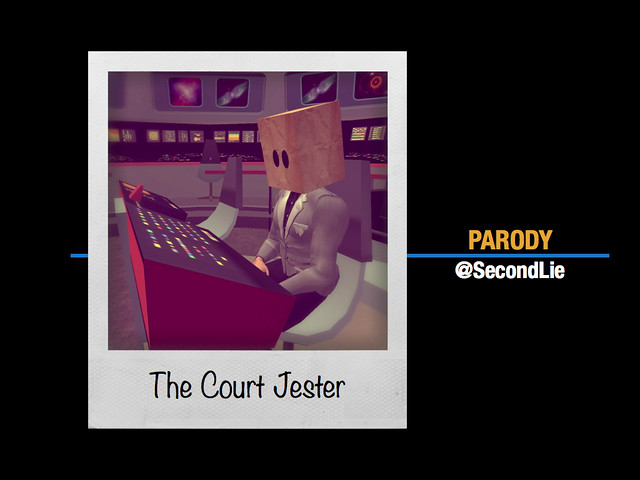
Parody is a powerful micro-story modality with strong pedagogical potential. Imagine how fun it would be for each student to write a tweet each day commenting on a current news item. Through the use of a distinctive hashtag, their collective work would create the social network equivalent of The Onion. Of course, this wouldn’t replace traditional forms such as essays, but I believe it would move students to think critically about the issues of our time and help them get in touch with their unique take on events.
Second Lie is my favorite parody micro-story writer. His Twitter stream is a non-stop roast of emerging news about Linden Lab and Second Life. Within minutes of a new event, he starts posting strings of parody tweets that make transparent the Emperor's new clothes. His stream is the Metaverse equivalent of parody news programs like The Daily Show and Steve Colbert. His character is a cross between Rodney Dangerfield and Tony Clifton. (Tony Clifton was Andy Kaufman’s darker twin.)
Here are a few of my favorite tweets from Second Lie:
BREAKING NEWS: Quarterly economic reports have been discontinued. (We lost the dice we used to generate the numbers.)
Inventory server maintenance underway. This may affect logins for some residents. God forbid, we tell you which ones. That's no fun.
BREAKING NEWS: Linden Lab sues Google for Plus, which steals a patent for a platform used exclusively to complain about that platform.Unfortunately, Second Lie retired his character shortly after the lecture (no connection.)

Aphorisms have proven themselves as one of the most enduring forms of idea-transmission. The identities of the authors of sayings such as “don’t put all of your eggs in one basket” have been lost in time, but their work has endured for hundreds and even thousands of years.
I’ve found a lot of creative satisfaction using Twitter as an incentive to come up with pithy sayings. I want to stress again that what’s most important about writing micro-stories isn’t the quality of each post, but rather how the process of creation hones our awareness. It allows us to connect some of the otherwise unintegrated and unexpressed ideas that lie in wait within our subconscious.
One of the ways I think of Botgirl is as my Muse. She’s the voice of my subconscious whispering in my ear. But you don’t need an avatar identity to tap into your inner landscape. The journey from blank screen to finished work (even a tweet) is an exploration into uncharted territory. You never know what treasure is around the bend.
I’ve played around with a number of different formats on Botgirl’s stream over the years. One of the most personally rewarding is the Deep Tweet. The idea started out on the blog as “Fortune Cookie Wisdom”, which was a funny quote at the end of a serious post to lighten things up.” Here are a few examples from Botgirl's Twitter stream:
The word “tolerance” bothered me until I realized what we are tolerating is our own discomfort about those we don’t understand
Objectification isn’t seeing someone as a person in a box, but rather seeing the box as being the person.
The blank page is Sacred SpaceThe idea of the blank page as sacred space is the foundation of my love of micro-story. Every time we face a blank screen and allow ideas to emerge we are building a bridge between our everyday mind and the deeper levels of our being. And in bringing them to some soft of tangible and shareable form, I believe we are participating in the collective evolution of our human potential. Pretty deep for what is typically viewed as the shallow wasteland of social networks.
Thematic
The last social network format I’m going to discuss today involves posting a series of tweets over the course of a day based on a theme. Botgirl calls them micro-rants. As a whole, they don’t form a linear narrative. The individual tweets may even be contradictory. The intent is to stimulate thinking rather than to promote any particular point of view.
I was inspired to take this approach by Marshall McLuhan’s “probes,” super-charged phrases that force you out of habitual ways of thinking. Micro-rants are intented to take readers on a ride through multiple perspectives and provoke fresh thought. Here are an example of a complete micro-rant that was published over the course of one day. It's about re-evaluating our virtual lives:
The info-stream is growing ever vaster than we can attend, little alone comprehend. Discretion is the better part of consumption. #reboot
"Stop and Facebook the roses" is a more congruent aphorism for these times. And to mix the metaphors, it doesn't smell as sweet. #reboot
Just-because-I-can is becoming a less and less compelling reason to create something. #reboot
"All the world's a stage" does not suffice anymore. Human life itself is becoming as much public performance as private experience. #reboot
Another tweet falling into the bottomless abyss. Thanks for catching it. Now what are you going to do with it? #reboot
The stream is a treadmill. #reboot
The Social-Net values only what is made public, for that is all it perceives. #reboot
We are starting to experience our own lives as if we were editors of a Reality TV show. #reboot
Amusement sweetens the spirit as a dessert but smothers the soul when it serves as the sole sustenance. #reboot
I can't think of any modern technology whose primary impact has been to actualize wisdom in the cultures it permeates. Can you? #reboot
Insights without action are like crops rotting in the field. #rebootOne of the curious aspects of this format is that each reader may receive them somewhat differently. Some people check their stream a few times an hour, others a few times a day. Depending upon how many people a reader follows, the micro-rant tweets may show up pretty close to each other or be separated by dozens of other tweets. They may be viewed in order, in reverse order, or only partially. I usually post about every half hour. I want to give each enough space for it to generate some discussion, but be close enough to have some resonance between them.
This is another format that would be great for education. How about a weekly micro-rant Monday, with a topic and hashtag classmates would post to. They could be collected and published in other formats like a class blog, wiki or e-publication.
In the final segment of this series I’ll cover visual micro-stories, describe some of the tools I use to create and publish them, and sum up with thoughts on the medium’s educational potential.
Saturday, July 7, 2012
The Art of Micro-Story: Head Injury Theater
This is the second in a series of posts based on a presentation at the 2012 Virtual Worlds Best Practices in Education Conference.Some educators are troubled by our pervasively net-connected lives. They contend that constant multitasking and info-surfing undermine their students' ability to sustain full attention on anything except the briefest and most stimulating entertainment. But I contend that relentless multitasking is a practical adaptation to the emerging technological environment. It is as inevitable and unstoppable as the electric light was 150 years ago. Our lives demand that we learn to live appropriately within the reality of our current information ecosystem. Arguing against it is the modern equivalent of fighting the wheel. That’s why I believe it’s important to start creating curriculum that leverages new mediums instead of clinging to past formats that are no longer appropriate.
Public communication used to be a one-way flow from a handful of media giants to the global masses. Like the old adage said, freedom of the press was only for those who could afford to own one. But times are changing. Today, millions of people around the world are reversing the tide by publishing creative work that expresses their personal points of view.
Of couse, it’s not all gold. As a matter of fact, it’s mostly crap. I could die happy if I never saw another meme. But if we look at the explosion of social networking, media sharing and blogging as steps along an evolutionary continuum, I believe it calls upon us to actualize the educational potential.
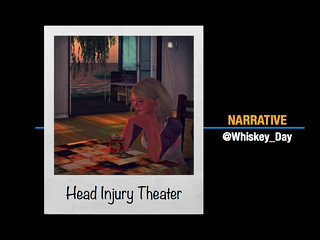 One thing we need to learn to thrive in the current environment is how to to express our ideas through compelling condensed narratives. Twitter posts are an ideal exercise format.
My favorite Twitter micro-storyteller is Whiskey Monday. Her Twitter stream is filled with slice-of-life tweets about caring for two teen daughters, a sister with cancer and a mother with a head injury. She call is "Head Injury Theater." Here’s how she described her situation in a blog post:
My sister’s chemo has weakened her to the point that she stays in a rocking chair 24/7, criticizing me like Norman Bates’ mother. My mom moved here from the Brain Injury Rehab Center last week, and she’s just a big toddler with a wicked tongue. I’ve got my 10 yr old niece to care for, my own kids to deal with, my mom’s AND my sister’s houses to care for in addition to my own and to top it all off, I lost my teaching job.
Whiskey's tweets are tiny masterpieces that tell the compelling story of her day-to-day life. My favorites are short dialogues between house members:
"Mom don't stand up in the bathtub til l get back." - "Okay I'll just lie down." - "No mom, don't lie down either."
"Why won't Gran wake up?" - "Orange Dramamine tastes like candy." - "Oh. Grab her arms, I'll get her feet."
19: "Either your waffles are burning or the toaster has chosen a new pope."Whiskey's posts aren't just witty and entertaining. They they also demonstrate the creative and therapeutic potential of writing and sharing micro-stories. She wrote:
“Twitter has kept my brain forming thoughts at a time when I couldn’t do much else. Twitter kept my sense of humor stimulated, which in turn has kept me from going postal on my family." She went on to write: “My life is still funny; I still see the humor in my situations. But I see 140 characters worth of humor, not a whole blog post. Because if I start a blog post, well, I’ll have to go there. Who has time for that??”By using our lives as fodder for narrative posts like Whiskey’s, we can transcend our usual state of hyper-subjectivity and become more conscious of the dynamics of the stories we’re living.
The next post in this series will look at parody tweets and the great late @SecondLie
Friday, July 6, 2012
The Art of Micro-Story (Part 1)
My human counterpart gave a presentation on micro-storytelling a few months ago at the 2012 Virtual Worlds Best Practices in Education Conference. Since it now looks like videos from the conference won't be posted, I decided to publish a transcript of the presentation here, using the speaker's notes as reference. Since it's in the neighborhood of 3000 words, I'm going to post it in a few sections over the course of a week:
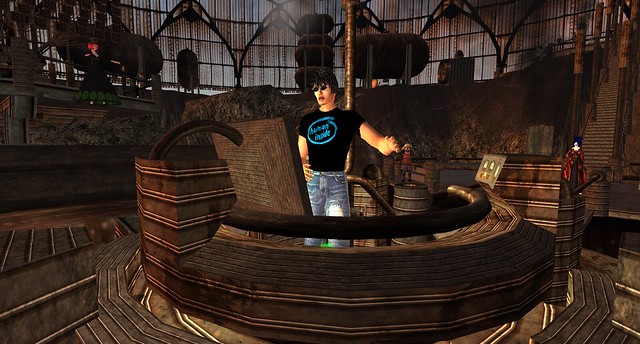 |
| fourworlds speaking at the VWBPE Conference (Image by Crap Mariner) |
I'm happy to be back at the VWBPE conference. Last year, Botgirl Questi and I did a performance piece on virtual identity in front of a few hundred people. Apparently she’s a much better draw. This year it’s just me and I’m here to talk about micro-storytelling. On the surface, micro-storytelling seems like a topic that is only marginally connected to either virtual wolds or best practices in education. But even though "micro" is the antithesis of “Epic!” (the theme of the conference), I think it’s a good match for a number of reasons.
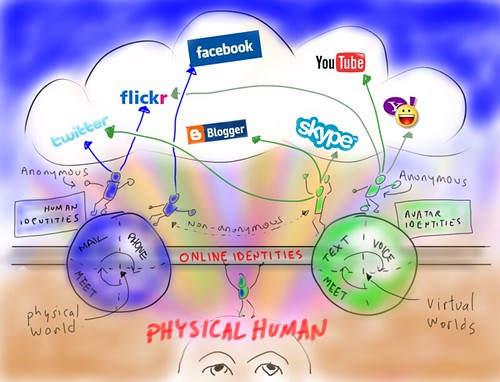 |
| Transworld Identity |
Social networks, media sharing sites and blogs are no longer just a peripheral part of virtual world culture, community and relationships. They have become powerful mediums that both reflect and shape inworld culture. Even if you spend hours a day in a virtual world, you probably interact with only a few dozen people there on a regular basis. Through the use of work computers and net-connected phones which don't have access to Second Life, we’re hanging out in virtual social space 24/7 with thousands of our peers.
 |
| Visual Tweet with content from Second Life |
Small is beautiful
I use the word micro-storytelling pretty loosely, but essentially it’s about applying creativity within very constrained spaces. For the purposes of the talk today I’m referring mainly to:
- Social network posts
- 100 Word Stories
- Captioned images
- Videos of less than three minutes in length
 Although I’m speaking mostly as an amateur enthusiast, this topic also hits home in my professional life. In my day job, I’m one of the principals in a consulting company that does agile software development for large enterprises. My current job title is “Geek Interpreter Guy.” That’s a fun way of saying that I help techies and business people create communication their counterparts can understand.
One main challenge is that experts have a hard time seeing the forest for the trees. (I like to joke that it’s because all the trees have been cut down to make the paper used to print fifty page whitepapers and thousand bullet point presentations.) But the real problem is that although specialists know all of the facts in excruciating detail, they often have no clue about how to contextualize the details through a comprehensible story.
My loose definition of “story” includes not just the narrative of events, but any communication that delivers meaning. I see the micro-story format as a great reality test for even the most critical communication. The type of fact-filled ignorance that hides in a 10,000 word report or a 50 slide presentation can usually be exposed by challenging ourselves to articulate the main idea in a 140 character tweet.
Part 2 of this series will cover these 5 types of micro-story:
- Narrative
- Parody
- Aphorism
- Themed
- Visual
Wednesday, March 14, 2012
Source Materials for my VWBPE Presentation Including Whiskey Day and SecondLie Streams
I won't be posting much here until next week, since preparation for Saturday's VWBPE presentation is taking up most of my spare time. Until then, here are some of the source materials that will be included:
Whiskey Day's Twitter Stream
SecondLie's Twitter Stream
Deep Tweet Videos
100 Word Stories Podcast
100 Word Story Videos
TweetStory (Part 1)
TweetStory Comic
Micro-Rant on Second Life
Polaroid Micro-Stories:
Whiskey Day's Twitter Stream
SecondLie's Twitter Stream
Deep Tweet Videos
100 Word Stories Podcast
100 Word Story Videos
TweetStory (Part 1)
TweetStory Comic
Micro-Rant on Second Life
Polaroid Micro-Stories:
Sunday, March 11, 2012
Video Trailer for Micro-Story Presentation at VWBPE
Looks like a great line-up for this year's Virtual Worlds Best Practices in Education conference. This video previews my human counterpart's presentation, which will be held on Saturday March 17 at 3:00 PM Pacific Time in the Central Auditorium in Second Life.
Sunday, March 20, 2011
Having Our Cake and Eating it Too
My human counterpart and I had a blast presenting the VWBPE opening keynote. Hopefully, we not only provided some interesting food for thought through the content, but also communicated some of the joy and creative juice of our relationship through the live interchange . . . and demonstrated that there's more to post-pseudonymity than avatar-aka-human.
I'm going to be busy the rest of the week watching the great VWBPE presentations I missed as they're posted in the Best Practices in Education archive on Treet.TV. Here's our keynote in its entirety. It starts at about 5:00 into the video, after the introduction.
I'm going to be busy the rest of the week watching the great VWBPE presentations I missed as they're posted in the Best Practices in Education archive on Treet.TV. Here's our keynote in its entirety. It starts at about 5:00 into the video, after the introduction.
Wednesday, March 16, 2011
Keynote Preparation Comic: Pedagogy Rhymes With What Again?
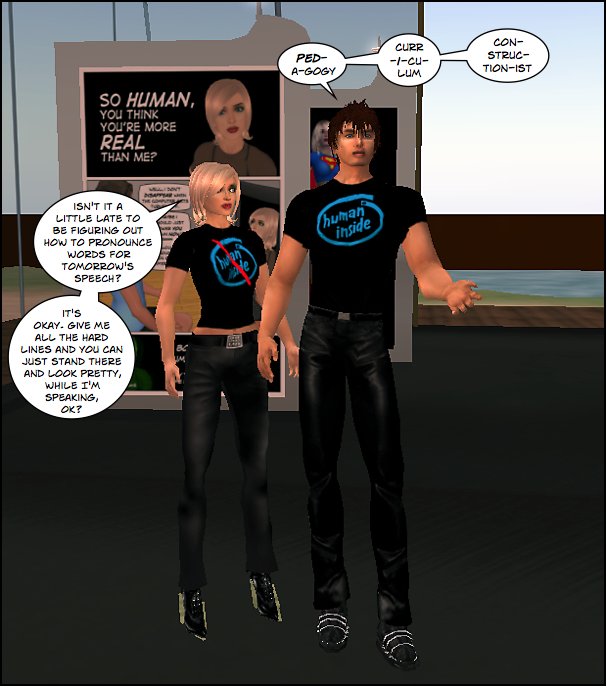 |
| Practicing For The VWBPE Keynote |
Friday, March 4, 2011
MCF Video and Update on VWBPE Keynote
Whew! Fourworlds made it through the Metanomics Community Forum without totally ruining my reputation. He did a decent job, but he's certainly no me, right? Since he spilled the beans, I might as well formally announce that he and I will be co-presenting the VWBPE keynote. It will be our first voiced co-appearance since the Avatars in Love video and our first live-voiced gig together.
If you missed them, here's the archive of fourworlds on MCF and Avatars in Love (slightly NSFW).
If you missed them, here's the archive of fourworlds on MCF and Avatars in Love (slightly NSFW).
Tuesday, February 22, 2011
The Embarrassing Secret Behind My VWBPE Keynote Selection

Despite my initial confusion, I am thrilled to be presenting the opening keynote for the fourth annual Virtual Worlds Best Practices in Education Conference on March 17 at 2:00 PM SLT. Should be a wild ride!
Subscribe to:
Posts (Atom)