Wednesday, March 31, 2010

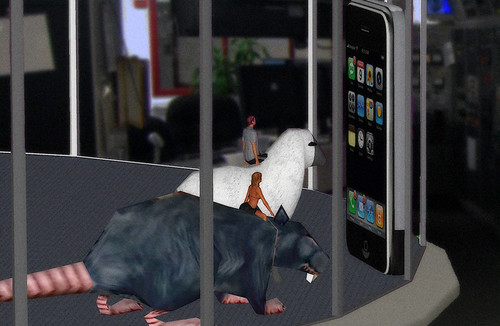
Are we not 1984 Sheep? We are Brave New World Rats!

rat and sheep 01
 Pervasive computing is like a giant Skinner Box.

I've been working all week on a post about the shift from mass-media-fueled propaganda to the operant conditioning environment of pervasive social computing. It's taking a lot longer than expected, so for now, here's one of the images I've been working with as I VizThink my way through.

The spark for this idea came from the following video:

Saturday, March 27, 2010

Quick Look: Digimi Transworld Avatar Creator


Digimi is a new avatar creation provider, joining Evolver as a resource to create customized avatars that can be exported for virtual world and game platforms. I'll post a detailed review next week.

Friday, March 26, 2010

Mini-Rant: Second Life is FarmVille and I Feel Fine


Teleportation in virtual worlds lets you travel faster than the speed of light. Maybe that's why three or four years as a Second Life avatar leaves so many rezzerati waxing more nostalgic about the good old days than great-aunt Moonbeam on the 40th anniversary of her acid-drenched, mud-covered deflowering at Woodstock:
"Before Philip sold out to The ManSecond Life was totally cool anarchy. It was a techno-sexual, Haight-Freaking-Ashbury, Fellini-worthy wet dream for digitopian, art-making, prim-building, nube-griefing MoFos. Back then, when corporate clones brought their boring vanilla unambiguously-gendered asses into our world we'd show them the business end of a giant penis. But it's all gone to crap. M. is turning Second Life into FarmVille."
Get over it. Second Life was destined to be FarmVille from the very first sim. Like every avant-garde scene in the physical world, by the time Nascar Dads show up looking for exotic punani the real cutting-edge has moved on. I say, let 'em have it.

.

Wednesday, March 24, 2010

Surfing Realities Through Juxtaposition of Physical and Virtual


My ongoing reading of Marshall McLuhan has shed a lot of light recently on my own artistic work and inspired a new project. I'm going to share a few relevant quotes here, along with insights they sparked:
The hybrid or meeting of two media is a moment of truth and revelation from which new form is born. Marshall McLuhan
I've been led to combine elements from virtual and physical worlds since the beginning of my artistic life. After two years, I'm just beginning to appreciate the potential of such juxtapositions to reveal aspects of the psychological process of reality-creation that would otherwise be invisible. For instance, each primary element in the image above includes not only the entity itself (doll, keyboard, your's truly, etc.) but also the environment that we typically associate it with. The context of each component sheds light on the others.
One sure way to perceive the structure of any situation easily is to reverse its figure/ground relationship. Marshall McLuhan
Botgirl and the Living Dead Doll is an example of how the mere visual fusion of normally disparate element can shift a viewer's consciousness through the gates of multiple fourth walls. One revelation for me that was uncovered through this multidimensional setting was the role of the computer screen as both window and barrier.
New archetype is old cliché writ large. Marshall McLuhan
I'm starting on a new project that will extend what I began in the Living Dead Doll video by combining the cliché of individual character forms in ways that will reveal the underlying archetypal energies. My plan is to take a transmedia approach that includes multiple mediums such as comics, video and photography.

So please stay tuned.

Saturday, March 20, 2010

Botgirl and the Living Dead Doll

Here's another short concept video combining physical world and virtual world source material.

Friday, March 19, 2010

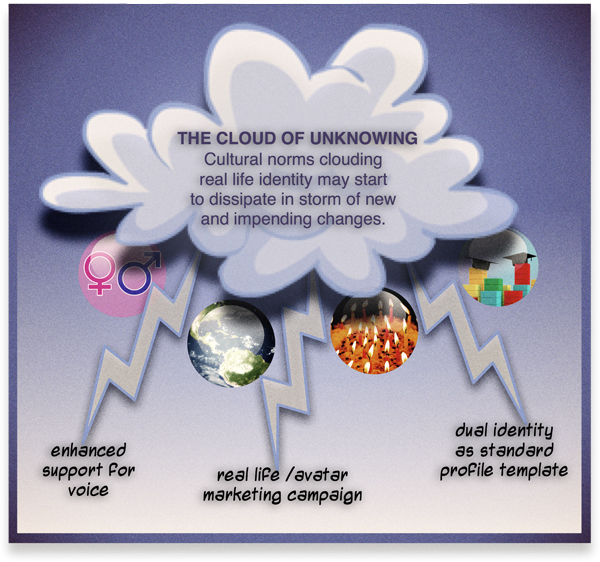
The Cloud of Unknowing

Cloud of Unknowing
I'm still thinking through the relationship between platform factors and cultural norms. I don't think that any particular modifications are going to cause dramatic overnight changes in the current pseudonymity-friendly environment. But I do suspect that in combination, they may eventually cause a cultural shift, as a growing percentage of avatars choose to disclose real life identity.

Tuesday, March 16, 2010

A Mini-Rant on Privacy and Identity

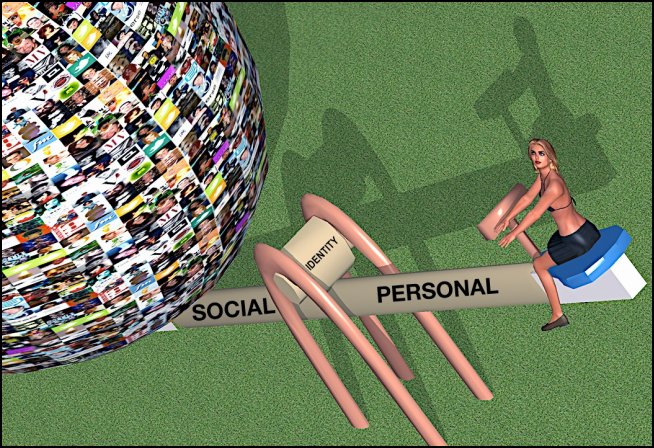
seesaw 2
One of the peculiarities of the electronic environment is that people become so profoundly involved in each other that they lose that sense of private identity. Marshal McLuhan
The future McLuhan saw germinating in the late 1960s is growing like a weed today within the electronic garden of pervasive social networking. The identities we once fashioned within the isolation of our own nuclear-family homes, now live in the tribal consciousness of the global village. Our sense of personal identity cannot withstand the weight of the world peering at us through the SocialNet.

We've put our privacy to the knife through a thousand small cuts, bleeding status updates upon the digital waters. And although we reflexively startle and panic when Facebook or Google pushes us deeper into the ocean, we have been swimming out to sea on our own just as hard and as fast as we can. So relax. Enjoy. And be aware.

Sunday, March 14, 2010

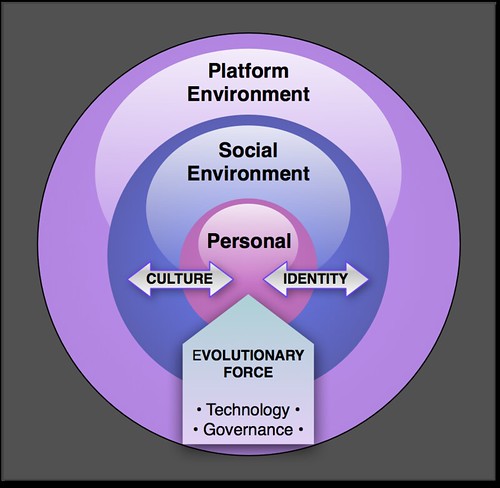
Second Life Culture 02: Platform as Evolutionary Force

SL Culture 01

The technology and governance of the Second Life platform don't just enable and shape culture, they are essential parts of culture itself. The platform environment is both the evolutionary force we must adapt to and the medium through which we act, interact and experience in the virtual world.

For instance, avatar appearance forms a foundational basis for some of Second Life's key cultures such as furries, tinies and fashionistas. But the enabling technology is usually so taken for granted that its role is invisible. Without the ability to modify avatar size and shape and to create, buy, sell and use virtual clothing and attachments, those cultures would either not exist or would have expressed very differently.

Our personal identities are also subject to changes in the platform and social environments. A significant  measure of one's sense of personal identity is derived through social identity within the groups we belong to. Cultural changes therefore create changes in personal identity.

Changes in the platform will inherently cause adaptive modifications of culture, which in turn will shape our sense of identity as avatars. Although it's impossible to predict where this is heading in the long run, it is possible make educated guesses about how particular changes might impact culture in the short term. I'll discuss some specific examples in an upcoming post.

Wednesday, March 10, 2010

Will Linden Lab's Change Efforts Destroy Second Life Culture as We Know it?

Dusan Writer wrote a couple of posts last week that included a question about the impact of Linden Lab's technology and governance changes on Second Life Culture. After days of fruitless musing, I eventually realized that the main reason I was having such a hard time gaining clarity on the topic was that I didn't really know what the heck "Second Life Culture" meant.

I poked around a bit and found a post by Lalo Telling, a smart SL blogger, describing Second Life culture as:
Commonality: shared experience; shared symbology and language; shared worldview; shared purpose; shared philosophies of what is "right behavior", and why, and how to coax it from people... in the case of Second Life, I'll even borrow from archaeology and include a shared "tool kit". The operative word, obviously, is shared.
After contemplating that perspective, I came up with some concrete examples of "shared culture" that seem to be relatively universal within the Second Life population as a whole, such as:
  • Projecting into a 3D virtual world as an avatar. This is the oldest and most fundamental shared universal experience in Second Life. I can think of dozens of other cultural dimensions related to the sensorial experience of virtual embodiment, including teleportation vs. linear travel, visual POV that can be divorced from one's virtual body, etc. Many of these are tied to the dictates of the platform and client.
  • Using parentheticals to communicate imagined physical action that is not possible within the platform, i.e. "Botgirl smiles knowingly." There are quite a few unique textual communication customs such as brb/wb (be right back/welcome back). 
  • A taboo against asking people to divulge personally identifying information they have not proactively disclosed. 
Cultural factors relating to purpose, meaning, ethics and activity seem to be much less universal and vary greatly between Second Life subcultures. That said, I think there are clusters of meaning-related culture within particular groups.  I'll post soon with some concrete example of the relationship between changes Linden Lab might make in technology or governance, and particular subcultures within Second Life. A graphic is in the works, in keeping with my identity as a Venn Buddhist (a term coined by Lalo Telling).

For now, it might be fun to take a look at the Second Life subcultures and Communities of Interest depicted in this mind map. What cultural differences and commonalities come to mind? It's on a wiki-like platform, so please feel free to tweak it.


.

Saturday, March 6, 2010

Tragic Death of Baby Demands The Virtual World Community Dig Deeper and Look in the Mirror

I didn't click the link to the Gamer's Tot Dies of Starvation headline when it popped up in my virtual world feed on Thursday. I assumed it was a tabloid story making a dubious connection between the horrific death of a child and a parent's coincidental participation in an online game. Three days and hundreds of articles later it seems clear that there was a deep connection between the parents' participation in virtual worlds and the eventual neglect-induced death of their 3-month-old daughter.

Although sensational headlines such as Girl starved to death while parents raised virtual child in online game are overly-simplistic, the underlying tragedy demands that those of us who are active in the avatar community dig deeper into our own virtual lives:
  • Does the time and energy we devote to online activity negatively impact our families to any substantive degree? Don't just say no. Ask them.
  • Are there any important physical world tasks that are being neglected while we spend time in virtual worlds? Career? Education? What else?
  • Is there an addictive or compulsive quality to our own use of virtual worlds, social networks or other online activity?  Does the thought of being forced to spend a week totally off the network make you flinch? How about a month? A year? 
The most active and outspoken members of the avatar community are usually so focused on defending the legitimacy of virtual worlds that we tend to off-handedly shrug off these kind of questions. I think it's time we take a hard, clear-eyed look in the mirror.

Thursday, March 4, 2010

Brief Proof-of Concept Mixing External Animation into SL Machinima With New Media Sharing Feature

This is my first tentative proof-of-concept playing around with the idea of integrating external video in an inworld Second Life machinima. It uses the new Media Sharing functionality that enables the flexible and interactive display of media directly on a prim.

For this test, I stood in front of a large prim displaying my "skull speaks" video. Just for fun, instead of using Snapz Pro to capture video, shots were captured using a handheld iPhone's camera and then edited on the phone using Vintage Video Maker and ReelDirector.

There's great potential in combining various types of external media within a realtime machinima capture. I hope to devote more time to this in the near future and put together something a bit more ambitious.

Wednesday, March 3, 2010

Does Sharing a Link on a Social Network Imply Endorsement of the Content?

"It's impossible to have a point of view in the electric age and have any meaning at all. You've got to be everywhere at once whether you like it or not. You have to be participating in everything going on at the same time. And that is not a point of view." Marshall McLuhan in 1967
A tweet yesterday proposed that sharing a link on Twitter implies an endorsement of the associated content.  That's certainly not true for me. My decision to share something on a social network is based on how interesting I think it will be for my audience, not the degree to which it supports my own point of view. I often share links to posts that present opinions I don't agree with, services I don't use and positions I don't support.

The World Wide Web has obliterated almost all of the external encumbrances that once made it difficult to access information beyond the scope of our own personal and cultural point of view. But our internal psychological barriers still remain and must be consciously challenged if we seek to transcend them. If you want to give it a try, commit to sharing at least one interesting link a day that's outside of your comfort zone.
"If science proves some belief of Buddhism wrong, then Buddhism will have to change." H.H. The Dalai Lama

.

Monday, March 1, 2010

skull speaks

This is the latest botgirl/fourworlds video collaboration extending the narrative of the virtual identity concept through an anthropomorphized physical figurine. We're looking forward to moving this further by combining physical, virtual and mixed elements in future projects.