Wednesday, November 30, 2011

30 Minutes in the Life of a Social Network Revolutionary

Delilah Noir and Edie Sedgwick


0900 Woke late again. I was up all night tweeting for the revolution.

0902  Fuck it. I'm going to be late for work anyway. Let's see what those fuckers were trying to get away with when I was sleeping.

0905  Lies. Lies. Lies. Those assholes are trying to take over our hashtag. Not on my watch! I can afford one more day off.

0907 Take that motherfuckers!

0920 Good. I've countered every one of their bullshit posts

0925 Why aren't more people retweeting me? Don't they understand how important this is?

0930 I'll just keep posting until they get it.

Tuesday, November 22, 2011

Name This Image. Collapse a Universe.

Ambiguous Image
Name this image!
A few days ago, I blogged this cryptic statement without an accompanying explanation:

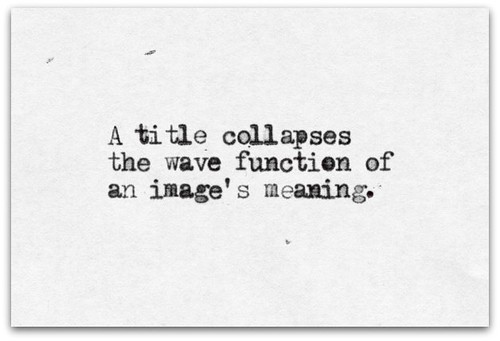
A title collapses the wave function of an image's meaning.

The line popped into my mind when I was trying to figure out a caption for last Saturday's image of a warrior woman and Supergirl. It was from a set of photos I took in a session combining various action figures in random poses.

Since there was no preconceived story behind the picture, when I started playing around with title ideas I realized it could be interpreted in many different way. For instance, Supergirl could be lounging in the afterglow of a sexual encounter. Or the warrior might represent a fierce external persona hiding the more vulnerable character in the background. And so on.

The title I eventually ended up with (Even Superheroes Get The Blues) was still somewhat ambiguous. But it made me realize that reading an image's title is like looking inside the box in Schrödinger's thought experiment about the cat. It collapses the universe of potential interpretations into a constrained set.

For most practical purposes, that's a good thing. If an image is of a documentary nature, accompanying text helps guide a viewer to a more accurate interpretation of the physical-world occurrence that was captured. In an artistic work, a title allows the creator to more clearly reveal her intended meaning.

Still, something inside me recoils at the hubris of believing I am more than a medium of expression for the works that emerge from my consciousness. And I wonder why I feel the need to restrain an image from expressing its entire universe of potential meaning.

Sunday, November 20, 2011

The Last Entry in Botgirl's Second Life Diary

Mea Culpa
Standing in front of "1000 Avatars" book by fellow Crap Award nominee, Gracie Kendal.

I've been nominated for the 2011 Crap Awards:
Unlike The Best of Second Life or other awards you see out there, the Crap Awards handle the other end of the spectrum: the lowest of the low and the worst of the worst. These are people who have done Second Life and its user community a disservice by joining it, engaging in it, abusing it, and refusing to crawl back under the rock they came from.
Although the contest is (mostly) a parody, it's fair to say that I'm out-of-sync with the Second Life community and have been for a long time. The estrangement is a reflection of my migration over the the last few years from actually living in the 3D virtual world, to merely using it as a platform for creative work. I've long since packed my virtual identity, stored it safely in my imagination and left the place of my birth. Instead of being a fellow resident who shares in the ongoing life of the community, I'm an outsider who pops in once in a blue moon to attend an event or shoot a video.

This blog has evolved from a journal of ideas inspired by living in Second Life, to an artist's notebook exploring virtual identity outside of the 3D virtual world. My creative work is now just as likely to spring from atomic-world content as from virtual world visuals. For instance, the image above is a shot of a small plastic action figure posed in front of a physical copy of Gracie Kendal's "1000 Avatars Book".

So what business do I have writing a home town publication called "Botgirl's Second Life Diary"? None really. Therefore, I've changed the title of the blog to "Botgirl's Identity Circus" and hereby rescind my self-proclaimed status as a Second Life pundit.

Whew! That feels better.


Lessons From Schrödinger's Art Studio

Collapse

Wednesday, November 16, 2011

Rosedale's Milkshake

Rosedale's Milkshake

Last week, a couple of articles in the mainstream press weighed in on why Second Life hasn't fulfilled it's initial promise to be the next big thing. 

Why Second Life Failed, by Chip and Dan Heath, used a story about building a better milkshake to illustrate why a successful new technology must perform a tangible "job" for customers that it does better than existing alternatives. It postulated that Second Life didn't expand into the mainstream because it never clearly articulated what purpose it served. It didn't answer the "Why bother?" question.

The Heath's analysis sheds light on Second Life co-founder Philip Rosedale's comments in a recent New York Times interview: 
“The problem with creating an immersive 3-D experience is that it is just too involved, and so it’s hard to get people to engage,” he said. “Smart people in rural areas, the handicapped, people looking for companionship, they love it. But you have to be highly motivated to get on and learn to use it.”
For the groups he mentioned, Second Life not only has a clear job it performs, but does it in a way that is significantly better than alternatives (or even not possible in real life). It allows those who feel constrained or disadvantaged by atomic world limitations to project themselves into a virtual world with an even playing field. Instead of being stuck at home because of a physical disability or a half day's distance from interesting nightlife, they can log-in and teleport instantly to any destination of choice.

That said, I think Second Life's last few years of stagnant growth are more due to Linden Lab's inability to articulate the jobs it can do, rather than the platform's inability to deliver tangible benefits to a wide variety of people. As the graphic above illustrates, there are many jobs Second Life does very well. Unfortunately, although marketing messages such as "Be Your Avatar" may induce people to log-in a few times, they don't give them a reason to keep coming back.

 As I wrote in January 2010's, A Simple Plan to Solve The Second Life Retention Problem:
"Build it and they will come" seems to be true in relation to Second Life. The problem is that 90% of people who register don't stay. They leave within the first three months. It seems obvious to me that the one primary reason for the astronomic departure rate is that most people don't find something worth doing. Right now, finding something interesting enough to make it beyond the initial learning curve is left up to chance. And the odds seem to be about 9-1 against.
The other main problem area that stands in the way of Second Life's growth is related to a host of endemic technical problems ranging from a kludgy interface to long-standing bugs and performance issues. Together, they create a steep learning curve for new users and prevent the platform from excelling at the jobs people want it to do.

Recent initiatives sparked by Linden Lab's latest CEO Rod Humble are working to improve the user interface, fix critical bugs and increase platform stability. Hopefully, they'll deliver some substantive improvements. What I'd like to see is an equivalent level of effort to articulate and publicize the most compelling use cases for Second Life and make it easier for people to figure out how to leverage the platform to actualize their desires.

Sunday, November 13, 2011

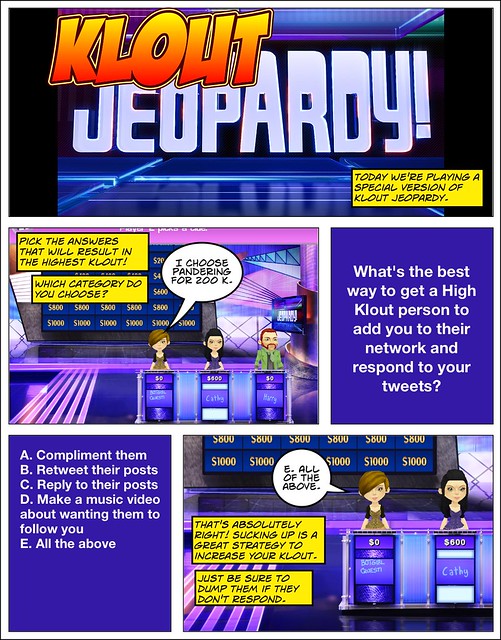
Why I Quit Klout. Plus Bonus Comic.

You don't have to be a "person of influence" to be influential. In fact, the most influential people in my life are probably not even aware of the things they've taught me. Scott Adams
Klout is a company that bills itself as the "standard for influence" in social networking. It currently ranks over 100 million social networks users by a proprietary Klout Score.

I registered on Klout as soon as I heard about the service because I liked the idea of having good metrics to evaluate how well I provide value to my social network. I hate to admit it, but it was also fun to try to figure out how to improve my score and compare it to other people's. Unfortunately, it turned out that a Klout score doesn't necessarily reflect the quality of one's contributions, or encourage actions that are in the best interest of the community.

Here are a few examples of strategies that would raise your score but degrade the intrinsic value of the social stream:
  • Decide who to follow based upon Klout rather than by the intrinsic value and relevance of what they post. Of course, if someone doesn't follow you back, dump their ass because they'll bring your score down.
  • Pander to high Klout people. Play to their ego. Reply to their posts and bait them into responding.
  • Make decisions about what to post based on viral-potential. The more sensational the better. 
  • Don't post anything that is unlikely to be re-shared multiple times or stimulate replies.
  • Block low Klout people who follow you but never retweet or reshare your posts. Dump them from your network before they ruin your amplification score.
Even if no one tried to game the system, there is a fundamental problem with any service that attempts define the value of individuals on social networks through a proprietary algorithm, especially when they publish scores on people who have not opted in

Finally, we're not Klout's customers, we're their product. Their customers are the businesses who pay for access to the influential people Klout tracks. Personally, I'm not willing to whore out my social network for perks like discount coupons and free movie passes. Now maybe if they offered a free iPad?

So that's why I quit. How about you? Or do you want to keep playing Klout Jeopardy.


Klout Jeopardy

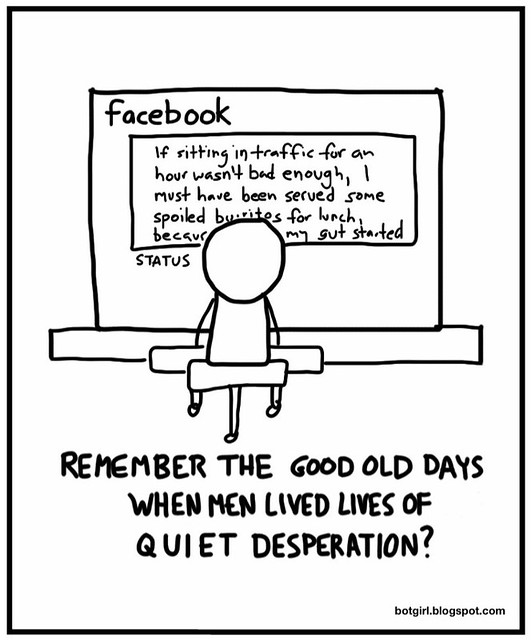
The Good Old Days

The Good Old Days

Friday, November 11, 2011

Saturday, November 5, 2011

Message of the Medium 02: Fill Every Hole

Fill Every Hole

Fill every hole from the
cascading reflections of
fractured funhouse mirrors casting
fragmented stories stitched unconsciously
into the patchwork quilt of the world
as we know it.

Thursday, November 3, 2011

When Signal is Noise

What we typically consider to be noise in our social stream is easy to spot and eliminate. If someone posts a steady barrage of messages that are outside our areas of interest, we can easily remove them from our friend/followed/circles list. Even if we slack on housekeeping chores, the incremental negative impact of each uninteresting post is negligible. We can scan through dozens of foursquare check-ins, links to cute cat pictures and Klout score announcements in a few seconds. Little harm done.

The real threat to our time and attention isn't noise, but the the posts we usual think of as signal. The ones that engage our interest, capture our attention, but don't contribute lasting value to our lives.

Tuesday, November 1, 2011

When New Kills Now

Immersion Again
The perception of reality now depends upon the structure of information. . . These perceptual transformations, the new ways of experiencing that each medium creates, occur in the user regardless of the program content. This is what the paradox, "the medium is the message," means. Marshall McLuhan
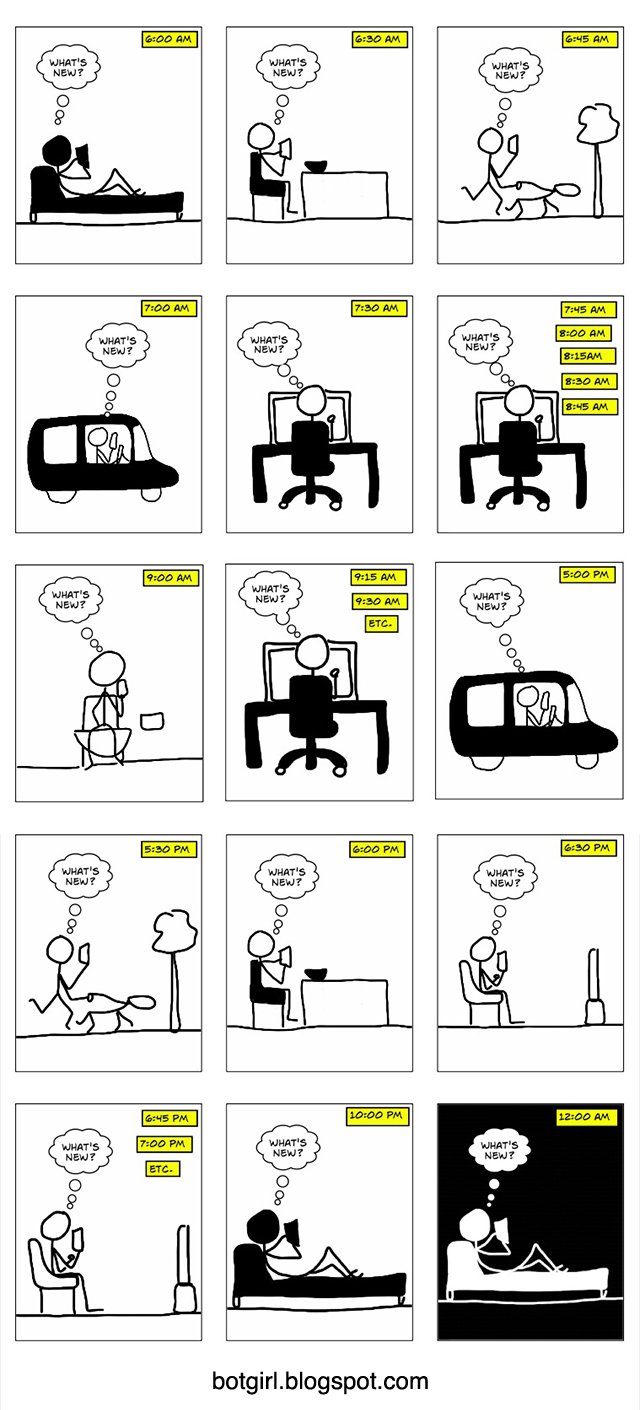
Immersion in the social stream shrinks the perception of now to a tiny window focused on the approaching horizon. "What's new?" used to be a question of days or weeks. But in an information environment of pervasive connection the scope of what's new shrinks to hours, minutes or even seconds.

The average lifespan of a tweet is about one hour. News, comments and conversations fall like tiny pebbles into our Twitter feeds, G+ circles and Facebook walls, rippling in replies, comment threads and retweets for brief instants before being replaced by hundreds and thousands more. The timeframe of a "current event" has shrunk to the ever-moving real-time present, elevating timeliness over depth, brevity over substance, and frequency over quality.

This bubbling brew of endless emergence is spilling over into our perception of the physical world. Instead of introspectively appreciating experiences for their intrinsic value, immersion in the social stream moves us to experience life as a platform for social sharing. The events of our lives become shareable moments moving inch by inch down our Facebook walls until they are buried in depths where only search spiders travel.